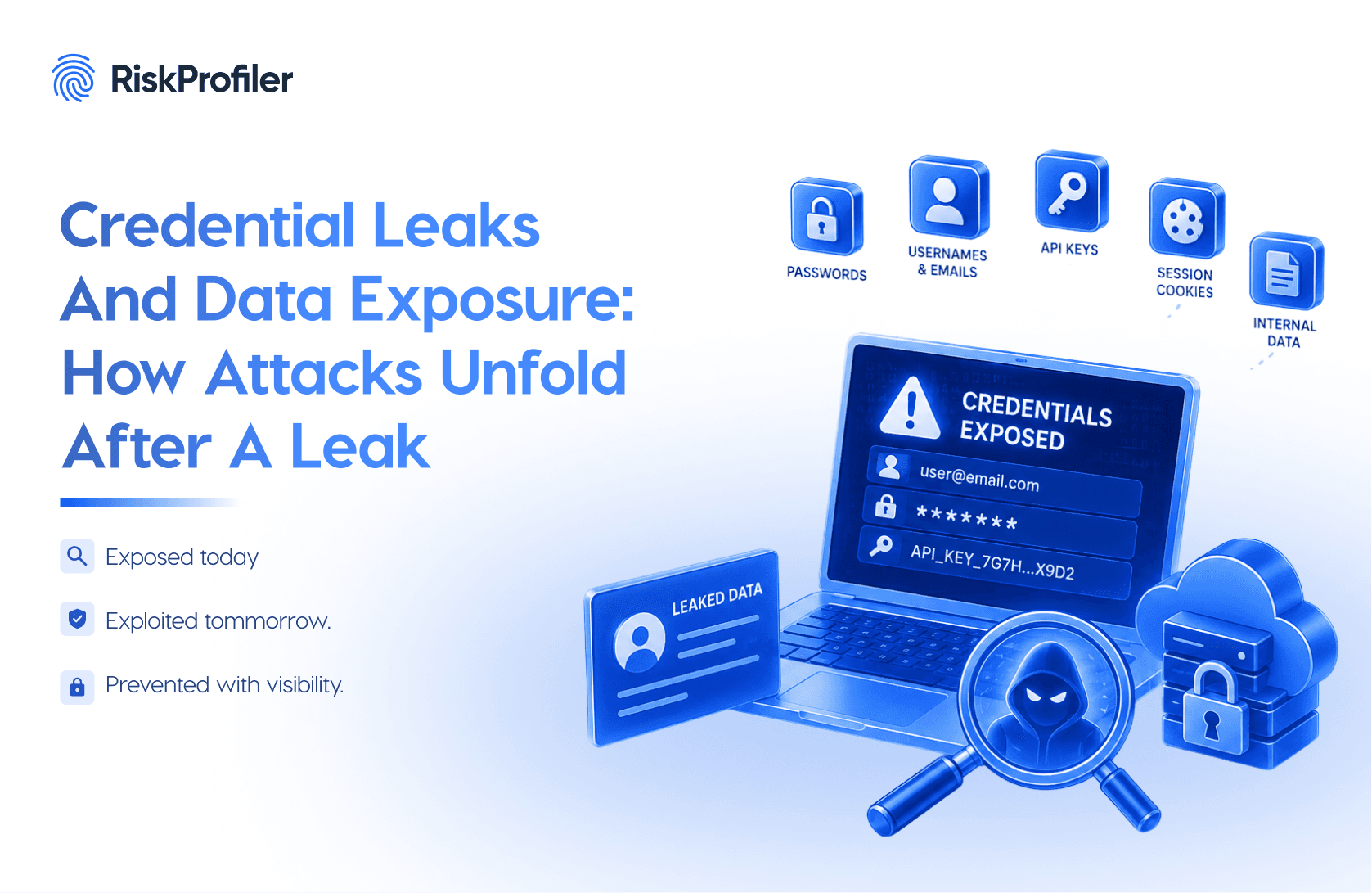
Credential Leaks and Data Exposure: How Attacks Unfold After Leak
Credential Leaks and Data Exposure: How Attacks Unfold After Leak
Session tokens, API keys, and passwords are exploited fast. Learn how Data leaks & credential exposure turn exposed data into immediate risk.
Read Time
7 min read
Posted On
Social Media
Your credentials didn't disappear when that breach happened two years ago. They were packaged, listed, and sold, and they may still be circulating on dark web forums today. Understanding exactly what gets exposed, how it travels, and what attackers do with it is the foundation of any serious external threat program.
Key Takeaways
Leaked credentials originate from breach data dumps, while compromised credentials are actively harvested through infostealer malware and often indicate real-time attacker access or ongoing intrusion.
Within 24 hours of exposure, automated systems validate credentials, credential stuffing attacks begin, and account takeover can escalate into fraud and lateral movement before detection occurs.
Credential exposure extends beyond passwords to include session cookies, API keys, IP addresses, and internal documents. This enables MFA bypass, cloud access, and user impersonation without password cracking.
Stolen credentials move rapidly through dark web marketplaces, Telegram channels, and paste sites, often within hours. Pricing ranges from bulk low-cost datasets to high-value executive and administrative accounts.
Credential-based breaches average $4.88 million in losses, and password reuse across personal and enterprise systems allows attackers to bridge consumer breaches into corporate environments.
What Are Credential Leaks and Data Exposures?
Credential leaks and data exposures are security incidents where authentication data, login credentials, API keys, session tokens, or sensitive information become accessible to unauthorized parties. This is possible through breaches, malware infections, cloud misconfigurations, exposed databases, phishing kits, or public code repositories. Cybercriminals use these exposed credentials to gain access to corporate systems, bypass weak security controls, escalate privileges, and support malicious cyber operations.
What Types of Data Get Exposed
Credential leaks often expose more than passwords. Modern breaches typically include authentication data, financial records, cloud credentials, and internal business information that attackers use to gain access, bypass security controls, and expand their compromise.
Usernames and Passwords: Enable account takeover and credential stuffing attacks.
Email Addresses: Support phishing, identity correlation, and BEC attacks.
Session Cookies and Tokens: Bypass passwords and sometimes MFA entirely.
API Keys and Cloud Credentials: Expose infrastructure, applications, and cloud environments.
Payment and Financial Data: Used for fraud, theft, and underground resale.
PII and Employee Records: Enable identity theft and targeted social engineering.
Internal Documents and Source Code: Reveal operational and proprietary business data.
IP Addresses and Device Metadata: Help attackers profile users and evade detection.
Leaked vs. Compromised Credentials: The Difference That Actually Matters
Leaked credentials appear in breach dumps, large datasets from infiltrated databases that get posted publicly or sold in bulk. Compromised credentials are actively in an attacker's hands, often sourced from infostealer malware that harvested them from a specific machine in real time. The distinction matters operationally because leaked credentials require immediate password resets; compromised credentials may indicate an active intrusion already in progress.
How Stolen Credentials and Data End Up Exposed?
Credentials reach the dark web through six primary vectors: database breaches, infostealer malware, phishing, misconfigured systems, session hijacking, and password reuse across accounts.
1. Data Breaches
Organizations storing user credentials in databases remain the largest single source of credential leaks at scale. Attackers exploit unpatched vulnerabilities, SQL injection flaws, or compromised admin accounts to exfiltrate entire databases. In 2024, researchers disclosed the “Mother of All Breaches” (MOAB) dataset containing more than 26 billion records aggregated from numerous historic and recent data breaches. Many of the exposed datasets included credentials, session data, and personally identifiable information accumulated across years of compromise activity.
2. Infostealer Malware
Infostealer malware such as RedLine, Vidar, Raccoon, and Lumma silently harvests browser passwords, session cookies, API tokens, and autofill data from infected systems. These stealer logs are rapidly sold on dark web markets with device metadata, installed software details, and geographic information that enable highly targeted account compromise.
3. Phishing Attacks Targeting Emails and Usernames
Phishing remains the most scalable credential theft method. A convincing spoofed login page can capture thousands of username and password combinations in a single campaign. Adversary-in-the-middle (AiTM) phishing kits now intercept session tokens in real time, making standard MFA ineffective against them. The stolen credentials and email addresses flow directly into the attacker's infrastructure within minutes of submission.
4. Misconfigured Databases and Cloud Exposures
Not all exposures require a sophisticated attack. Publicly accessible Elasticsearch instances, unsecured MongoDB deployments, and AWS S3 buckets with open read permissions have exposed hundreds of millions of records without any intrusion required. Proprietary databases containing customer emails, internal usernames, and IP addresses have been indexed by search engines. It has been scraped by automated bots before organizations realized the misconfiguration existed.
5. Session Hijacking and Stolen Cookies
Session tokens stored in browser cookies authenticate users to applications without requiring repeated password entry. When these tokens are stolen via infostealers, cross-site scripting attacks, or man-in-the-middle interception, attackers inherit an active authenticated session. They bypass login flows entirely, including MFA prompts. Session token theft is now a standard component of cloud account compromise.
6. Weak and Reused Passwords
Technical vectors aside, weak password hygiene remains a structural vulnerability. When users reuse the same password across personal and corporate accounts, a breach of a low-security consumer platform becomes an entry point into enterprise systems. Password analysis from breach dumps consistently shows that variations of simple passwords, sequential numbers, company names, and seasonal patterns account for a disproportionate share of compromised credentials.
Where Do Stolen Credentials and Leaked Data End Up After a Breach?
Stolen credentials and exposed data typically move into dark web marketplaces, hacker forums, Telegram channels, paste sites, and publicly accessible repositories. There, threat actors buy, sell, share, analyze, and weaponize the data for credential stuffing, ransomware access, phishing campaigns, fraud, and lateral network compromise.
1. Dark Web Marketplaces
Dark web marketplaces operate with disturbing efficiency. Credential dumps are listed with structured metadata, which includes breach source, data freshness, industry vertical, and geographic distribution. Bulk credential sets sell for as little as $1–10 per thousand records.
High-value targets like executives, system administrators, and users at financial institutions command significantly higher prices. Ransomware groups and initial access brokers (IABs) are active buyers, using stolen credentials to establish footholds they later sell to ransomware operators.
2. Paste Sites and Hacker Forums
Paste sites such as Pastebin and its successors serve as free distribution channels for credential dumps. Hacker forums on both the surface web and the TOR network host breach discussions, share leaked datasets, and coordinate credential stuffing campaigns.
Telegram channels have become an increasingly dominant location for such activities. The platform’s decentralized and encrypted environment allows private groups to share stealer logs, breach data, and operational tooling with minimal friction.
3. Misconfigured Systems That Expose Data Publicly
GitHub repositories with hardcoded API keys, cloud credentials, and database connection strings represent a persistent exposure class. Automated scanners continuously monitor public code repositories for secrets.
Proprietary source code, internal IP addresses, and cloud credentials have been exposed through developer error, often in repositories that were briefly public before being set to private, but not before being indexed.
As this ecosystem develops, underground activity becomes increasingly fragmented across multiple channels. This makes it difficult for security teams to track where exposed credentials are actively being discussed or reused. This is where platforms like RiskProfiler’s KnyX Dark Web AI correlate underground credential activity with affected employees, systems, and cloud assets so security teams can identify exposure before it is operationalized.
What Happens Within the First 24 Hours After a Credential Leak?
Once credentials are listed or leaked, automated attack infrastructure activates within hours. By the 24-hour mark, account takeovers, fraud, and lateral escalation are already underway at organizations that haven't detected the exposure.
1. Hour 0–6: The Data Gets Listed or Sold
Fresh stealer logs and breach data command premium prices. Within hours of a new dump appearing, it circulates across Telegram channels, dark web forums, and private marketplaces. Automated validation bots test credentials against major platforms, including email providers, banking portals, and SaaS tools, to filter live accounts from stale ones. Validated credential sets sell for multiples of the raw dump price.
2. Hour 6–12: Credential Stuffing Begins
Credential stuffing tools, automated scripts that systematically test username and password combinations against target applications, begin operating at scale. At 6 to 12 hours post-exposure, security teams monitoring login anomalies may observe geographic impossibilities (logins from multiple countries within minutes), unusual user agents, or high-volume authentication failures. Teams without real-time monitoring see nothing until the damage is done.
3. Hour 12–24: Account Takeover, Fraud, and Escalation
Successful authentications convert into account takeovers. Attackers enumerate accessible systems, exfiltrate sensitive data, establish persistence mechanisms, and in corporate environments, begin lateral movement. Financial fraud, wire transfer manipulation, and unauthorized data exports occur in this window. In ransomware scenarios, the initial credential compromise that began with a single leaked password can result in full domain compromise within 24 hours.
What Is the Real Risk and Cost of Credential Exposure?
Credential exposure creates direct account compromise risk and systemic organizational damage. Stolen authentication data is reused across personal and enterprise systems, enabling unauthorized access, privilege escalation, and downstream cyberattacks.
1. Personal Risk: Identity Theft, Financial Fraud, and Account Takeovers
For individuals, exposed email addresses and passwords translate directly into identity theft, unauthorized financial transactions, and account takeovers across banking, retail, and social platforms.
Once an email account is compromised, attackers use it as a pivot point, password reset flows on connected services, and hand over access to everything linked to that inbox.
2. Business Risk: Proprietary Data, Intellectual Property, and Corporate Espionage
For enterprises, the stakes extend beyond individual accounts. Compromised employee credentials provide access to internal systems, cloud infrastructure, customer databases, and proprietary intellectual property.
IBM’s 2025 Cost of a Data Breach Report found that the global average breach cost reached USD 4.44 million, highlighting the significant financial impact cyber incidents continue to create for organizations.
3. The Compounding Risk of Password Reuse Across Accounts
Password reuse turns a consumer breach into an enterprise incident. When employees reuse the same password across personal and corporate accounts, a breach of a low-security consumer platform becomes an entry point into enterprise systems.
Bitwarden’s World Password Day research found that a majority of global respondents (84%) reuse passwords across more than one site, significantly increasing the blast radius of a single credential leak. Security teams focused exclusively on perimeter defenses often miss this vector entirely because the attack never touches the firewall.
How Can You Check If Your Credentials or Data Are Already Exposed?
Detecting exposed credential data requires correlating breach-indexed records, stealer log intelligence, and authentication telemetry. This helps identify whether account credentials, individual credentials, or organizational data have already appeared in data dumps, malicious software logs, or credentials on the dark web. You will also be informed whether they are being used in credential stuffing attacks or unauthorized access attempts.
Breach Index Exposure and Previously Leaked Credential Detection
Breach aggregation systems such as Have I Been Pwned identify whether credentials linked to leaked email addresses exist in historically confirmed security breaches. This enables the detection of previously leaked credentials at both the individual and domain levels. Here’s how it works:
Match email addresses against indexed breach datasets containing exposed credentials.
Detect organization-wide leakage across multiple previously leaked credentials datasets.
Identify historical data theft events where account credentials were revealed in prior breaches.
Establish baseline identity intelligence from aggregated breach records and compromised identity datasets.
This only covers confirmed breaches and does not include fresh infostealer logs, private data sales, or real-time credentials on the dark web.
Active Credential Compromise Signals in Authentication Telemetry
Active exploitation of leaked credentials is identified through authentication-layer anomalies where attackers use stolen credentials to access bank accounts, SaaS platforms, or corporate data. It’s done by using valid credentials obtained from credential stuffing attacks. Here’s how:
Login attempts from new ASNs or IP ranges are inconsistent with the user baseline.
Impossible travel authentication events within short time windows.
Concurrent session creation from geographically distinct endpoints.
MFA push fatigue attacks or repeated unauthorized MFA prompts.
Password reset or recovery flows initiated without user action.
Spike in failed logins followed by successful authentication using valid credentials.
These signals indicate attackers are actively leveraging leaked credentials to gain access and move toward data theft or ransomware attacks.
Immediate Containment After Credential Exposure Detection
Once credentials are confirmed as exposed, containment focuses on eliminating all attacker-valid access paths and preventing reuse of compromised identity artifacts across systems. Here’s how it processes:
Immediate password reset for all affected accounts with invalidation of old hashes.
Forced session termination across all active user sessions and device tokens.
Full OAuth and API token revocation across connected applications.
Rotation of cloud IAM keys, access keys, and service account credentials.
Audit of authentication logs for pre-detection access windows and lateral movement.
Reset of MFA enrollment, recovery factors, and backup authentication channels.
These actions reduce exploitation windows where attackers use leaked credentials for ransomware deployment, corporate data exfiltration, and financial loss.
How Can You Protect Against Credential Leaks and Data Exposure?
Preventing credential leaks and data exposure requires layered cybersecurity controls that reduce credential theft, limit reuse impact, and continuously monitor for exposed credentials. It's done across data breaches, infostealer logs, and credentials on the dark web before attackers can exploit them for unauthorized access or data theft.
1. Use Strong, Unique Passwords for Every Account
Every account, corporate and personal, where corporate access exists, requires a unique, randomly generated password of sufficient length. Password managers make this operationally feasible at scale. Passphrases of 16 or more characters with no dictionary words provide strong resistance to offline cracking of leaked hashes.
Password policies should enforce minimum length and prohibit known compromised passwords, which NIST SP 800-63B now recommends as standard practice.
2. Enable Multi-Factor Authentication Across All Logins
MFA reduces the risk of credential-based account takeover significantly. Microsoft's research indicates that MFA blocks over 99.9% of automated account compromise attacks. FIDO2 hardware keys and passkeys provide phishing-resistant authentication that session-hijacking attacks cannot bypass.
SMS-based MFA, while better than nothing, remains vulnerable to SIM-swapping and AiTM interception. Security teams should prioritize migration away from SMS toward app-based TOTP or hardware tokens for privileged accounts.
3. Monitor for Leaked Credentials and Breach Notifications
Reactive breach checking is insufficient. Continuous dark web monitoring surfaces compromised credentials before attackers exploit them, as the window between initial exposure and first use is measurable in hours, not days. Monitoring should cover TOR/Onion sites, ransomware group leak pages, Telegram channels, paste sites, stealer log markets, and encrypted forums where fresh credential dumps circulate.
Alerts should be prioritized by severity and correlated to specific employees or systems to enable targeted, immediate response rather than broad, unfocused remediation.
4. Adopt a Zero Trust Approach to Access and Permissions
Zero Trust architecture operates on the principle that no user, device, or network segment is inherently trusted. Every access request is verified regardless of origin. Least-privilege access controls limit the blast radius of any single compromised credential. An attacker who gains a developer's credentials should not automatically inherit access to production databases or customer data stores.
Microsegmentation, just-in-time access provisioning, and continuous session verification are the operational pillars of this model.
5. Employee Training to Prevent Phishing and Credential Theft
Human behavior remains the most exploited attack surface. Phishing simulation programs, security awareness training calibrated to current threat tactics, and clear incident reporting procedures reduce the probability that employees will surrender credentials to sophisticated social engineering.
Training should cover AI TM phishing techniques, pretexting scenarios, and the mechanics of credential stuffing. Security teams that understand how their credentials get used against them are more motivated to protect them.
How RiskProfiler Prevents Credential Leaks Through Dark Web Monitoring
Credential leaks are identified by continuously monitoring dark web ecosystems where stolen credentials and sensitive data appear before being used in attacks. RiskProfiler uses KnyX Dark Web AI to detect leaked credentials, correlate them with organizational assets, and help security teams respond before unauthorized access or data theft escalates.
Here’s how Kynx works:
Stealer Log Credential Detection: Detects usernames, passwords, session tokens, and API keys extracted from infostealer malware such as RedLine, Vidar, Raccoon, and Lumma.
Dark Web and Leak Site Monitoring: Continuously scans TOR networks, ransomware leak pages, and encrypted channels like Telegram, Discord, Signal, and IRC for exposed organizational data.
Asset-Based Correlation: Maps exposed credentials and leaked data to employees, cloud assets, domains, and external infrastructure to determine security impact.
Prioritized Alerts and Remediation: Sends contextual exposure alerts to Slack, Jira, ServiceNow, and SIEM/SOAR tools with AI-generated remediation steps for security teams.
Request a demo to see what RiskProfiler has already found for organizations like yours.
Sources:
https://cybernews.com/security/billions-passwords-credentials-leaked-mother-of-all-breaches/
https://www.ibm.com/reports/data-breach?
Your credentials didn't disappear when that breach happened two years ago. They were packaged, listed, and sold, and they may still be circulating on dark web forums today. Understanding exactly what gets exposed, how it travels, and what attackers do with it is the foundation of any serious external threat program.
Key Takeaways
Leaked credentials originate from breach data dumps, while compromised credentials are actively harvested through infostealer malware and often indicate real-time attacker access or ongoing intrusion.
Within 24 hours of exposure, automated systems validate credentials, credential stuffing attacks begin, and account takeover can escalate into fraud and lateral movement before detection occurs.
Credential exposure extends beyond passwords to include session cookies, API keys, IP addresses, and internal documents. This enables MFA bypass, cloud access, and user impersonation without password cracking.
Stolen credentials move rapidly through dark web marketplaces, Telegram channels, and paste sites, often within hours. Pricing ranges from bulk low-cost datasets to high-value executive and administrative accounts.
Credential-based breaches average $4.88 million in losses, and password reuse across personal and enterprise systems allows attackers to bridge consumer breaches into corporate environments.
What Are Credential Leaks and Data Exposures?
Credential leaks and data exposures are security incidents where authentication data, login credentials, API keys, session tokens, or sensitive information become accessible to unauthorized parties. This is possible through breaches, malware infections, cloud misconfigurations, exposed databases, phishing kits, or public code repositories. Cybercriminals use these exposed credentials to gain access to corporate systems, bypass weak security controls, escalate privileges, and support malicious cyber operations.
What Types of Data Get Exposed
Credential leaks often expose more than passwords. Modern breaches typically include authentication data, financial records, cloud credentials, and internal business information that attackers use to gain access, bypass security controls, and expand their compromise.
Usernames and Passwords: Enable account takeover and credential stuffing attacks.
Email Addresses: Support phishing, identity correlation, and BEC attacks.
Session Cookies and Tokens: Bypass passwords and sometimes MFA entirely.
API Keys and Cloud Credentials: Expose infrastructure, applications, and cloud environments.
Payment and Financial Data: Used for fraud, theft, and underground resale.
PII and Employee Records: Enable identity theft and targeted social engineering.
Internal Documents and Source Code: Reveal operational and proprietary business data.
IP Addresses and Device Metadata: Help attackers profile users and evade detection.
Leaked vs. Compromised Credentials: The Difference That Actually Matters
Leaked credentials appear in breach dumps, large datasets from infiltrated databases that get posted publicly or sold in bulk. Compromised credentials are actively in an attacker's hands, often sourced from infostealer malware that harvested them from a specific machine in real time. The distinction matters operationally because leaked credentials require immediate password resets; compromised credentials may indicate an active intrusion already in progress.
How Stolen Credentials and Data End Up Exposed?
Credentials reach the dark web through six primary vectors: database breaches, infostealer malware, phishing, misconfigured systems, session hijacking, and password reuse across accounts.
1. Data Breaches
Organizations storing user credentials in databases remain the largest single source of credential leaks at scale. Attackers exploit unpatched vulnerabilities, SQL injection flaws, or compromised admin accounts to exfiltrate entire databases. In 2024, researchers disclosed the “Mother of All Breaches” (MOAB) dataset containing more than 26 billion records aggregated from numerous historic and recent data breaches. Many of the exposed datasets included credentials, session data, and personally identifiable information accumulated across years of compromise activity.
2. Infostealer Malware
Infostealer malware such as RedLine, Vidar, Raccoon, and Lumma silently harvests browser passwords, session cookies, API tokens, and autofill data from infected systems. These stealer logs are rapidly sold on dark web markets with device metadata, installed software details, and geographic information that enable highly targeted account compromise.
3. Phishing Attacks Targeting Emails and Usernames
Phishing remains the most scalable credential theft method. A convincing spoofed login page can capture thousands of username and password combinations in a single campaign. Adversary-in-the-middle (AiTM) phishing kits now intercept session tokens in real time, making standard MFA ineffective against them. The stolen credentials and email addresses flow directly into the attacker's infrastructure within minutes of submission.
4. Misconfigured Databases and Cloud Exposures
Not all exposures require a sophisticated attack. Publicly accessible Elasticsearch instances, unsecured MongoDB deployments, and AWS S3 buckets with open read permissions have exposed hundreds of millions of records without any intrusion required. Proprietary databases containing customer emails, internal usernames, and IP addresses have been indexed by search engines. It has been scraped by automated bots before organizations realized the misconfiguration existed.
5. Session Hijacking and Stolen Cookies
Session tokens stored in browser cookies authenticate users to applications without requiring repeated password entry. When these tokens are stolen via infostealers, cross-site scripting attacks, or man-in-the-middle interception, attackers inherit an active authenticated session. They bypass login flows entirely, including MFA prompts. Session token theft is now a standard component of cloud account compromise.
6. Weak and Reused Passwords
Technical vectors aside, weak password hygiene remains a structural vulnerability. When users reuse the same password across personal and corporate accounts, a breach of a low-security consumer platform becomes an entry point into enterprise systems. Password analysis from breach dumps consistently shows that variations of simple passwords, sequential numbers, company names, and seasonal patterns account for a disproportionate share of compromised credentials.
Where Do Stolen Credentials and Leaked Data End Up After a Breach?
Stolen credentials and exposed data typically move into dark web marketplaces, hacker forums, Telegram channels, paste sites, and publicly accessible repositories. There, threat actors buy, sell, share, analyze, and weaponize the data for credential stuffing, ransomware access, phishing campaigns, fraud, and lateral network compromise.
1. Dark Web Marketplaces
Dark web marketplaces operate with disturbing efficiency. Credential dumps are listed with structured metadata, which includes breach source, data freshness, industry vertical, and geographic distribution. Bulk credential sets sell for as little as $1–10 per thousand records.
High-value targets like executives, system administrators, and users at financial institutions command significantly higher prices. Ransomware groups and initial access brokers (IABs) are active buyers, using stolen credentials to establish footholds they later sell to ransomware operators.
2. Paste Sites and Hacker Forums
Paste sites such as Pastebin and its successors serve as free distribution channels for credential dumps. Hacker forums on both the surface web and the TOR network host breach discussions, share leaked datasets, and coordinate credential stuffing campaigns.
Telegram channels have become an increasingly dominant location for such activities. The platform’s decentralized and encrypted environment allows private groups to share stealer logs, breach data, and operational tooling with minimal friction.
3. Misconfigured Systems That Expose Data Publicly
GitHub repositories with hardcoded API keys, cloud credentials, and database connection strings represent a persistent exposure class. Automated scanners continuously monitor public code repositories for secrets.
Proprietary source code, internal IP addresses, and cloud credentials have been exposed through developer error, often in repositories that were briefly public before being set to private, but not before being indexed.
As this ecosystem develops, underground activity becomes increasingly fragmented across multiple channels. This makes it difficult for security teams to track where exposed credentials are actively being discussed or reused. This is where platforms like RiskProfiler’s KnyX Dark Web AI correlate underground credential activity with affected employees, systems, and cloud assets so security teams can identify exposure before it is operationalized.
What Happens Within the First 24 Hours After a Credential Leak?
Once credentials are listed or leaked, automated attack infrastructure activates within hours. By the 24-hour mark, account takeovers, fraud, and lateral escalation are already underway at organizations that haven't detected the exposure.
1. Hour 0–6: The Data Gets Listed or Sold
Fresh stealer logs and breach data command premium prices. Within hours of a new dump appearing, it circulates across Telegram channels, dark web forums, and private marketplaces. Automated validation bots test credentials against major platforms, including email providers, banking portals, and SaaS tools, to filter live accounts from stale ones. Validated credential sets sell for multiples of the raw dump price.
2. Hour 6–12: Credential Stuffing Begins
Credential stuffing tools, automated scripts that systematically test username and password combinations against target applications, begin operating at scale. At 6 to 12 hours post-exposure, security teams monitoring login anomalies may observe geographic impossibilities (logins from multiple countries within minutes), unusual user agents, or high-volume authentication failures. Teams without real-time monitoring see nothing until the damage is done.
3. Hour 12–24: Account Takeover, Fraud, and Escalation
Successful authentications convert into account takeovers. Attackers enumerate accessible systems, exfiltrate sensitive data, establish persistence mechanisms, and in corporate environments, begin lateral movement. Financial fraud, wire transfer manipulation, and unauthorized data exports occur in this window. In ransomware scenarios, the initial credential compromise that began with a single leaked password can result in full domain compromise within 24 hours.
What Is the Real Risk and Cost of Credential Exposure?
Credential exposure creates direct account compromise risk and systemic organizational damage. Stolen authentication data is reused across personal and enterprise systems, enabling unauthorized access, privilege escalation, and downstream cyberattacks.
1. Personal Risk: Identity Theft, Financial Fraud, and Account Takeovers
For individuals, exposed email addresses and passwords translate directly into identity theft, unauthorized financial transactions, and account takeovers across banking, retail, and social platforms.
Once an email account is compromised, attackers use it as a pivot point, password reset flows on connected services, and hand over access to everything linked to that inbox.
2. Business Risk: Proprietary Data, Intellectual Property, and Corporate Espionage
For enterprises, the stakes extend beyond individual accounts. Compromised employee credentials provide access to internal systems, cloud infrastructure, customer databases, and proprietary intellectual property.
IBM’s 2025 Cost of a Data Breach Report found that the global average breach cost reached USD 4.44 million, highlighting the significant financial impact cyber incidents continue to create for organizations.
3. The Compounding Risk of Password Reuse Across Accounts
Password reuse turns a consumer breach into an enterprise incident. When employees reuse the same password across personal and corporate accounts, a breach of a low-security consumer platform becomes an entry point into enterprise systems.
Bitwarden’s World Password Day research found that a majority of global respondents (84%) reuse passwords across more than one site, significantly increasing the blast radius of a single credential leak. Security teams focused exclusively on perimeter defenses often miss this vector entirely because the attack never touches the firewall.
How Can You Check If Your Credentials or Data Are Already Exposed?
Detecting exposed credential data requires correlating breach-indexed records, stealer log intelligence, and authentication telemetry. This helps identify whether account credentials, individual credentials, or organizational data have already appeared in data dumps, malicious software logs, or credentials on the dark web. You will also be informed whether they are being used in credential stuffing attacks or unauthorized access attempts.
Breach Index Exposure and Previously Leaked Credential Detection
Breach aggregation systems such as Have I Been Pwned identify whether credentials linked to leaked email addresses exist in historically confirmed security breaches. This enables the detection of previously leaked credentials at both the individual and domain levels. Here’s how it works:
Match email addresses against indexed breach datasets containing exposed credentials.
Detect organization-wide leakage across multiple previously leaked credentials datasets.
Identify historical data theft events where account credentials were revealed in prior breaches.
Establish baseline identity intelligence from aggregated breach records and compromised identity datasets.
This only covers confirmed breaches and does not include fresh infostealer logs, private data sales, or real-time credentials on the dark web.
Active Credential Compromise Signals in Authentication Telemetry
Active exploitation of leaked credentials is identified through authentication-layer anomalies where attackers use stolen credentials to access bank accounts, SaaS platforms, or corporate data. It’s done by using valid credentials obtained from credential stuffing attacks. Here’s how:
Login attempts from new ASNs or IP ranges are inconsistent with the user baseline.
Impossible travel authentication events within short time windows.
Concurrent session creation from geographically distinct endpoints.
MFA push fatigue attacks or repeated unauthorized MFA prompts.
Password reset or recovery flows initiated without user action.
Spike in failed logins followed by successful authentication using valid credentials.
These signals indicate attackers are actively leveraging leaked credentials to gain access and move toward data theft or ransomware attacks.
Immediate Containment After Credential Exposure Detection
Once credentials are confirmed as exposed, containment focuses on eliminating all attacker-valid access paths and preventing reuse of compromised identity artifacts across systems. Here’s how it processes:
Immediate password reset for all affected accounts with invalidation of old hashes.
Forced session termination across all active user sessions and device tokens.
Full OAuth and API token revocation across connected applications.
Rotation of cloud IAM keys, access keys, and service account credentials.
Audit of authentication logs for pre-detection access windows and lateral movement.
Reset of MFA enrollment, recovery factors, and backup authentication channels.
These actions reduce exploitation windows where attackers use leaked credentials for ransomware deployment, corporate data exfiltration, and financial loss.
How Can You Protect Against Credential Leaks and Data Exposure?
Preventing credential leaks and data exposure requires layered cybersecurity controls that reduce credential theft, limit reuse impact, and continuously monitor for exposed credentials. It's done across data breaches, infostealer logs, and credentials on the dark web before attackers can exploit them for unauthorized access or data theft.
1. Use Strong, Unique Passwords for Every Account
Every account, corporate and personal, where corporate access exists, requires a unique, randomly generated password of sufficient length. Password managers make this operationally feasible at scale. Passphrases of 16 or more characters with no dictionary words provide strong resistance to offline cracking of leaked hashes.
Password policies should enforce minimum length and prohibit known compromised passwords, which NIST SP 800-63B now recommends as standard practice.
2. Enable Multi-Factor Authentication Across All Logins
MFA reduces the risk of credential-based account takeover significantly. Microsoft's research indicates that MFA blocks over 99.9% of automated account compromise attacks. FIDO2 hardware keys and passkeys provide phishing-resistant authentication that session-hijacking attacks cannot bypass.
SMS-based MFA, while better than nothing, remains vulnerable to SIM-swapping and AiTM interception. Security teams should prioritize migration away from SMS toward app-based TOTP or hardware tokens for privileged accounts.
3. Monitor for Leaked Credentials and Breach Notifications
Reactive breach checking is insufficient. Continuous dark web monitoring surfaces compromised credentials before attackers exploit them, as the window between initial exposure and first use is measurable in hours, not days. Monitoring should cover TOR/Onion sites, ransomware group leak pages, Telegram channels, paste sites, stealer log markets, and encrypted forums where fresh credential dumps circulate.
Alerts should be prioritized by severity and correlated to specific employees or systems to enable targeted, immediate response rather than broad, unfocused remediation.
4. Adopt a Zero Trust Approach to Access and Permissions
Zero Trust architecture operates on the principle that no user, device, or network segment is inherently trusted. Every access request is verified regardless of origin. Least-privilege access controls limit the blast radius of any single compromised credential. An attacker who gains a developer's credentials should not automatically inherit access to production databases or customer data stores.
Microsegmentation, just-in-time access provisioning, and continuous session verification are the operational pillars of this model.
5. Employee Training to Prevent Phishing and Credential Theft
Human behavior remains the most exploited attack surface. Phishing simulation programs, security awareness training calibrated to current threat tactics, and clear incident reporting procedures reduce the probability that employees will surrender credentials to sophisticated social engineering.
Training should cover AI TM phishing techniques, pretexting scenarios, and the mechanics of credential stuffing. Security teams that understand how their credentials get used against them are more motivated to protect them.
How RiskProfiler Prevents Credential Leaks Through Dark Web Monitoring
Credential leaks are identified by continuously monitoring dark web ecosystems where stolen credentials and sensitive data appear before being used in attacks. RiskProfiler uses KnyX Dark Web AI to detect leaked credentials, correlate them with organizational assets, and help security teams respond before unauthorized access or data theft escalates.
Here’s how Kynx works:
Stealer Log Credential Detection: Detects usernames, passwords, session tokens, and API keys extracted from infostealer malware such as RedLine, Vidar, Raccoon, and Lumma.
Dark Web and Leak Site Monitoring: Continuously scans TOR networks, ransomware leak pages, and encrypted channels like Telegram, Discord, Signal, and IRC for exposed organizational data.
Asset-Based Correlation: Maps exposed credentials and leaked data to employees, cloud assets, domains, and external infrastructure to determine security impact.
Prioritized Alerts and Remediation: Sends contextual exposure alerts to Slack, Jira, ServiceNow, and SIEM/SOAR tools with AI-generated remediation steps for security teams.
Request a demo to see what RiskProfiler has already found for organizations like yours.
Sources:
https://cybernews.com/security/billions-passwords-credentials-leaked-mother-of-all-breaches/
https://www.ibm.com/reports/data-breach?
Jump to
Share Article
We Have Answers!
Explore our FAQ to learn more about how RiskProfiler can help safeguard your digital assets and manage risks efficiently.
Should I worry if my password was in a data leak?
Yes. If your password appears in a data leak, it may be part of leaked credentials that cybercriminals collect data from and use to exploit leaked credentials for unauthorized access. This includes access to bank accounts or corporate systems. Risk increases significantly if you reuse passwords.
What are leaked credentials?
Leaked credentials refer to account credentials such as usernames, passwords, and login credentials exposed in security breaches or malicious software incidents. Attackers use these leaked accounts to gain access to sensitive information and execute credential stuffing attacks.
How can I tell if my password has been leaked?
You can check breach databases and identity intelligence alerts to see if credentials are leaked or previously exposed. Monitoring unusual login activity or unauthorized access attempts also helps detect if leaked credentials are being actively used. Platforms like RiskProfiler help organizations monitor exposed credentials, correlate identity exposure with external threat activity, and prioritize remediation actions faster.
Is one-time protection enough after a data breach?
No. One-time action is not sufficient because attackers continuously exploit leaked credentials. Best practices require ongoing monitoring for exposed credentials, MFA enforcement, and eliminating the habit of reusing passwords to reduce long-term risk.
Latest Insights
Stay informed with expert perspectives on cybersecurity, attack surface management,
and building digital resilience.



Enterprise-Grade Security & Trust
Specialized intelligence agents working together toprotect your organization
Ready to Transform
Your Threat Management?
Join hundreds of security teams who trust KnyX to cut through the noise and focus on what matters most.
Book a Demo Today