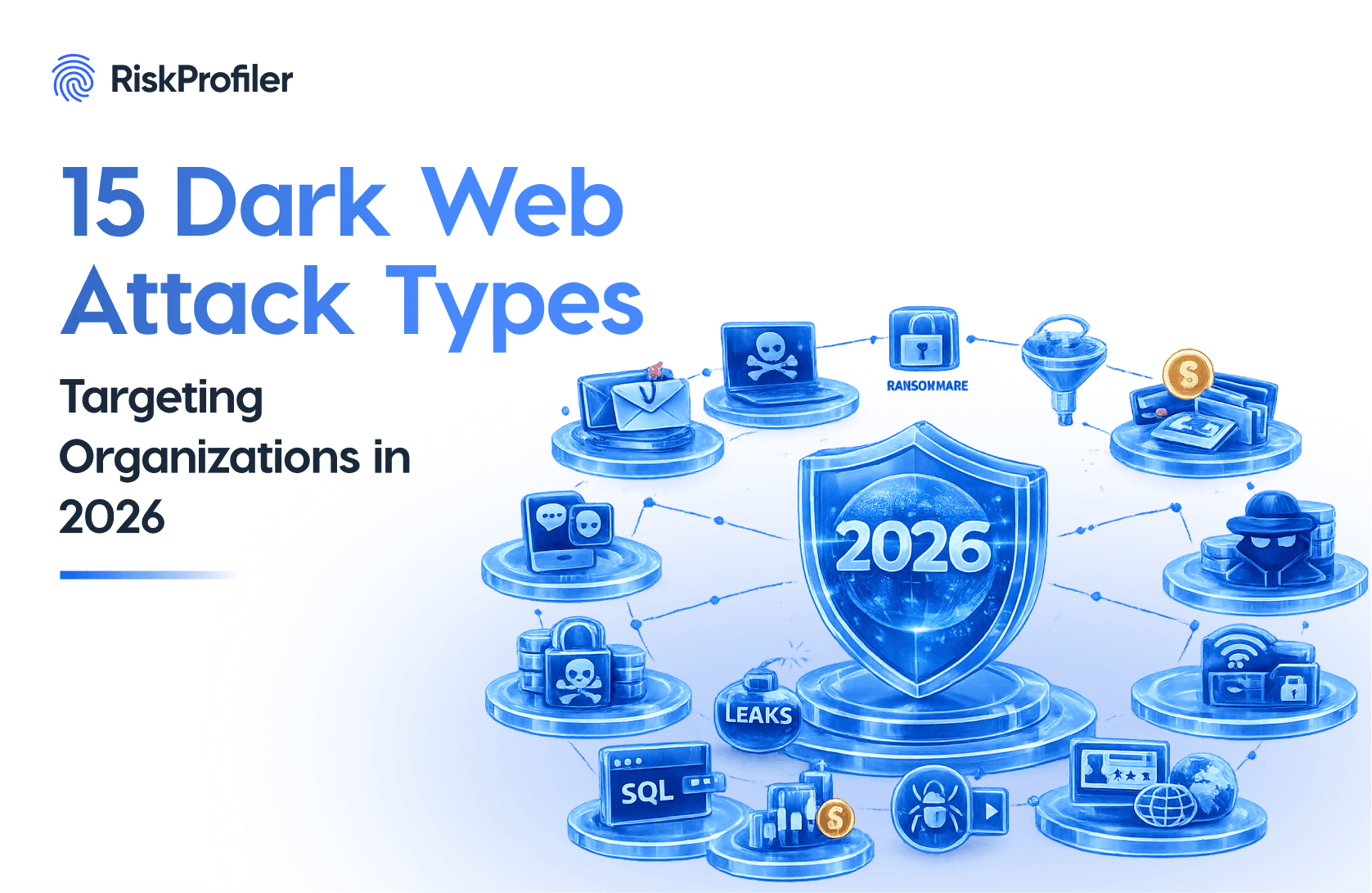
15 Dark Web Attack Types Targeting Organizations in 2026
15 Dark Web Attack Types Targeting Organizations in 2026
Cybercriminals buy corporate access for as little as $500. Discover 15 major threats targeting your business in 2026 and how to protect your network.
Read Time
7 min read
Posted On
Social Media
The dark web has become a commercialized cybercrime economy where ransomware, phishing kits, stolen access, and malware are bought and sold like services. This article breaks down the 15 major threats driving that economy, the organizations being targeted, and how these attacks unfold in practice.
Key Takeaways
The dark web now operates as a service economy where ransomware, phishing kits, malware, exploit kits, and stolen corporate access are openly traded.
RaaS, MaaS, infostealers, credential dumps, access brokers, and phishing-as-a-service platforms are among the fastest-growing dark web threats targeting organizations.
Dark web-enabled attacks now extend beyond malware deployment into credential theft, leak site extortion, financial fraud, DDoS services, and AI-powered phishing operations.
Healthcare, financial services, manufacturing, government entities, and SMBs face different dark web threats based on infrastructure exposure, sensitive data value, and operational dependency.
Continuous dark web monitoring, vulnerability management, MFA, Zero Trust controls, and incident response readiness help organizations detect threats before attackers operationalize access.
What Is the Dark Web and Why Are Organizations the Main Target?
The internet is commonly divided into three layers. The surface web includes publicly indexed content like websites, search results, and news pages. The deep web contains private but legitimate systems such as email accounts, banking portals, HR platforms, and internal databases that require authentication.
The dark web is a hidden section of the deep web accessed through anonymizing networks like TOR, where identities, infrastructure, and activity are intentionally concealed. This is also why dark web monitoring has become increasingly important for organizations trying to detect exposed credentials, leaked data, and underground threat activity early.
Layer | Access Method | Common Examples |
Surface Web | Standard browsers | Public websites, Google, news platforms |
Deep Web | Authenticated access | Email, SaaS platforms, and banking systems |
Dark Web | TOR / Onion routing | Leak sites, underground forums, illicit markets |
For years, dark web activity focused mainly on individuals through stolen credit cards, personal identity packages, and password attacks. That has now changed significantly as organizations generate far higher returns for threat actors. A single access broker sale granting entry into a mid-sized corporate network can fetch anywhere from $500 to $50,000, depending on the target's industry, revenue, and access level.
Ransomware operators can extract millions from a single deployment. The economics now favor organizational targeting, and the underground infrastructure supporting these attacks has scaled with it.
15 Dark Web Attack Types and Threats Targeting Organizations
Modern dark web ecosystems operate like organized cybercrime markets where ransomware, phishing infrastructure, malware, and stolen corporate access are bought and sold as services. The following attack types represent some of the most active cyber threats targeting organizations in 2026.
1. Ransomware-as-a-Service (RaaS)
RaaS is ransomware repackaged as a subscription model. Groups like RansomHub and Akira, which rose to prominence after law enforcement disrupted LockBit and BlackCat, advertise on dark web forums. They share recruitment posts, affiliate terms, and revenue splits, typically running 70/30 in favor of the affiliate.
Affiliates handle deployment, while the RaaS operator handles the malware, payment infrastructure, and negotiation support. The model functions like a franchise operation for ransomware attacks.
2. Double and Triple Extortion Ransomware
Classic ransomware encrypts files and demands payment for decryption. Double extortion adds a data leak threat where stolen data gets published on a dark web leak site if the victim refuses to pay. Triple extortion adds a DDoS attack on top, hitting the organization's infrastructure simultaneously to amplify operational pressure during negotiations.
Leak sites now function as public shaming portals, often displaying countdown timers and sample data to prove the threat is real. Groups such as ShinyHunters have also used stolen data leak tactics and extortion pressure through underground forums and leak channels after breaching organizations.
3. Malware-as-a-Service (MaaS)
MaaS mirrors RaaS structurally but covers a broader toolkit, including keyloggers, remote access trojans, banking malware, and wipers. Developers build and maintain the malware, while affiliates pay monthly fees or per-use rates to access the infrastructure and tooling.
Customer support, documentation, and update logs are common features, which means the barrier to launching sophisticated malware campaigns has dropped to the cost of a software subscription.
4. Infostealers
Infostealers are a specific malware category designed to harvest credentials, browser-saved passwords, session tokens, cryptocurrency wallet data, and autofill information from infected machines. Variants like RedLine, Vidar, Raccoon, and Lumma have generated hundreds of millions of compromised records across both consumer and enterprise environments.
The harvested data is packaged into "logs" and sold in bulk on dark web marketplaces, often within hours of infection.
5. Stolen Credentials and Credential Dumps
Credential dumps are aggregated databases of username and password pairs sourced from prior breaches, infostealer logs, and phishing campaigns. These datasets are freely traded or sold at low cost because volume is the value proposition for attackers operating credential-stuffing campaigns at scale.
The credentials are commonly used against corporate login portals, VPNs, and cloud services, where password reuse continues to create opportunities for unauthorized access.
6. Access Brokers
Access brokers are a distinct category of threat actor that specializes in breaching networks and selling the access rather than deploying ransomware directly. Listings on dark web forums often specify the target company's industry, revenue, country, and type of access available, including domain admin privileges, VPN credentials, or RDP sessions.
This division of labor has made the ransomware ecosystem significantly more efficient because specialists now handle different stages of the intrusion lifecycle.
7. Exploit Kits and Zero-Day Markets
Exploit kits bundle known vulnerabilities with automated delivery mechanisms and are sold to attackers who lack the technical skill to develop them independently. Zero-day markets operate at the higher end by selling unpatched and undisclosed vulnerabilities before vendors become aware of them.
Prices for critical enterprise software zero-days can reach six figures, with some sold exclusively and others distributed to multiple buyers.
8. Phishing-as-a-Service (PhaaS)
PhaaS platforms provide phishing infrastructure as a packaged service that includes branded login page templates, hosting on bulletproof infrastructure, evasion tools that bypass standard email filters, and analytics dashboards showing click and credential capture rates.
Operators targeting Microsoft 365, Okta, and banking portals remain commercially active across underground forums. A phishing campaign against a target organization can often be launched within hours.
9. DDoS-for-Hire
Distributed denial-of-service attacks are openly sold on dark web marketplaces with pricing tiers based on attack duration, traffic volume, and target type. Rates can start below $20 for short attacks against smaller targets, making these services widely accessible even to low-skilled attackers.
These operations are commonly used for extortion, competitive disruption, and as part of triple extortion ransomware campaigns.
10. Business Email Compromise (BEC) Kits
BEC kits equip attackers with spoofed domain registrations, email templates impersonating executives or finance teams, and targeting lists focused on organizational payment workflows. The objective is financial fraud through wire transfer redirection, invoice manipulation, or compromise of accounts payable processes.
The FBI's Internet Crime Complaint Center has consistently ranked BEC among the highest-cost cybercrime categories, with reported losses exceeding $3 billion in 2025 alone.
11. Carding and Financial Fraud Marketplaces
Stolen payment card data, compromised bank account credentials, and "fullz" packages containing complete identity profiles are traded at scale on carding forums. These profiles often include Personally Identifiable Information or PII details such as Social Security numbers, dates of birth, account details, and other sensitive personal information used in financial fraud operations.
For organizations, the exposure extends beyond customer data theft into direct attacks targeting payroll systems, employee benefits platforms, and corporate financial accounts.
12. Botnet Rentals
Pre-built botnets, which are networks of compromised machines controlled remotely by an operator, are rented for credential stuffing attacks, spam distribution, ad fraud, and DDoS campaigns.
Organizations frequently face botnet-driven attacks against authentication endpoints where automated login attempts use credential dump data to identify valid accounts at scale. The automation behind these attacks allows threat actors to test millions of credentials rapidly.
13. Dark Web Leak Sites
Leak sites are a dark web mechanism closely associated with ransomware operations. When a victim organization refuses to pay, the ransomware group publishes stolen data on a dedicated TOR-hosted site, sometimes incrementally to maintain pressure throughout negotiations.
These sites are actively tracked by security researchers and dark web monitoring providers because the reputational and regulatory damage from a leak can exceed the ransom demand itself.
14. Hacking-as-a-Service
Targeted attack services involving intrusion, data theft, corporate espionage, and account takeover are openly advertised on dark web forums against specific organizations or industries. Buyers specify the target while operators execute the attack and deliver the results.
This category increasingly overlaps with cyber mercenary activity and nation-state-adjacent actors supplementing political objectives with commercially motivated operations.
15. AI-Powered Malware and Deepfake Fraud Tools
AI tools developed specifically for offensive use are becoming an emerging dark web commodity. These offerings include LLM-based phishing content generators capable of producing personalized lure emails at scale, voice cloning tools used for CEO fraud and vishing attacks, and evasion tools designed to rewrite malware signatures to avoid detection.
This category continues to expand rapidly as AI capability becomes cheaper and more accessible across underground communities.
Which Organizations Are Being Targeted and by What Attack Type?
Dark web cyber threats are not distributed evenly across industries. Attackers prioritize sectors based on data value, operational dependency, attack surface exposure, and weaknesses in organizational security. Different industries therefore face different types of cyberattacks depending on how profitable or disruptive the intrusion can be.
1. Healthcare
Healthcare organizations remain major ransomware and MaaS targets because operational downtime directly impacts patient care. Attackers actively pursue EHR credentials, sensitive information, and network access, while legacy systems, over-reliance on third-party ecosystems, limited endpoint detection, and response capabilities often expand the healthcare attack surface.
2. Financial Services and Fintech
Financial institutions face concentrated activity around credential dumps, phishing attacks, BEC fraud, and account takeover campaigns. Attackers target customer financial data, payment workflows, and email security systems because direct financial theft remains one of the highest-return cybercrime operations.
3. Manufacturing
Manufacturing environments combine high revenue with legacy OT and ICS infrastructure, making them attractive targets for ransomware groups and access brokers. Unpatched industrial systems, weak network security segmentation, and operational continuity requirements create exposure to various types of cybersecurity threats.
4. Government and Public Sector
Government entities attract state-sponsored actors, hacktivist campaigns, espionage malware, and leak site extortion. These attacks often focus on confidential information, political disruption, and long-term intelligence collection rather than purely financial objectives.
5. Small and Mid-Sized Businesses (SMBs)
SMBs are frequently targeted through phishing-as-a-service platforms, credential stuffing, and botnet-driven password attacks because security measures and incident response capabilities are often limited. Ransomware affiliates commonly view smaller organizations as easier targets with a higher probability of payment.
How a Dark Web Attack Actually Unfolds: The Full Attack Chain
Most dark web-driven cyber attacks follow a structured sequence rather than a single isolated intrusion. Different threat actors often handle different stages of the operation, from initial access and malware deployment to extortion and data leakage. Understanding this attack chain helps security teams identify where detection and response efforts can interrupt the breach before major damage occurs.
Step 1: Exposure Appears on the Dark Web
The attack usually begins when leaked credentials, details of an exposed web application, or an infostealer log appear on a dark web forum or marketplace. In many cases, the organization remains completely unaware that sensitive information or access credentials are already circulating among cybercriminals.
Step 2: Access Is Sold to Another Threat Actor
An access broker validates the exposed credential or confirms the vulnerability is exploitable before selling the entry point to a ransomware affiliate or independent attacker. The access may include VPN credentials, privileged accounts, or remote desktop sessions capable of enabling unauthorized network access.
Step 3: Malware Deployment and Lateral Movement
After gaining entry, the attacker moves laterally across the environment, escalates privileges, and deploys malicious software across critical systems. MaaS or RaaS payloads are commonly positioned quietly inside the network while attackers identify sensitive data, backup systems, and high-value infrastructure before execution begins.
Step 4: Data Theft and Ransomware Execution
Attackers typically exfiltrate confidential information before triggering encryption to ensure double extortion exists. Once ransomware executes, systems become unavailable, business operations are disrupted, and the organization finally becomes aware of the intrusion and broader cybersecurity incident.
Step 5: Leak Site Extortion and Public Exposure
If the ransom demand is not paid within the deadline, the ransomware group publishes stolen data on its leak site or sells it to secondary buyers. At this stage, organizations often face regulatory notification obligations, reputational damage, legal exposure, and long-term information security consequences.
How to Protect Your Organization From Dark Web Threats?
Protecting against dark web cyber threats requires visibility beyond the traditional network perimeter because many attacks begin long before ransomware deployment or public data leakage occurs. Organizations that detect exposed credentials, malicious infrastructure activity, or unauthorized access early are significantly more likely to interrupt the attack chain before operational damage occurs.
1. Continuous Dark Web Monitoring
Dark web monitoring provides early visibility into stolen credentials, leaked sensitive information, exposed infrastructure data, and brand impersonation activity circulating across underground forums, ransomware leak sites, TOR networks, and criminal marketplaces.
Platforms like RiskProfiler's KnyX Dark Web AI monitor more than 5 million dark web mentions daily. It correlates findings to specific employees, systems, and cloud assets, helping security teams prioritize actionable threats instead of raw intelligence feeds.
2. Prioritized Vulnerability and Patch Management
Patch management remains critical because exploit kits and access brokers actively target exposed vulnerabilities advertised across underground communities. Vulnerabilities discussed on dark web forums should be treated as actively exploitable threats regardless of whether public exploitation has been widely reported or assigned a high CVE severity score.
3. Zero Trust Architecture and MFA Enforcement
Zero Trust security models reduce the blast radius when usernames, passwords, or authentication tokens are compromised through infostealers or credential dumps. Multi-factor authentication adds an additional barrier against unauthorized access, while segmentation and identity-based controls help restrict lateral movement inside the environment after compromise occurs.
4. Incident Response and Detection Readiness
Organizations with tested incident response plans and mature detection and response capabilities consistently reduce breach impact and recovery time. Playbooks covering ransomware attacks, data exfiltration, leak site publication, and credential compromise allow security teams to contain malicious activity faster and coordinate regulatory, legal, and operational response efforts more effectively.
5. Employee Training Against Phishing and Social Engineering
Employee awareness training reduces the effectiveness of phishing attacks, credential theft, and business email compromise campaigns that continue to drive many successful intrusions. Modern training programs should address current phishing-as-a-service tactics, including adversary-in-the-middle attacks capable of intercepting authentication sessions and bypassing multi-factor authentication protections.
Detect the Dark Web Threats Targeting Your Organization Earlier
RaaS operators, access brokers, infostealer campaigns, phishing kits, and ransomware leak sites rely on exposed credentials and stolen access circulating across underground ecosystems before the intrusion becomes visible internally. RiskProfiler's KnyX Dark Web AI continuously monitors those environments, correlates findings to organizational assets, and helps security teams identify high-risk exposure earlier in the attack chain.
Key Capabilities of RiskProfiler:
Stealer Log and Credential Monitoring: Detects leaked usernames, passwords, session tokens, API keys, and cloud credentials originating from infostealer malware families like RedLine, Vidar, Raccoon, and Lumma.
Ransomware Leak Site Visibility: Continuously monitors TOR leak sites, underground forums, Telegram channels, and ransomware infrastructure for exposed organizational data, stolen access listings, and ransomware-related activity.
Correlated Threat Intelligence: Maps dark web findings to specific identities, systems, exposed infrastructure, and cloud assets to reduce alert fatigue and prioritize remediation actions.
Integrated Incident Response Workflows: Sends prioritized findings into Slack, Jira, ServiceNow, Splunk, and SIEM/SOAR workflows so security teams can investigate and respond faster.
Organizations looking to improve visibility into leaked credentials, ransomware exposure, and dark web activity can explore how RiskProfiler supports earlier detection and response through a live demo.
Source:
https://www.ic3.gov/AnnualReport/Reports/2025_IC3Report.pdf?
The dark web has become a commercialized cybercrime economy where ransomware, phishing kits, stolen access, and malware are bought and sold like services. This article breaks down the 15 major threats driving that economy, the organizations being targeted, and how these attacks unfold in practice.
Key Takeaways
The dark web now operates as a service economy where ransomware, phishing kits, malware, exploit kits, and stolen corporate access are openly traded.
RaaS, MaaS, infostealers, credential dumps, access brokers, and phishing-as-a-service platforms are among the fastest-growing dark web threats targeting organizations.
Dark web-enabled attacks now extend beyond malware deployment into credential theft, leak site extortion, financial fraud, DDoS services, and AI-powered phishing operations.
Healthcare, financial services, manufacturing, government entities, and SMBs face different dark web threats based on infrastructure exposure, sensitive data value, and operational dependency.
Continuous dark web monitoring, vulnerability management, MFA, Zero Trust controls, and incident response readiness help organizations detect threats before attackers operationalize access.
What Is the Dark Web and Why Are Organizations the Main Target?
The internet is commonly divided into three layers. The surface web includes publicly indexed content like websites, search results, and news pages. The deep web contains private but legitimate systems such as email accounts, banking portals, HR platforms, and internal databases that require authentication.
The dark web is a hidden section of the deep web accessed through anonymizing networks like TOR, where identities, infrastructure, and activity are intentionally concealed. This is also why dark web monitoring has become increasingly important for organizations trying to detect exposed credentials, leaked data, and underground threat activity early.
Layer | Access Method | Common Examples |
Surface Web | Standard browsers | Public websites, Google, news platforms |
Deep Web | Authenticated access | Email, SaaS platforms, and banking systems |
Dark Web | TOR / Onion routing | Leak sites, underground forums, illicit markets |
For years, dark web activity focused mainly on individuals through stolen credit cards, personal identity packages, and password attacks. That has now changed significantly as organizations generate far higher returns for threat actors. A single access broker sale granting entry into a mid-sized corporate network can fetch anywhere from $500 to $50,000, depending on the target's industry, revenue, and access level.
Ransomware operators can extract millions from a single deployment. The economics now favor organizational targeting, and the underground infrastructure supporting these attacks has scaled with it.
15 Dark Web Attack Types and Threats Targeting Organizations
Modern dark web ecosystems operate like organized cybercrime markets where ransomware, phishing infrastructure, malware, and stolen corporate access are bought and sold as services. The following attack types represent some of the most active cyber threats targeting organizations in 2026.
1. Ransomware-as-a-Service (RaaS)
RaaS is ransomware repackaged as a subscription model. Groups like RansomHub and Akira, which rose to prominence after law enforcement disrupted LockBit and BlackCat, advertise on dark web forums. They share recruitment posts, affiliate terms, and revenue splits, typically running 70/30 in favor of the affiliate.
Affiliates handle deployment, while the RaaS operator handles the malware, payment infrastructure, and negotiation support. The model functions like a franchise operation for ransomware attacks.
2. Double and Triple Extortion Ransomware
Classic ransomware encrypts files and demands payment for decryption. Double extortion adds a data leak threat where stolen data gets published on a dark web leak site if the victim refuses to pay. Triple extortion adds a DDoS attack on top, hitting the organization's infrastructure simultaneously to amplify operational pressure during negotiations.
Leak sites now function as public shaming portals, often displaying countdown timers and sample data to prove the threat is real. Groups such as ShinyHunters have also used stolen data leak tactics and extortion pressure through underground forums and leak channels after breaching organizations.
3. Malware-as-a-Service (MaaS)
MaaS mirrors RaaS structurally but covers a broader toolkit, including keyloggers, remote access trojans, banking malware, and wipers. Developers build and maintain the malware, while affiliates pay monthly fees or per-use rates to access the infrastructure and tooling.
Customer support, documentation, and update logs are common features, which means the barrier to launching sophisticated malware campaigns has dropped to the cost of a software subscription.
4. Infostealers
Infostealers are a specific malware category designed to harvest credentials, browser-saved passwords, session tokens, cryptocurrency wallet data, and autofill information from infected machines. Variants like RedLine, Vidar, Raccoon, and Lumma have generated hundreds of millions of compromised records across both consumer and enterprise environments.
The harvested data is packaged into "logs" and sold in bulk on dark web marketplaces, often within hours of infection.
5. Stolen Credentials and Credential Dumps
Credential dumps are aggregated databases of username and password pairs sourced from prior breaches, infostealer logs, and phishing campaigns. These datasets are freely traded or sold at low cost because volume is the value proposition for attackers operating credential-stuffing campaigns at scale.
The credentials are commonly used against corporate login portals, VPNs, and cloud services, where password reuse continues to create opportunities for unauthorized access.
6. Access Brokers
Access brokers are a distinct category of threat actor that specializes in breaching networks and selling the access rather than deploying ransomware directly. Listings on dark web forums often specify the target company's industry, revenue, country, and type of access available, including domain admin privileges, VPN credentials, or RDP sessions.
This division of labor has made the ransomware ecosystem significantly more efficient because specialists now handle different stages of the intrusion lifecycle.
7. Exploit Kits and Zero-Day Markets
Exploit kits bundle known vulnerabilities with automated delivery mechanisms and are sold to attackers who lack the technical skill to develop them independently. Zero-day markets operate at the higher end by selling unpatched and undisclosed vulnerabilities before vendors become aware of them.
Prices for critical enterprise software zero-days can reach six figures, with some sold exclusively and others distributed to multiple buyers.
8. Phishing-as-a-Service (PhaaS)
PhaaS platforms provide phishing infrastructure as a packaged service that includes branded login page templates, hosting on bulletproof infrastructure, evasion tools that bypass standard email filters, and analytics dashboards showing click and credential capture rates.
Operators targeting Microsoft 365, Okta, and banking portals remain commercially active across underground forums. A phishing campaign against a target organization can often be launched within hours.
9. DDoS-for-Hire
Distributed denial-of-service attacks are openly sold on dark web marketplaces with pricing tiers based on attack duration, traffic volume, and target type. Rates can start below $20 for short attacks against smaller targets, making these services widely accessible even to low-skilled attackers.
These operations are commonly used for extortion, competitive disruption, and as part of triple extortion ransomware campaigns.
10. Business Email Compromise (BEC) Kits
BEC kits equip attackers with spoofed domain registrations, email templates impersonating executives or finance teams, and targeting lists focused on organizational payment workflows. The objective is financial fraud through wire transfer redirection, invoice manipulation, or compromise of accounts payable processes.
The FBI's Internet Crime Complaint Center has consistently ranked BEC among the highest-cost cybercrime categories, with reported losses exceeding $3 billion in 2025 alone.
11. Carding and Financial Fraud Marketplaces
Stolen payment card data, compromised bank account credentials, and "fullz" packages containing complete identity profiles are traded at scale on carding forums. These profiles often include Personally Identifiable Information or PII details such as Social Security numbers, dates of birth, account details, and other sensitive personal information used in financial fraud operations.
For organizations, the exposure extends beyond customer data theft into direct attacks targeting payroll systems, employee benefits platforms, and corporate financial accounts.
12. Botnet Rentals
Pre-built botnets, which are networks of compromised machines controlled remotely by an operator, are rented for credential stuffing attacks, spam distribution, ad fraud, and DDoS campaigns.
Organizations frequently face botnet-driven attacks against authentication endpoints where automated login attempts use credential dump data to identify valid accounts at scale. The automation behind these attacks allows threat actors to test millions of credentials rapidly.
13. Dark Web Leak Sites
Leak sites are a dark web mechanism closely associated with ransomware operations. When a victim organization refuses to pay, the ransomware group publishes stolen data on a dedicated TOR-hosted site, sometimes incrementally to maintain pressure throughout negotiations.
These sites are actively tracked by security researchers and dark web monitoring providers because the reputational and regulatory damage from a leak can exceed the ransom demand itself.
14. Hacking-as-a-Service
Targeted attack services involving intrusion, data theft, corporate espionage, and account takeover are openly advertised on dark web forums against specific organizations or industries. Buyers specify the target while operators execute the attack and deliver the results.
This category increasingly overlaps with cyber mercenary activity and nation-state-adjacent actors supplementing political objectives with commercially motivated operations.
15. AI-Powered Malware and Deepfake Fraud Tools
AI tools developed specifically for offensive use are becoming an emerging dark web commodity. These offerings include LLM-based phishing content generators capable of producing personalized lure emails at scale, voice cloning tools used for CEO fraud and vishing attacks, and evasion tools designed to rewrite malware signatures to avoid detection.
This category continues to expand rapidly as AI capability becomes cheaper and more accessible across underground communities.
Which Organizations Are Being Targeted and by What Attack Type?
Dark web cyber threats are not distributed evenly across industries. Attackers prioritize sectors based on data value, operational dependency, attack surface exposure, and weaknesses in organizational security. Different industries therefore face different types of cyberattacks depending on how profitable or disruptive the intrusion can be.
1. Healthcare
Healthcare organizations remain major ransomware and MaaS targets because operational downtime directly impacts patient care. Attackers actively pursue EHR credentials, sensitive information, and network access, while legacy systems, over-reliance on third-party ecosystems, limited endpoint detection, and response capabilities often expand the healthcare attack surface.
2. Financial Services and Fintech
Financial institutions face concentrated activity around credential dumps, phishing attacks, BEC fraud, and account takeover campaigns. Attackers target customer financial data, payment workflows, and email security systems because direct financial theft remains one of the highest-return cybercrime operations.
3. Manufacturing
Manufacturing environments combine high revenue with legacy OT and ICS infrastructure, making them attractive targets for ransomware groups and access brokers. Unpatched industrial systems, weak network security segmentation, and operational continuity requirements create exposure to various types of cybersecurity threats.
4. Government and Public Sector
Government entities attract state-sponsored actors, hacktivist campaigns, espionage malware, and leak site extortion. These attacks often focus on confidential information, political disruption, and long-term intelligence collection rather than purely financial objectives.
5. Small and Mid-Sized Businesses (SMBs)
SMBs are frequently targeted through phishing-as-a-service platforms, credential stuffing, and botnet-driven password attacks because security measures and incident response capabilities are often limited. Ransomware affiliates commonly view smaller organizations as easier targets with a higher probability of payment.
How a Dark Web Attack Actually Unfolds: The Full Attack Chain
Most dark web-driven cyber attacks follow a structured sequence rather than a single isolated intrusion. Different threat actors often handle different stages of the operation, from initial access and malware deployment to extortion and data leakage. Understanding this attack chain helps security teams identify where detection and response efforts can interrupt the breach before major damage occurs.
Step 1: Exposure Appears on the Dark Web
The attack usually begins when leaked credentials, details of an exposed web application, or an infostealer log appear on a dark web forum or marketplace. In many cases, the organization remains completely unaware that sensitive information or access credentials are already circulating among cybercriminals.
Step 2: Access Is Sold to Another Threat Actor
An access broker validates the exposed credential or confirms the vulnerability is exploitable before selling the entry point to a ransomware affiliate or independent attacker. The access may include VPN credentials, privileged accounts, or remote desktop sessions capable of enabling unauthorized network access.
Step 3: Malware Deployment and Lateral Movement
After gaining entry, the attacker moves laterally across the environment, escalates privileges, and deploys malicious software across critical systems. MaaS or RaaS payloads are commonly positioned quietly inside the network while attackers identify sensitive data, backup systems, and high-value infrastructure before execution begins.
Step 4: Data Theft and Ransomware Execution
Attackers typically exfiltrate confidential information before triggering encryption to ensure double extortion exists. Once ransomware executes, systems become unavailable, business operations are disrupted, and the organization finally becomes aware of the intrusion and broader cybersecurity incident.
Step 5: Leak Site Extortion and Public Exposure
If the ransom demand is not paid within the deadline, the ransomware group publishes stolen data on its leak site or sells it to secondary buyers. At this stage, organizations often face regulatory notification obligations, reputational damage, legal exposure, and long-term information security consequences.
How to Protect Your Organization From Dark Web Threats?
Protecting against dark web cyber threats requires visibility beyond the traditional network perimeter because many attacks begin long before ransomware deployment or public data leakage occurs. Organizations that detect exposed credentials, malicious infrastructure activity, or unauthorized access early are significantly more likely to interrupt the attack chain before operational damage occurs.
1. Continuous Dark Web Monitoring
Dark web monitoring provides early visibility into stolen credentials, leaked sensitive information, exposed infrastructure data, and brand impersonation activity circulating across underground forums, ransomware leak sites, TOR networks, and criminal marketplaces.
Platforms like RiskProfiler's KnyX Dark Web AI monitor more than 5 million dark web mentions daily. It correlates findings to specific employees, systems, and cloud assets, helping security teams prioritize actionable threats instead of raw intelligence feeds.
2. Prioritized Vulnerability and Patch Management
Patch management remains critical because exploit kits and access brokers actively target exposed vulnerabilities advertised across underground communities. Vulnerabilities discussed on dark web forums should be treated as actively exploitable threats regardless of whether public exploitation has been widely reported or assigned a high CVE severity score.
3. Zero Trust Architecture and MFA Enforcement
Zero Trust security models reduce the blast radius when usernames, passwords, or authentication tokens are compromised through infostealers or credential dumps. Multi-factor authentication adds an additional barrier against unauthorized access, while segmentation and identity-based controls help restrict lateral movement inside the environment after compromise occurs.
4. Incident Response and Detection Readiness
Organizations with tested incident response plans and mature detection and response capabilities consistently reduce breach impact and recovery time. Playbooks covering ransomware attacks, data exfiltration, leak site publication, and credential compromise allow security teams to contain malicious activity faster and coordinate regulatory, legal, and operational response efforts more effectively.
5. Employee Training Against Phishing and Social Engineering
Employee awareness training reduces the effectiveness of phishing attacks, credential theft, and business email compromise campaigns that continue to drive many successful intrusions. Modern training programs should address current phishing-as-a-service tactics, including adversary-in-the-middle attacks capable of intercepting authentication sessions and bypassing multi-factor authentication protections.
Detect the Dark Web Threats Targeting Your Organization Earlier
RaaS operators, access brokers, infostealer campaigns, phishing kits, and ransomware leak sites rely on exposed credentials and stolen access circulating across underground ecosystems before the intrusion becomes visible internally. RiskProfiler's KnyX Dark Web AI continuously monitors those environments, correlates findings to organizational assets, and helps security teams identify high-risk exposure earlier in the attack chain.
Key Capabilities of RiskProfiler:
Stealer Log and Credential Monitoring: Detects leaked usernames, passwords, session tokens, API keys, and cloud credentials originating from infostealer malware families like RedLine, Vidar, Raccoon, and Lumma.
Ransomware Leak Site Visibility: Continuously monitors TOR leak sites, underground forums, Telegram channels, and ransomware infrastructure for exposed organizational data, stolen access listings, and ransomware-related activity.
Correlated Threat Intelligence: Maps dark web findings to specific identities, systems, exposed infrastructure, and cloud assets to reduce alert fatigue and prioritize remediation actions.
Integrated Incident Response Workflows: Sends prioritized findings into Slack, Jira, ServiceNow, Splunk, and SIEM/SOAR workflows so security teams can investigate and respond faster.
Organizations looking to improve visibility into leaked credentials, ransomware exposure, and dark web activity can explore how RiskProfiler supports earlier detection and response through a live demo.
Source:
https://www.ic3.gov/AnnualReport/Reports/2025_IC3Report.pdf?
Jump to
Share Article
We Have Answers!
Explore our FAQ to learn more about how RiskProfiler can help safeguard your digital assets and manage risks efficiently.
What are the most common dark web attack vectors targeting organizations?
Common attack vectors include phishing attacks, credential theft, ransomware deployment, exposed VPN services, vulnerable web applications, and malware infections. Attackers often combine multiple methods to gain unauthorized access to sensitive information.
How do cybercriminals use stolen credentials from the dark web?
Cybercriminals use stolen usernames and passwords in credential stuffing attacks against email accounts, VPNs, cloud platforms, and enterprise portals where password reuse creates opportunities for unauthorized access.
Why do ransomware groups buy network access from brokers?
Access brokers specialize in breaching organizations and selling verified entry points. This allows ransomware operators to focus on malware deployment, extortion, and data theft instead of performing the initial intrusion themselves.
Which type of malware is most associated with credential theft?
Infostealers are one of the most active malware categories linked to credential theft. They harvest passwords, browser data, session tokens, and authentication information from infected systems and sell the data on dark web markets. Platforms such as RiskProfiler help organizations identify exposed credentials and stealer log activity earlier through continuous dark web monitoring and threat intelligence correlation.
Latest Insights
Stay informed with expert perspectives on cybersecurity, attack surface management,
and building digital resilience.



Enterprise-Grade Security & Trust
Specialized intelligence agents working together toprotect your organization
Ready to Transform
Your Threat Management?
Join hundreds of security teams who trust KnyX to cut through the noise and focus on what matters most.
Book a Demo Today