Domain Protection ROI: Measuring Takedown Metrics for CISOs
Domain Protection ROI: Measuring Takedown Metrics for CISOs
Learn how faster domain detection, validation, and takedowns reduce fraud exposure, preserve customer trust, and improve domain protection ROI.

Read Time
7 min read
Posted On
Malicious domains remain operational while security teams detect the threat, validate hostile intent, preserve evidence, obtain internal approval, contact intermediaries, and pursue enforcement. During that interval, attackers may continue collecting credentials, redirecting customers, distributing malware, or facilitating payment fraud.
Counting completed takedowns captures activity, but not the full business impact. Ten parked domains removed are not equivalent to disrupting one active credential-harvesting site. Effective domain protection must therefore measure response speed, severity, exposure, operational effort, and prevented harm in order to understand the resulting reduction in campaign exposure and impact.
Key Takeaways
Track mean time to detect, validation time, submission time, mean time to takedown, recurrence, exposure, and analyst effort.
Faster disruption reduces the number of hours during which customers and employees can encounter malicious infrastructure.
Severity-based prioritization directs resources toward weaponized domains with the greatest potential impact.
A defined SLA framework separates internally controlled response stages from third-party enforcement dependencies.
ROI can be estimated through avoided fraud exposure, lower response costs, saved analyst time, and preserved trust.
RiskProfiler supports the domain lifecycle from discovery and validation through escalation, verification, and recurrence monitoring.
The End-to-End Domain Disruption and Takedown Workflow
Responding to a malicious domain may require domain disruption, takedown, or a coordinated combination of both. Disruption focuses on quickly limiting the domain’s ability to cause harm, while takedown seeks formal removal or suspension through the relevant service providers. Understanding this distinction helps security teams select the fastest and most appropriate response for each case.
What Is Domain Disruption?
Domain disruption involves actions that reduce access to, trust in, or functionality of malicious infrastructure, even when the domain itself has not been removed. Disruption is typically prioritized when a domain is actively collecting credentials, distributing malware, facilitating payment fraud, or targeting customers and employees. Its purpose is to reduce immediate exposure while formal enforcement continues.
What Is Domain Takedown?
Domain takedown is the formal process of requesting the suspension, cancellation, or removal of a malicious domain or its supporting services. A takedown request normally requires validated evidence, preserved technical artifacts, abuse-policy references, and proof of impersonation or malicious activity. Completion time depends partly on third-party responsiveness, jurisdiction, contractual obligations, and the strength of the submitted evidence.
Domain Disruption vs. Domain Takedown
Area | Domain disruption | Domain takedown |
Primary objective | Rapidly reduce the threat’s reach or functionality | Formally remove or suspend the domain or supporting service |
Typical methods | Domain blocking, content removal, email blocking, hosting suspension, payment-service restriction, and threat-intelligence blocklisting | Registrar or registry suspension, domain cancellation, hosting termination, or formal platform enforcement |
Common use cases | Active phishing, credential theft, malware distribution, payment fraud, or campaigns requiring immediate containment | Confirmed impersonation, policy violations, trademark abuse, persistent phishing infrastructure, or repeat malicious activity |
Trigger point | When credible evidence shows an active or imminent risk that requires rapid containment | When sufficient evidence supports a formal enforcement request |
Dependency | May involve internal controls and external providers | Primarily depends on registrars, registries, hosting providers, platforms, and applicable policies |
Success measure | Reduced accessibility, functionality, traffic, or victim exposure | Verified suspension, cancellation, or removal |
A Threat Severity Model for Domain Protection
Once a threat signal has been successfully detected and validated, the next crucial step is to determine its significance to the overall business operations and risk exposure in order to prioritize the right response. Threat severity should reflect probable impact, evidence confidence, and exposure, not brand similarity alone.
Level | Typical indicators | Response priority |
Critical | Active credential collection, malware delivery, payment fraud, executive impersonation, or a cloned login page with confirmed victim exposure | Immediate validation, evidence preservation, notification, and escalation |
High | Operational cloned site, active email or MX records, issued certificate, strong brand similarity, or infrastructure connected to known campaigns | Expedited investigation and enforcement initiated during the same response cycle |
Medium | Configured or parked lookalike domain with suspicious content, redirects, email capability, or credible indicators of preparation | Investigate promptly and monitor for weaponization |
Low | Newly registered or inactive variation with limited evidence, low similarity, and no active infrastructure | Record, monitor, and reassess when signals change |
Calculating ROI from Faster Domain Takedowns
Domain protection ROI should compare risk-adjusted benefits with the complete cost of operating the program:
ROI (%) = [(Risk-adjusted benefits−Total program cost) ÷ Total program cost] ×100
Risk-adjusted benefits may include estimated fraud losses avoided, incident-response savings, customer-support savings, and monetized analyst time saved. Total program cost should include platform licensing, takedown fees, integrations, implementation, analyst and legal effort, training, workflow maintenance, and program administration.
Teams should also track:
Cost per investigated domain = Program cost ÷ Domains investigated
Cost per successful disruption = Program cost ÷ Verified disruptions
Recurrence rate = (Campaigns recurring within the defined period ÷ campaigns successfully disrupted) ×100
ROI should compare a representative pre-implementation baseline with an equivalent post-implementation period, using consistent definitions and normalizing results for domain volume, severity, and campaign type.
Reports should distinguish verified savings, such as documented reductions in analyst hours or support costs, from modeled avoidance, such as estimated fraud losses prevented. Modeled benefits should use conservative, expected, and upper confidence ranges. Organizations should also disclose attribution limitations and avoid counting the same benefit across multiple categories.
Hypothetical portfolio example: An annual program costs $200,000, investigates 1,000 domains, and produces 200 verified disruptions. The cost is therefore $200 per investigation and $1,000 per successful disruption. If verified savings total $90,000 and $220,000 of modeled avoidance is adjusted to 60% confidence, risk-adjusted benefits equal $222,000. The resulting estimated ROI is 11%.
This model supports investment decisions but does not guarantee that every modeled loss would otherwise have occurred.
How RiskProfiler Strengthens Domain Protection and Takedown ROI
RiskProfiler threat intelligence platform supports an integrated domain protection lifecycle rather than producing isolated alerts. It brings together detection, investigation, validation, enforcement, and monitoring for recurring threat campaigns with its agentic AI-powered workflow, orchestrated by its proprietary model, KnyX AI. This helps CISOs observe a significant reduction in manual delays and takedown bottlenecks, redirect analysts’ focus to high-impact threats, and measure improved outcomes of faster disruption.
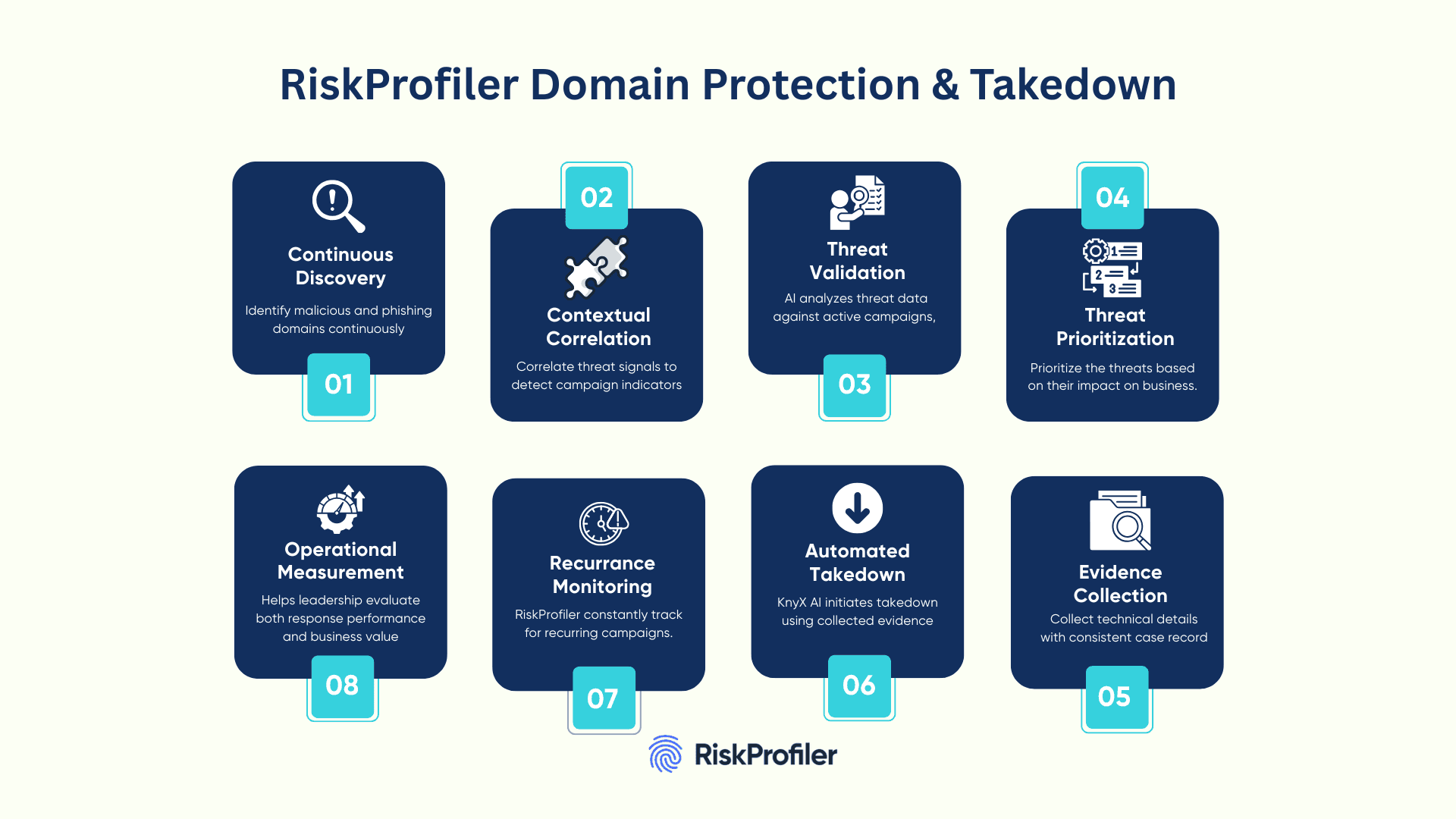
Continuous Domain Discovery: The domain protection platform continuously monitors for signals of brand abuse by identifying suspicious, lookalike, phishing, and domain impersonations, while typosquatting detection helps surface variations that could misdirect customers or employees. Early domain monitoring reduces the time malicious assets and domains can stay active without investigation, significantly reducing prolonged exposure.
AI Investigation & Contextual Correlation: The platform assigns the KnyX Domain Protection agent to investigate malicious domains by correlating DNS, certificate, hosting, webpage, email, and threat intelligence signals. This context helps teams distinguish passive registrations from cloned pages, phishing indicators, brand misuse, and actively weaponized infrastructure. Better evidence can shorten validation time and support more defensible severity decisions.
Domain Threat Validation: Once the domain impersonation monitoring tool correlates the identified threat signals, RiskProfiler’s KnyX domain protection agent analyzes this context to distinguish inactive registrations from configured domains being actively weaponized in phishing and similar brand impersonation attacks for credential theft, malware delivery, reputational damage, or other similar adversary campaigns, reducing false positives and time spent on manual investigation.
Severity-Based Threat Prioritization: RiskProfiler evaluates indicators such as cloned login pages, credential collection, malware delivery, email infrastructure, certificate issuance, customer exposure, and re-emergence of threat campaigns. This helps security teams prioritize critical cases while continuing to monitor lower-confidence threats.
Centralized Evidence Collection: Centralized evidence and case management reduce manual investigation, the chance of duplication across workflows, and fragmented communication while improving takedown efficiency. RiskProfiler collects screenshots, URLs, DNS records, certificates, hosting details, WHOIS data, timestamps, and webpage indicators with a consistent case record.
Automated Takedown: The RiskProfiler digital risk protection platform uses configuration workflows to create cases, route approvals, identify relevant intermediaries, prepare abuse notifications, initiate domain takedown protocol or other enforcement workflows, and track response. AI-powered validation and workflow automation remove delays between discovery and takedown initiation.
Recurrence Monitoring: RiskProfiler brand protection platform tracks each case from discovery through takedown and verifies whether the disruption was successfully implemented. Continued domain impersonation monitoring identifies domain reactivation, hosting migration, phishing replicas, and repeat brand abuse campaigns connected to previously observed infrastructure,
Operational and Executive Measurement: Centralized operational dashboards can measure detection, validation, submission, disruption, exposure reduction, recurrence, and analyst effort. This allows leadership to evaluate both response performance and business value while recognizing dependencies outside the organization’s direct control.
Faster Disruption Turns Domain Protection Into Measurable Value
Domain protection becomes strategically meaningful when organizations move beyond takedown counts. An advanced domain protection platform focuses on how quickly threats are found, how accurately they are prioritized, how long exposure persists, how much effort remediation requires, and whether attackers return.
RiskProfiler helps organizations operationalize this approach across discovery, investigation, enforcement, verification, and reporting. Explore how RiskProfiler can help your team measure and improve domain protection outcomes across the complete abuse-disruption lifecycle.
Malicious domains remain operational while security teams detect the threat, validate hostile intent, preserve evidence, obtain internal approval, contact intermediaries, and pursue enforcement. During that interval, attackers may continue collecting credentials, redirecting customers, distributing malware, or facilitating payment fraud.
Counting completed takedowns captures activity, but not the full business impact. Ten parked domains removed are not equivalent to disrupting one active credential-harvesting site. Effective domain protection must therefore measure response speed, severity, exposure, operational effort, and prevented harm in order to understand the resulting reduction in campaign exposure and impact.
Key Takeaways
Track mean time to detect, validation time, submission time, mean time to takedown, recurrence, exposure, and analyst effort.
Faster disruption reduces the number of hours during which customers and employees can encounter malicious infrastructure.
Severity-based prioritization directs resources toward weaponized domains with the greatest potential impact.
A defined SLA framework separates internally controlled response stages from third-party enforcement dependencies.
ROI can be estimated through avoided fraud exposure, lower response costs, saved analyst time, and preserved trust.
RiskProfiler supports the domain lifecycle from discovery and validation through escalation, verification, and recurrence monitoring.
The End-to-End Domain Disruption and Takedown Workflow
Responding to a malicious domain may require domain disruption, takedown, or a coordinated combination of both. Disruption focuses on quickly limiting the domain’s ability to cause harm, while takedown seeks formal removal or suspension through the relevant service providers. Understanding this distinction helps security teams select the fastest and most appropriate response for each case.
What Is Domain Disruption?
Domain disruption involves actions that reduce access to, trust in, or functionality of malicious infrastructure, even when the domain itself has not been removed. Disruption is typically prioritized when a domain is actively collecting credentials, distributing malware, facilitating payment fraud, or targeting customers and employees. Its purpose is to reduce immediate exposure while formal enforcement continues.
What Is Domain Takedown?
Domain takedown is the formal process of requesting the suspension, cancellation, or removal of a malicious domain or its supporting services. A takedown request normally requires validated evidence, preserved technical artifacts, abuse-policy references, and proof of impersonation or malicious activity. Completion time depends partly on third-party responsiveness, jurisdiction, contractual obligations, and the strength of the submitted evidence.
Domain Disruption vs. Domain Takedown
Area | Domain disruption | Domain takedown |
Primary objective | Rapidly reduce the threat’s reach or functionality | Formally remove or suspend the domain or supporting service |
Typical methods | Domain blocking, content removal, email blocking, hosting suspension, payment-service restriction, and threat-intelligence blocklisting | Registrar or registry suspension, domain cancellation, hosting termination, or formal platform enforcement |
Common use cases | Active phishing, credential theft, malware distribution, payment fraud, or campaigns requiring immediate containment | Confirmed impersonation, policy violations, trademark abuse, persistent phishing infrastructure, or repeat malicious activity |
Trigger point | When credible evidence shows an active or imminent risk that requires rapid containment | When sufficient evidence supports a formal enforcement request |
Dependency | May involve internal controls and external providers | Primarily depends on registrars, registries, hosting providers, platforms, and applicable policies |
Success measure | Reduced accessibility, functionality, traffic, or victim exposure | Verified suspension, cancellation, or removal |
A Threat Severity Model for Domain Protection
Once a threat signal has been successfully detected and validated, the next crucial step is to determine its significance to the overall business operations and risk exposure in order to prioritize the right response. Threat severity should reflect probable impact, evidence confidence, and exposure, not brand similarity alone.
Level | Typical indicators | Response priority |
Critical | Active credential collection, malware delivery, payment fraud, executive impersonation, or a cloned login page with confirmed victim exposure | Immediate validation, evidence preservation, notification, and escalation |
High | Operational cloned site, active email or MX records, issued certificate, strong brand similarity, or infrastructure connected to known campaigns | Expedited investigation and enforcement initiated during the same response cycle |
Medium | Configured or parked lookalike domain with suspicious content, redirects, email capability, or credible indicators of preparation | Investigate promptly and monitor for weaponization |
Low | Newly registered or inactive variation with limited evidence, low similarity, and no active infrastructure | Record, monitor, and reassess when signals change |
Calculating ROI from Faster Domain Takedowns
Domain protection ROI should compare risk-adjusted benefits with the complete cost of operating the program:
ROI (%) = [(Risk-adjusted benefits−Total program cost) ÷ Total program cost] ×100
Risk-adjusted benefits may include estimated fraud losses avoided, incident-response savings, customer-support savings, and monetized analyst time saved. Total program cost should include platform licensing, takedown fees, integrations, implementation, analyst and legal effort, training, workflow maintenance, and program administration.
Teams should also track:
Cost per investigated domain = Program cost ÷ Domains investigated
Cost per successful disruption = Program cost ÷ Verified disruptions
Recurrence rate = (Campaigns recurring within the defined period ÷ campaigns successfully disrupted) ×100
ROI should compare a representative pre-implementation baseline with an equivalent post-implementation period, using consistent definitions and normalizing results for domain volume, severity, and campaign type.
Reports should distinguish verified savings, such as documented reductions in analyst hours or support costs, from modeled avoidance, such as estimated fraud losses prevented. Modeled benefits should use conservative, expected, and upper confidence ranges. Organizations should also disclose attribution limitations and avoid counting the same benefit across multiple categories.
Hypothetical portfolio example: An annual program costs $200,000, investigates 1,000 domains, and produces 200 verified disruptions. The cost is therefore $200 per investigation and $1,000 per successful disruption. If verified savings total $90,000 and $220,000 of modeled avoidance is adjusted to 60% confidence, risk-adjusted benefits equal $222,000. The resulting estimated ROI is 11%.
This model supports investment decisions but does not guarantee that every modeled loss would otherwise have occurred.
How RiskProfiler Strengthens Domain Protection and Takedown ROI
RiskProfiler threat intelligence platform supports an integrated domain protection lifecycle rather than producing isolated alerts. It brings together detection, investigation, validation, enforcement, and monitoring for recurring threat campaigns with its agentic AI-powered workflow, orchestrated by its proprietary model, KnyX AI. This helps CISOs observe a significant reduction in manual delays and takedown bottlenecks, redirect analysts’ focus to high-impact threats, and measure improved outcomes of faster disruption.
Continuous Domain Discovery: The domain protection platform continuously monitors for signals of brand abuse by identifying suspicious, lookalike, phishing, and domain impersonations, while typosquatting detection helps surface variations that could misdirect customers or employees. Early domain monitoring reduces the time malicious assets and domains can stay active without investigation, significantly reducing prolonged exposure.
AI Investigation & Contextual Correlation: The platform assigns the KnyX Domain Protection agent to investigate malicious domains by correlating DNS, certificate, hosting, webpage, email, and threat intelligence signals. This context helps teams distinguish passive registrations from cloned pages, phishing indicators, brand misuse, and actively weaponized infrastructure. Better evidence can shorten validation time and support more defensible severity decisions.
Domain Threat Validation: Once the domain impersonation monitoring tool correlates the identified threat signals, RiskProfiler’s KnyX domain protection agent analyzes this context to distinguish inactive registrations from configured domains being actively weaponized in phishing and similar brand impersonation attacks for credential theft, malware delivery, reputational damage, or other similar adversary campaigns, reducing false positives and time spent on manual investigation.
Severity-Based Threat Prioritization: RiskProfiler evaluates indicators such as cloned login pages, credential collection, malware delivery, email infrastructure, certificate issuance, customer exposure, and re-emergence of threat campaigns. This helps security teams prioritize critical cases while continuing to monitor lower-confidence threats.
Centralized Evidence Collection: Centralized evidence and case management reduce manual investigation, the chance of duplication across workflows, and fragmented communication while improving takedown efficiency. RiskProfiler collects screenshots, URLs, DNS records, certificates, hosting details, WHOIS data, timestamps, and webpage indicators with a consistent case record.
Automated Takedown: The RiskProfiler digital risk protection platform uses configuration workflows to create cases, route approvals, identify relevant intermediaries, prepare abuse notifications, initiate domain takedown protocol or other enforcement workflows, and track response. AI-powered validation and workflow automation remove delays between discovery and takedown initiation.
Recurrence Monitoring: RiskProfiler brand protection platform tracks each case from discovery through takedown and verifies whether the disruption was successfully implemented. Continued domain impersonation monitoring identifies domain reactivation, hosting migration, phishing replicas, and repeat brand abuse campaigns connected to previously observed infrastructure,
Operational and Executive Measurement: Centralized operational dashboards can measure detection, validation, submission, disruption, exposure reduction, recurrence, and analyst effort. This allows leadership to evaluate both response performance and business value while recognizing dependencies outside the organization’s direct control.
Faster Disruption Turns Domain Protection Into Measurable Value
Domain protection becomes strategically meaningful when organizations move beyond takedown counts. An advanced domain protection platform focuses on how quickly threats are found, how accurately they are prioritized, how long exposure persists, how much effort remediation requires, and whether attackers return.
RiskProfiler helps organizations operationalize this approach across discovery, investigation, enforcement, verification, and reporting. Explore how RiskProfiler can help your team measure and improve domain protection outcomes across the complete abuse-disruption lifecycle.
Jump to
Share Article
We Have Answers!
Explore our FAQ to learn more about how RiskProfiler can help safeguard your digital assets and manage risks efficiently.
What is domain protection?
Domain protection is the continuous process of discovering, assessing, monitoring, and disrupting domains that misuse an organization’s brand, identity, infrastructure, or customer trust.
How is time to takedown measured?
Mean time to takedown typically runs from threat detection to verified disruption. Organizations should also measure detection, validation, submission, external waiting, and verification separately to identify bottlenecks.
What affects how quickly a malicious domain can be removed?
Timing depends on threat severity, evidence quality, internal approvals, intermediary responsiveness, applicable policies, hosting arrangements, jurisdiction, and whether the abuse spans multiple service providers.
How can organizations calculate domain takedown ROI?
Organizations can estimate avoided fraud exposure, response costs, analyst effort, support volume, and trust impact, then subtract operating costs. Inputs should use internal data and clearly stated assumptions.
Which metrics should CISOs report to leadership?
Useful metrics include critical-case exposure time, median and percentile takedown times, SLA attainment, exposure hours eliminated, estimated avoided loss, recurrence rates, third-party delays, and analyst effort.
How does RiskProfiler support malicious-domain detection and takedowns?
RiskProfiler discovers suspicious domains, correlates technical and threat signals, supports validation and prioritization, centralizes evidence, coordinates enforcement workflows, verifies disruption, monitors recurrence, and reports performance across the lifecycle.
Latest Insights
Stay informed with expert perspectives on cybersecurity, attack surface management,
and building digital resilience.


Enterprise-Grade Security & Trust
Specialized intelligence agents working together toprotect your organization
Ready to Transform
Your Threat Management?
Join hundreds of security teams who trust KnyX to cut through the noise and focus on what matters most.
Book a Demo Today