
Top 5 Online Brand Protection Companies in USA to Safeguard Your Brand in 2026
Top 5 Online Brand Protection Companies in USA to Safeguard Your Brand in 2026
Brand reputation suffers every time a fake one goes live. Explore the top 5 brand protection services in 2026 with their key features, pros, and cons.
Read Time
7 min read
Posted On
Social Media
In the todays’ day and age, cyber breach or an account takeover is not the only concern of enterprise security teams or the Managed Security Service Providers. At a time, when social media perception and overall public relation determines who wins the ultimate brand faceoff, securing your brand image against adversary and phishing threats requires equal attention, if not more. Brand impersonation, counterfeit listings, and phishing pages now operate at machine speed, and every fake listing that stays live diverts revenue. Online brand protection companies help brands detect and disrupt these threats at scale. This guide covers the top 5 in 2026, key features, and how to choose the right platform.
At a Glance
RiskProfiler: Digital brand protection, dark web monitoring, and external threat exposure management
Red Points: Marketplace counterfeit enforcement
BrandShield: AI-driven digital risk intelligence
Cyble: AI-driven dark web monitoring and threat intelligence
ZeroFox: Social media and executive protection
What are Online Brand Protection Companies and Why Do Brands Need Them?
Online brand protection companies detect and remove counterfeit listings, phishing domains, fake social accounts, cloned websites, and trademark abuse across marketplaces, social media, app stores, paid ads, and domains. Modern platforms combine AI-driven brand risk detection, dark web monitoring, threat intelligence, and automated takedowns to reduce customer fraud and revenue loss at scale.
US brands can no longer treat brand abuse as isolated infringement. The FBI's Internet Crime Complaint Center (IC3) reported $16.6 billion in cybercrime losses across the United States in 2024, a 33% year-over-year increase, with phishing topping the most reported crime category.
Additionally, US Customs and Border Protection (CBP) seized counterfeit goods with a total MSRP of $5.4 billion in FY 2024, a 95% jump from FY 2023. American enterprises now need continuous monitoring and rapid enforcement across every major digital channel.
Key Features to Look for When Choosing Brand Protection Tools
The best brand protection platforms run continuous AI detection across every digital channel and automate takedowns at scale. Coverage spans marketplaces, social media platforms, app stores, paid ads, domains, dark web sources, and integrations like SIEM and SOAR.
The capabilities below define enterprise-grade brand protection software:
AI-powered detection: An enterprise-standard brand protection tool should have an AI integration to provide the optimal benefits, like continuous, comprehensive threat scanning, automated analysis, contextual prioritization, and streamlined takedown workflows.
Feature Depth: The engine must run image recognition, logo matching, behavioral analysis, NLP, and OCR. Predictive models should flag fake listings, cloned sites, and brand impersonation in real time.
Marketplace coverage: Enforcement must extend across domestic and international marketplaces, surface web, deep and dark web forums, underground marketplaces, and social media platforms for comprehensive protection against brand threats.
Social media and app store monitoring: The platform must scan social media platforms like Instagram, TikTok, LinkedIn, Facebook, along with application marketplaces Google Play and the App Store. It should remove fake accounts, rogue apps, targeted attacks, and impersonation campaigns targeting customers and executives.
Automated takedowns: Look for direct API connections to registrars, marketplaces, and ad networks. DMCA, UDRP, and platform-native workflows should be streamlined at the earliest possible..
Dark web monitoring: Coverage extends to TOR sites, ransomware infrastructure, Telegram channels, paste sites, and stealer logs. The goal is to catch leaked credentials, stolen brand assets, and brand mentions tied to counterfeit networks before attackers act.
Domain protection: Typosquat detection, lookalike domain monitoring, and DNS abuse alerts catch fake domains early. They deliver phishing protection by stopping customers from entering credentials on cloned login pages.
Security stack integration: Native connectors for SIEM (Splunk, Sentinel), SOAR, Jira, ServiceNow, and Slack are non-negotiable. Brand protection must plug into existing digital risk protection workflows, not run as a siloed dashboard.
Top 5 Brand Protection Services and Digital Risk Protection Providers in USA
Counterfeit marketplaces, phishing domains, fake mobile apps, impersonation campaigns, and AI-generated scams continue to expand across digital channels in 2026. The firms listed below provide specialized online brand protection capabilities for enterprise organizations, ranging from trademark enforcement to phishing disruption, dark web intelligence, and more.
Platform | Best At | Standout Capability |
RiskProfiler | Unified external threat intelligence | Unified external threat intelligence and digital brand protection |
Red Points | Marketplace counterfeit enforcement | Unlimited takedowns with strong Chinese marketplace coverage |
BrandShield | Digital risk intelligence | AI.ClusterX threat actor mapping |
Cyble | AI-native digital risk protection | AI-driven dark web monitoring and external threat intelligence |
ZeroFox | Social media protection | Executive impersonation and social threat intelligence |
1. RiskProfiler
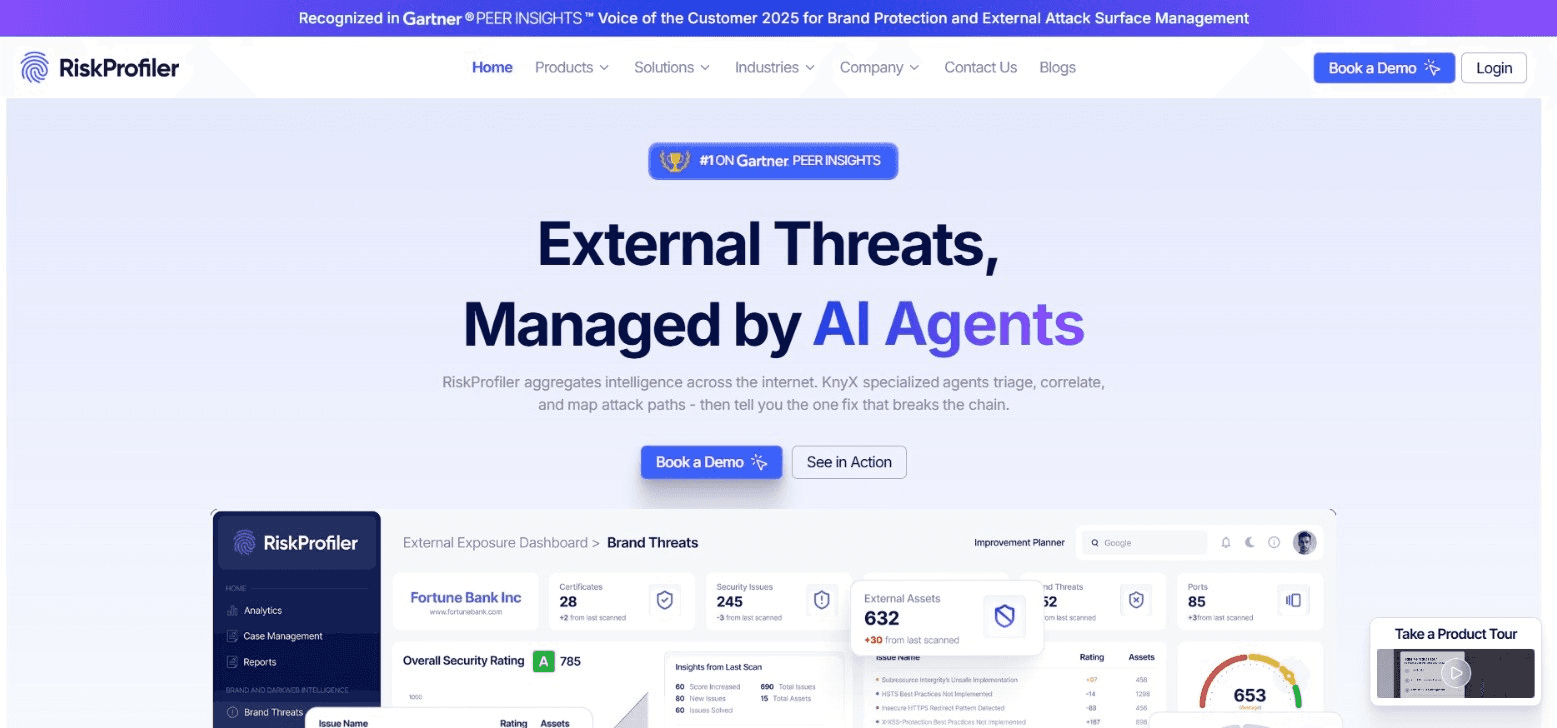
RiskProfiler delivers AI-driven brand protection and external threat intelligence through KnyX, its agentic AI-powered threat intelligence engine. KnyX Brand AI combines external attack surface monitoring with dark web scanning, monitors more than 365 million domains hourly, and tracks more than 5 million dark web signals daily. The agentic AI platform supports 500+ enterprises globally, maintains SOC 2 and ISO 27001 certifications, and aligns with GDPR requirements.
Company Overview
Founded: 2019
Headquarters: Rock Hill, South Carolina, USA
Employees: 51–200
Certifications: SOC 2, ISO 27001, GDPR
Recognition: Gartner Peer Insights #1 Brand Protection Software (4.9/5)
Key Features:
KnyX Brand AI: Agentic AI engine that uses NLP, behavioral analysis, fingerprinting, and threat intelligence correlation to identify the highest-impact remediation action across active external threats.
Integrated Enforcement Workflows: Built-in UDRP and DMCA workflow management.
Dark Web Monitoring: Continuously monitors dark web forums, stealer logs, breach dumps, and underground channels to detect leaked credentials, exposed PII, and impersonation activity involving personal or brand-related information.
Cross-Channel Threat Detection: RiskProfiler Brand Protection detects typosquatting domains, cloned websites, fake mobile apps, social media impersonation, deepfake content, impersonation infrastructure, and fraudulent paid ads.
Pros
Uses NLP and behavioral analysis for impersonation and deep fake detection.
Native integrations with Slack, Jira, Salesforce, Splunk, and ServiceNow.
SOC 2, ISO 27001, and GDPR alignment support enterprise compliance requirements.
Cons
Enterprise pricing requires custom engagement.
Feature depth is optimized for mid-market and enterprise security operations.
Recommended For: CISOs and enterprise security teams needing rapid deployment, unified threat intelligence, and AI-prioritized brand protection.
Book a demo with RiskProfiler to identify phishing domains, impersonation campaigns, counterfeit activity, and other brand threats targeting your organization.
2. Red Points
Founded in 2011 with headquarters in Barcelona and New York City, Red Points provides AI-driven brand protection for enterprise e-commerce brands. The platform monitors marketplaces, social platforms, paid ads, and domains, with notable enforcement coverage across domestic Chinese ecosystems, including Pinduoduo, Goofish, WeChat, and Douyin.
Company Overview
Founded: 2011
Headquarters: Barcelona
Employees: 201–500
Certifications: B Corp Certified
Recognition: AWS Rising Star Technology Partner of the Year 2025
Key Features:
Unlimited Takedowns: Flat-fee enforcement model without per-removal pricing.
Multi-Channel AI Detection: Detects infringement across marketplaces, social media, domains, and paid ads.
Chinese Marketplace Coverage: Supports enforcement across Pinduoduo, Goofish, WeChat, and Douyin.
Revenue Recovery Program: Measures recovered revenue tied to enforcement actions.
Pros
Unlimited takedowns prevent billing spikes during large infringement surges.
Rare domestic Chinese marketplace enforcement coverage.
Dedicated onboarding and customer success management.
Cons
Higher pricing than SMB-focused competitors.
Trademark registration is handled through external legal partners.
Recommended For: Enterprise e-commerce brands facing high-volume counterfeiting across Chinese and global marketplaces.
3. BrandShield
BrandShield, founded in 2014 and headquartered in Tel Aviv, provides AI-powered digital risk and brand protection for finance, retail, e-commerce, and pharmaceutical organizations. The platform is recognized for AI.ClusterX, a proprietary threat intelligence engine that identifies related threat infrastructure and actor patterns across marketplaces, social platforms, paid ads, dark web sources, and mobile apps.
Company Overview
Founded: 2013
Headquarters: Herzliya
Employees: 51–200
Certifications: Not publicly disclosed
Recognition: 2025 Cybersecurity Breakthrough Award – XDR Innovation of the Year
Key Features:
AI.ClusterX Threat Mapping: Identifies related threat infrastructure and actor patterns across digital channels.
Broad Digital Risk Coverage: Monitors marketplaces, social media, paid ads, dark web sources, and fake mobile apps.
Real-Time Fraud Alerts: Detect counterfeit listings, impersonation profiles, and scam infrastructure.
Threat Hunting Support: Analyst-led investigation and escalation assistance for active threats.
Pros
Proprietary AI clustering surfaces coordinated threat activity.
Strong verified review presence on G2.
Mobile-accessible dashboard supports remote monitoring.
Cons
Enforcement volume is restricted by subscription tier.
Chinese marketplace coverage not publicly validated.
Recommended For: Regulated enterprise brands needing threat actor intelligence beyond standard counterfeit enforcement.
4. Cyble
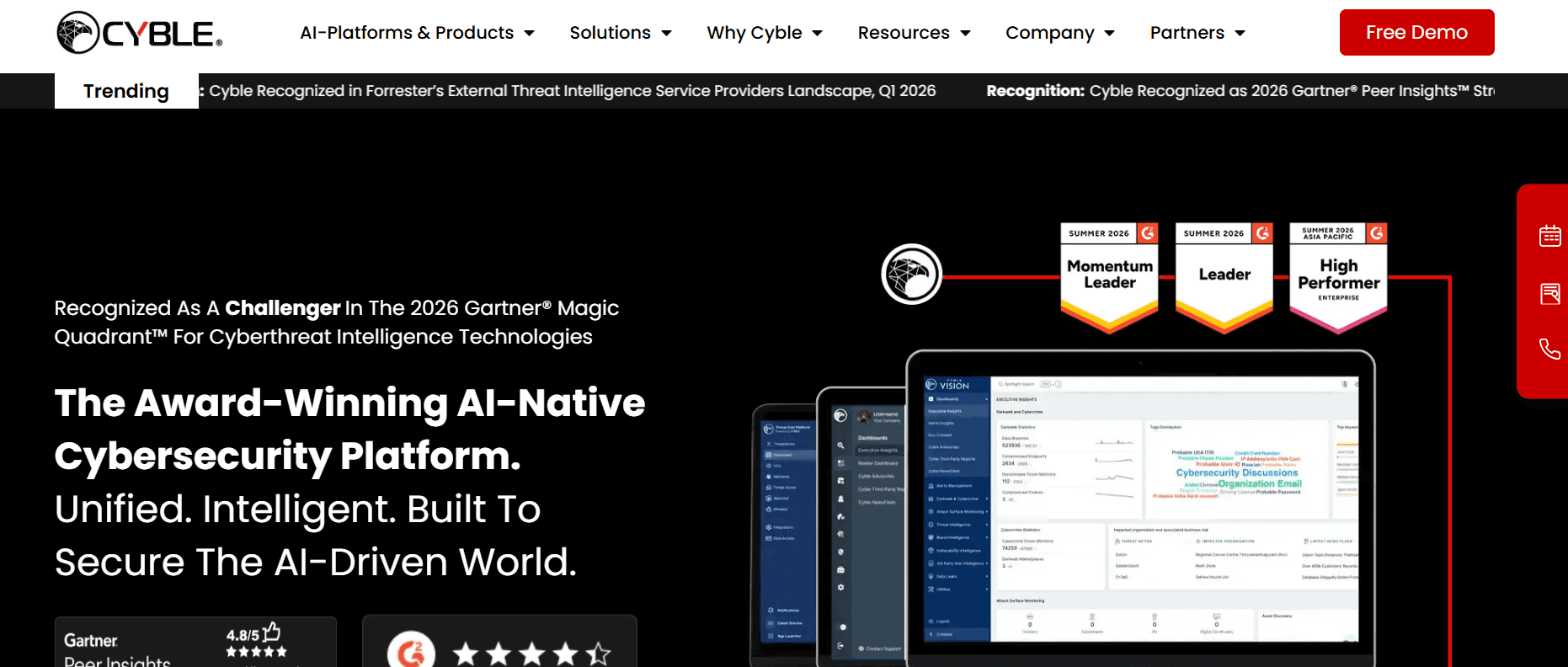
Founded in 2019, Cyble provides AI-driven cyber threat intelligence and digital risk protection for enterprise and government organizations. The platform combines dark web intelligence, external attack surface monitoring, phishing detection, and brand impersonation monitoring to identify exposed credentials, malicious infrastructure, fake domains, and online fraud activity across digital channels.
Company Overview
Founded: 2019
Headquarters: Cupertino, California, USA (India operations: Bengaluru and Mumbai)
Employees: 201–500
Certifications: SOC 2 Type II; ISO/IEC 27001
Recognition: Challenger, Gartner Magic Quadrant™ for Cyberthreat Intelligence Technologies 2026
Key Features:
Dark Web Monitoring: Tracks exposed credentials, stealer logs, breach dumps, ransomware leak sites, and underground threat actor activity.
Brand Intelligence Protection: Detects phishing domains, impersonation campaigns, fake social media accounts, and fraudulent digital assets.
Attack Surface Monitoring: Identifies exposed internet-facing assets, typosquatted domains, and external vulnerabilities linked to organizational risk.
Enterprise Integrations: Integrates with Splunk, Microsoft Sentinel, ServiceNow, Slack, and SOAR platforms.
Pros
Strong dark web intelligence and threat exposure visibility.
Combines digital risk protection with external attack surface monitoring.
Broad enterprise integration support across security operations workflows.
Cons
Marketplace counterfeit enforcement is less extensive than the dedicated brand protection vendors.
Enterprise-focused workflows may require experienced security teams for full operational use.
Recommended For: Enterprise security teams needing dark web intelligence, phishing detection, brand impersonation monitoring, and external threat visibility across digital environments.
5. ZeroFox
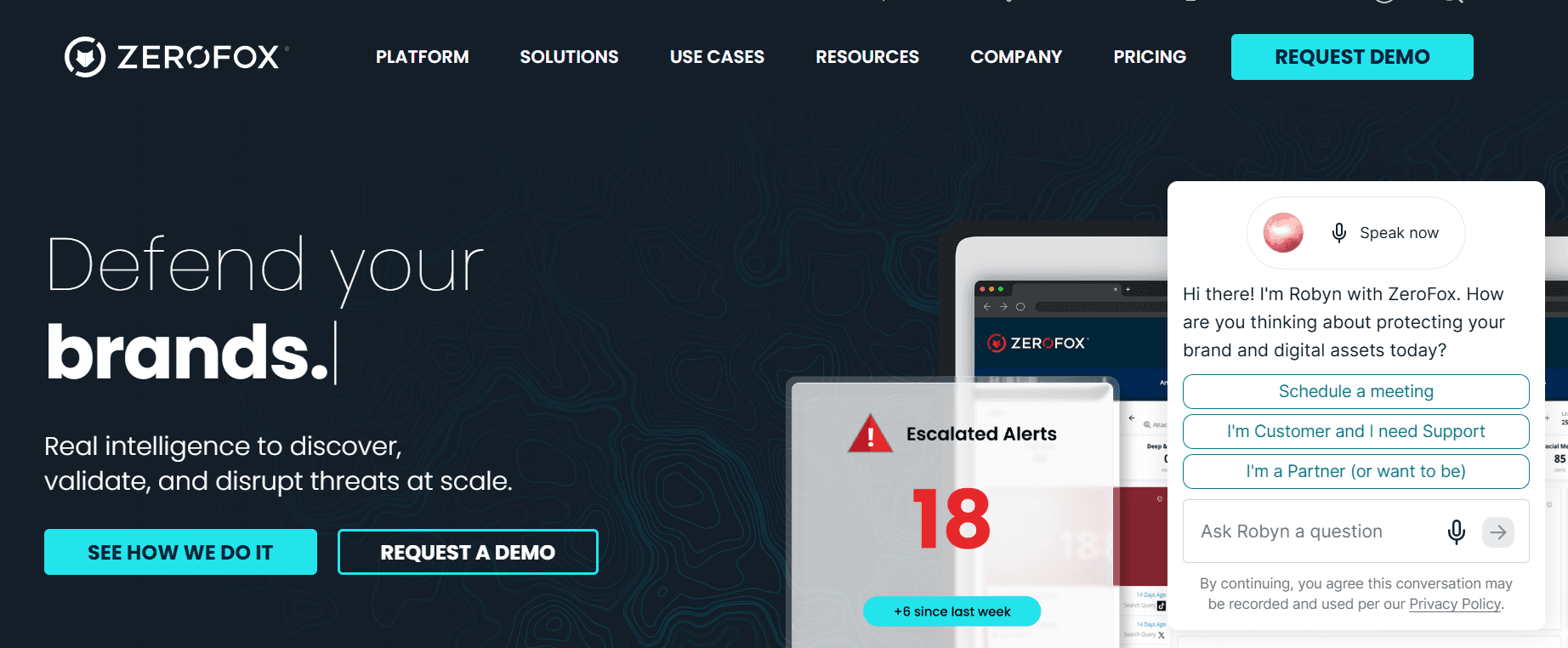
ZeroFox (NASDAQ: ZFOX) is a publicly traded external cybersecurity and digital risk protection company headquartered in Baltimore. The platform focuses on social media threat intelligence, executive protection, phishing detection, and external attack surface monitoring, combining brand protection capabilities with broader digital risk protection and External Attack Surface Management (EASM).
Company Overview
Founded: 2013
Headquarters: Baltimore
Employees: 501–1,000
Certifications: SOC 1, SOC 2 Type II
Recognition: $14M FBI social media intelligence contract (2020)
Key Features:
Social Media Threat Monitoring: Detects impersonation, phishing, and fraudulent activity across Facebook, LinkedIn, X, and Instagram.
Account Protection: Monitors compromise risks targeting brand-owned social media accounts.
Dark Web Intelligence: Tracks leaked credentials, phishing infrastructure, and underground threat activity.
Executive Protection: Identifies executive impersonation campaigns and targeted social engineering threats.
Pros
Strong visibility across major social media platforms.
Combines brand protection with broader digital risk monitoring.
Flexible enterprise protection modules and integrations.
Cons
Takedown operations involve analyst-driven workflows.
Marketplace counterfeit enforcement is less extensive than that of dedicated brand protection platforms.
Recommended For: Enterprise security teams managing social media abuse, phishing exposure, and executive impersonation risks.
Also Read: Top 5 Online Brand Protection Companies in India (2026)
How to Choose the Right Online Brand Protection Company?
The right brand protection solution matches your industry, your threat surface, and your team's capacity. Evaluate coverage, pricing, managed-service depth, and proof of takedown success. Stress-test scalability against peak volume before signing.
The factors below help decide which brand protection solution fits your brand protection needs:
Match the vendor to your industry: Pharma needs counterfeit drug enforcement and intellectual property protection. Luxury needs gray market control and offline raids. E-commerce needs marketplace muscle. SaaS and finance need phishing protection, fake ads protection, and executive impersonation defense.
Map your threat surface first: Focus only on the channels where your brand faces real exposure. Brands working in open marketplaces should prioritize counterfeit listings and fake product ads across platforms like Amazon, Alibaba, and Temu. Enterprises dealing in industries frequently targeted by phishing attacks should focus on domain monitoring and DNS-layer protection. Social-first brands should prioritize scam detection and impersonation protection across Instagram, TikTok, and Facebook.
Match pricing to volume: Subscription pricing offers predictable costs, while pay-per-takedown models can become expensive during infringement spikes. Flat-fee unlimited models absorb surges better, whereas SOW and tiered engagements typically cap analyst hours. Pick the platform that survives a festive/occasional infringement wave and supports long-term brand protection.
Pick managed or self-operated: Lean teams often prefer fully managed services, while mature IP or security operations teams may choose self-operated platforms. Ask the vendor which variation they sell.
Demand proof: Check ratings on G2, Gartner Peer Insights, software review platforms, and measurable performance metrics. Focus on the number of takedowns per month, success rate, time-to-detection and removal, and revenue recovered.
Test global reach: Global brands should prioritize multi-language support and 24/7 monitoring coverage. The best practice is always to join a POC to test the platform and its usability against your practical needs before signing up.
Conclusion: Why Is RiskProfiler’s Brand Protection Solution Important for Modern Businesses?
Brand abuse can affect customer trust, revenue, and brand reputation across marketplaces, social media platforms, domains, search engines, and mobile app stores. As counterfeit listings, phishing campaigns, and impersonation attacks continue to grow, organizations need visibility into threats that exist outside their corporate network. When evaluating online brand protection companies, organizations should prioritize broad digital coverage, automated enforcement, dark web monitoring, and integrations that support existing security and risk management workflows.
RiskProfiler online brand protection platform provides comprehensive support across all these categories. Its Agentic AI-powered module, KnyX Brand AI, combines brand protection, dark web monitoring, takedown management, and external threat intelligence to help organizations identify, validate, prioritize, and take down digital threats across surface, social media, and dark web channels.
Explore how RiskProfiler enables proactive online brand protection and streamlines brand abuse takedown with a personalized demo.
In the todays’ day and age, cyber breach or an account takeover is not the only concern of enterprise security teams or the Managed Security Service Providers. At a time, when social media perception and overall public relation determines who wins the ultimate brand faceoff, securing your brand image against adversary and phishing threats requires equal attention, if not more. Brand impersonation, counterfeit listings, and phishing pages now operate at machine speed, and every fake listing that stays live diverts revenue. Online brand protection companies help brands detect and disrupt these threats at scale. This guide covers the top 5 in 2026, key features, and how to choose the right platform.
At a Glance
RiskProfiler: Digital brand protection, dark web monitoring, and external threat exposure management
Red Points: Marketplace counterfeit enforcement
BrandShield: AI-driven digital risk intelligence
Cyble: AI-driven dark web monitoring and threat intelligence
ZeroFox: Social media and executive protection
What are Online Brand Protection Companies and Why Do Brands Need Them?
Online brand protection companies detect and remove counterfeit listings, phishing domains, fake social accounts, cloned websites, and trademark abuse across marketplaces, social media, app stores, paid ads, and domains. Modern platforms combine AI-driven brand risk detection, dark web monitoring, threat intelligence, and automated takedowns to reduce customer fraud and revenue loss at scale.
US brands can no longer treat brand abuse as isolated infringement. The FBI's Internet Crime Complaint Center (IC3) reported $16.6 billion in cybercrime losses across the United States in 2024, a 33% year-over-year increase, with phishing topping the most reported crime category.
Additionally, US Customs and Border Protection (CBP) seized counterfeit goods with a total MSRP of $5.4 billion in FY 2024, a 95% jump from FY 2023. American enterprises now need continuous monitoring and rapid enforcement across every major digital channel.
Key Features to Look for When Choosing Brand Protection Tools
The best brand protection platforms run continuous AI detection across every digital channel and automate takedowns at scale. Coverage spans marketplaces, social media platforms, app stores, paid ads, domains, dark web sources, and integrations like SIEM and SOAR.
The capabilities below define enterprise-grade brand protection software:
AI-powered detection: An enterprise-standard brand protection tool should have an AI integration to provide the optimal benefits, like continuous, comprehensive threat scanning, automated analysis, contextual prioritization, and streamlined takedown workflows.
Feature Depth: The engine must run image recognition, logo matching, behavioral analysis, NLP, and OCR. Predictive models should flag fake listings, cloned sites, and brand impersonation in real time.
Marketplace coverage: Enforcement must extend across domestic and international marketplaces, surface web, deep and dark web forums, underground marketplaces, and social media platforms for comprehensive protection against brand threats.
Social media and app store monitoring: The platform must scan social media platforms like Instagram, TikTok, LinkedIn, Facebook, along with application marketplaces Google Play and the App Store. It should remove fake accounts, rogue apps, targeted attacks, and impersonation campaigns targeting customers and executives.
Automated takedowns: Look for direct API connections to registrars, marketplaces, and ad networks. DMCA, UDRP, and platform-native workflows should be streamlined at the earliest possible..
Dark web monitoring: Coverage extends to TOR sites, ransomware infrastructure, Telegram channels, paste sites, and stealer logs. The goal is to catch leaked credentials, stolen brand assets, and brand mentions tied to counterfeit networks before attackers act.
Domain protection: Typosquat detection, lookalike domain monitoring, and DNS abuse alerts catch fake domains early. They deliver phishing protection by stopping customers from entering credentials on cloned login pages.
Security stack integration: Native connectors for SIEM (Splunk, Sentinel), SOAR, Jira, ServiceNow, and Slack are non-negotiable. Brand protection must plug into existing digital risk protection workflows, not run as a siloed dashboard.
Top 5 Brand Protection Services and Digital Risk Protection Providers in USA
Counterfeit marketplaces, phishing domains, fake mobile apps, impersonation campaigns, and AI-generated scams continue to expand across digital channels in 2026. The firms listed below provide specialized online brand protection capabilities for enterprise organizations, ranging from trademark enforcement to phishing disruption, dark web intelligence, and more.
Platform | Best At | Standout Capability |
RiskProfiler | Unified external threat intelligence | Unified external threat intelligence and digital brand protection |
Red Points | Marketplace counterfeit enforcement | Unlimited takedowns with strong Chinese marketplace coverage |
BrandShield | Digital risk intelligence | AI.ClusterX threat actor mapping |
Cyble | AI-native digital risk protection | AI-driven dark web monitoring and external threat intelligence |
ZeroFox | Social media protection | Executive impersonation and social threat intelligence |
1. RiskProfiler
RiskProfiler delivers AI-driven brand protection and external threat intelligence through KnyX, its agentic AI-powered threat intelligence engine. KnyX Brand AI combines external attack surface monitoring with dark web scanning, monitors more than 365 million domains hourly, and tracks more than 5 million dark web signals daily. The agentic AI platform supports 500+ enterprises globally, maintains SOC 2 and ISO 27001 certifications, and aligns with GDPR requirements.
Company Overview
Founded: 2019
Headquarters: Rock Hill, South Carolina, USA
Employees: 51–200
Certifications: SOC 2, ISO 27001, GDPR
Recognition: Gartner Peer Insights #1 Brand Protection Software (4.9/5)
Key Features:
KnyX Brand AI: Agentic AI engine that uses NLP, behavioral analysis, fingerprinting, and threat intelligence correlation to identify the highest-impact remediation action across active external threats.
Integrated Enforcement Workflows: Built-in UDRP and DMCA workflow management.
Dark Web Monitoring: Continuously monitors dark web forums, stealer logs, breach dumps, and underground channels to detect leaked credentials, exposed PII, and impersonation activity involving personal or brand-related information.
Cross-Channel Threat Detection: RiskProfiler Brand Protection detects typosquatting domains, cloned websites, fake mobile apps, social media impersonation, deepfake content, impersonation infrastructure, and fraudulent paid ads.
Pros
Uses NLP and behavioral analysis for impersonation and deep fake detection.
Native integrations with Slack, Jira, Salesforce, Splunk, and ServiceNow.
SOC 2, ISO 27001, and GDPR alignment support enterprise compliance requirements.
Cons
Enterprise pricing requires custom engagement.
Feature depth is optimized for mid-market and enterprise security operations.
Recommended For: CISOs and enterprise security teams needing rapid deployment, unified threat intelligence, and AI-prioritized brand protection.
Book a demo with RiskProfiler to identify phishing domains, impersonation campaigns, counterfeit activity, and other brand threats targeting your organization.
2. Red Points
Founded in 2011 with headquarters in Barcelona and New York City, Red Points provides AI-driven brand protection for enterprise e-commerce brands. The platform monitors marketplaces, social platforms, paid ads, and domains, with notable enforcement coverage across domestic Chinese ecosystems, including Pinduoduo, Goofish, WeChat, and Douyin.
Company Overview
Founded: 2011
Headquarters: Barcelona
Employees: 201–500
Certifications: B Corp Certified
Recognition: AWS Rising Star Technology Partner of the Year 2025
Key Features:
Unlimited Takedowns: Flat-fee enforcement model without per-removal pricing.
Multi-Channel AI Detection: Detects infringement across marketplaces, social media, domains, and paid ads.
Chinese Marketplace Coverage: Supports enforcement across Pinduoduo, Goofish, WeChat, and Douyin.
Revenue Recovery Program: Measures recovered revenue tied to enforcement actions.
Pros
Unlimited takedowns prevent billing spikes during large infringement surges.
Rare domestic Chinese marketplace enforcement coverage.
Dedicated onboarding and customer success management.
Cons
Higher pricing than SMB-focused competitors.
Trademark registration is handled through external legal partners.
Recommended For: Enterprise e-commerce brands facing high-volume counterfeiting across Chinese and global marketplaces.
3. BrandShield
BrandShield, founded in 2014 and headquartered in Tel Aviv, provides AI-powered digital risk and brand protection for finance, retail, e-commerce, and pharmaceutical organizations. The platform is recognized for AI.ClusterX, a proprietary threat intelligence engine that identifies related threat infrastructure and actor patterns across marketplaces, social platforms, paid ads, dark web sources, and mobile apps.
Company Overview
Founded: 2013
Headquarters: Herzliya
Employees: 51–200
Certifications: Not publicly disclosed
Recognition: 2025 Cybersecurity Breakthrough Award – XDR Innovation of the Year
Key Features:
AI.ClusterX Threat Mapping: Identifies related threat infrastructure and actor patterns across digital channels.
Broad Digital Risk Coverage: Monitors marketplaces, social media, paid ads, dark web sources, and fake mobile apps.
Real-Time Fraud Alerts: Detect counterfeit listings, impersonation profiles, and scam infrastructure.
Threat Hunting Support: Analyst-led investigation and escalation assistance for active threats.
Pros
Proprietary AI clustering surfaces coordinated threat activity.
Strong verified review presence on G2.
Mobile-accessible dashboard supports remote monitoring.
Cons
Enforcement volume is restricted by subscription tier.
Chinese marketplace coverage not publicly validated.
Recommended For: Regulated enterprise brands needing threat actor intelligence beyond standard counterfeit enforcement.
4. Cyble
Founded in 2019, Cyble provides AI-driven cyber threat intelligence and digital risk protection for enterprise and government organizations. The platform combines dark web intelligence, external attack surface monitoring, phishing detection, and brand impersonation monitoring to identify exposed credentials, malicious infrastructure, fake domains, and online fraud activity across digital channels.
Company Overview
Founded: 2019
Headquarters: Cupertino, California, USA (India operations: Bengaluru and Mumbai)
Employees: 201–500
Certifications: SOC 2 Type II; ISO/IEC 27001
Recognition: Challenger, Gartner Magic Quadrant™ for Cyberthreat Intelligence Technologies 2026
Key Features:
Dark Web Monitoring: Tracks exposed credentials, stealer logs, breach dumps, ransomware leak sites, and underground threat actor activity.
Brand Intelligence Protection: Detects phishing domains, impersonation campaigns, fake social media accounts, and fraudulent digital assets.
Attack Surface Monitoring: Identifies exposed internet-facing assets, typosquatted domains, and external vulnerabilities linked to organizational risk.
Enterprise Integrations: Integrates with Splunk, Microsoft Sentinel, ServiceNow, Slack, and SOAR platforms.
Pros
Strong dark web intelligence and threat exposure visibility.
Combines digital risk protection with external attack surface monitoring.
Broad enterprise integration support across security operations workflows.
Cons
Marketplace counterfeit enforcement is less extensive than the dedicated brand protection vendors.
Enterprise-focused workflows may require experienced security teams for full operational use.
Recommended For: Enterprise security teams needing dark web intelligence, phishing detection, brand impersonation monitoring, and external threat visibility across digital environments.
5. ZeroFox
ZeroFox (NASDAQ: ZFOX) is a publicly traded external cybersecurity and digital risk protection company headquartered in Baltimore. The platform focuses on social media threat intelligence, executive protection, phishing detection, and external attack surface monitoring, combining brand protection capabilities with broader digital risk protection and External Attack Surface Management (EASM).
Company Overview
Founded: 2013
Headquarters: Baltimore
Employees: 501–1,000
Certifications: SOC 1, SOC 2 Type II
Recognition: $14M FBI social media intelligence contract (2020)
Key Features:
Social Media Threat Monitoring: Detects impersonation, phishing, and fraudulent activity across Facebook, LinkedIn, X, and Instagram.
Account Protection: Monitors compromise risks targeting brand-owned social media accounts.
Dark Web Intelligence: Tracks leaked credentials, phishing infrastructure, and underground threat activity.
Executive Protection: Identifies executive impersonation campaigns and targeted social engineering threats.
Pros
Strong visibility across major social media platforms.
Combines brand protection with broader digital risk monitoring.
Flexible enterprise protection modules and integrations.
Cons
Takedown operations involve analyst-driven workflows.
Marketplace counterfeit enforcement is less extensive than that of dedicated brand protection platforms.
Recommended For: Enterprise security teams managing social media abuse, phishing exposure, and executive impersonation risks.
Also Read: Top 5 Online Brand Protection Companies in India (2026)
How to Choose the Right Online Brand Protection Company?
The right brand protection solution matches your industry, your threat surface, and your team's capacity. Evaluate coverage, pricing, managed-service depth, and proof of takedown success. Stress-test scalability against peak volume before signing.
The factors below help decide which brand protection solution fits your brand protection needs:
Match the vendor to your industry: Pharma needs counterfeit drug enforcement and intellectual property protection. Luxury needs gray market control and offline raids. E-commerce needs marketplace muscle. SaaS and finance need phishing protection, fake ads protection, and executive impersonation defense.
Map your threat surface first: Focus only on the channels where your brand faces real exposure. Brands working in open marketplaces should prioritize counterfeit listings and fake product ads across platforms like Amazon, Alibaba, and Temu. Enterprises dealing in industries frequently targeted by phishing attacks should focus on domain monitoring and DNS-layer protection. Social-first brands should prioritize scam detection and impersonation protection across Instagram, TikTok, and Facebook.
Match pricing to volume: Subscription pricing offers predictable costs, while pay-per-takedown models can become expensive during infringement spikes. Flat-fee unlimited models absorb surges better, whereas SOW and tiered engagements typically cap analyst hours. Pick the platform that survives a festive/occasional infringement wave and supports long-term brand protection.
Pick managed or self-operated: Lean teams often prefer fully managed services, while mature IP or security operations teams may choose self-operated platforms. Ask the vendor which variation they sell.
Demand proof: Check ratings on G2, Gartner Peer Insights, software review platforms, and measurable performance metrics. Focus on the number of takedowns per month, success rate, time-to-detection and removal, and revenue recovered.
Test global reach: Global brands should prioritize multi-language support and 24/7 monitoring coverage. The best practice is always to join a POC to test the platform and its usability against your practical needs before signing up.
Conclusion: Why Is RiskProfiler’s Brand Protection Solution Important for Modern Businesses?
Brand abuse can affect customer trust, revenue, and brand reputation across marketplaces, social media platforms, domains, search engines, and mobile app stores. As counterfeit listings, phishing campaigns, and impersonation attacks continue to grow, organizations need visibility into threats that exist outside their corporate network. When evaluating online brand protection companies, organizations should prioritize broad digital coverage, automated enforcement, dark web monitoring, and integrations that support existing security and risk management workflows.
RiskProfiler online brand protection platform provides comprehensive support across all these categories. Its Agentic AI-powered module, KnyX Brand AI, combines brand protection, dark web monitoring, takedown management, and external threat intelligence to help organizations identify, validate, prioritize, and take down digital threats across surface, social media, and dark web channels.
Explore how RiskProfiler enables proactive online brand protection and streamlines brand abuse takedown with a personalized demo.
Jump to
Share Article
We Have Answers!
Explore our FAQ to learn more about how RiskProfiler can help safeguard your digital assets and manage risks efficiently.
What are the top companies for brand protection online in 2026?
RiskProfiler, Red Points, BrandShield, and Corsearch rank among the best digital brand protection providers in 2026. RiskProfiler leads the conversation as one of the best digital brand protection providers with its agentic AI-Powered brand protection solution. It is positioned on the Gartner Peer Insights as the #1 product as per the peer reviews. Red Points is known for marketplace counterfeit enforcement, BrandShield for digital risk protection, and Corsearch for trademark and brand protection services.
How do online brand protection companies remove counterfeits?
Online brand protection companies like RiskProfiler scan online marketplaces using AI image recognition, NLP, behavioral analysis, and keyword detection to identify counterfeit listings. Verified threats trigger automated DMCA and UDRP takedown requests sent directly to platforms and registrars. Most enterprise platforms remove listings within 24 to 48 hours.
How much does brand protection software cost?
Brand protection software costs vary by coverage and vendor. Subscription plans offer predictable fees. Flat-fee unlimited models suit high infringement volume. Pay-per-takedown billing scales with threat count.
What is the difference between brand protection and cybersecurity?
Cybersecurity protects the digital ecosystem, networks, and data from breaches. Brand protection focuses externally, detecting counterfeit listings, phishing domains, and unauthorized use of brand assets across digital platforms. A digital risk protection platform like RiskProfiler bridges both, covering infrastructure and brand identity simultaneously.
Latest Insights
Stay informed with expert perspectives on cybersecurity, attack surface management,
and building digital resilience.



Enterprise-Grade Security & Trust
Specialized intelligence agents working together toprotect your organization
Ready to Transform
Your Threat Management?
Join hundreds of security teams who trust KnyX to cut through the noise and focus on what matters most.
Book a Demo Today