5 Online External Threat Management Companies in the USA (2026)
5 Online External Threat Management Companies in the USA (2026)
Lack of visibility into external assets leads to cyber risk. See how ETM improves detection, prioritization, and prevents costly data breaches.

Read Time
7 min read
Posted On
External Threat Management helps organizations identify and reduce exposure across external attack surfaces through visibility, intelligence, and risk prioritization. This article discusses the top 5 ETM platforms, evaluation criteria, and vendor selection guidance.
At a Glance
RiskProfiler: Unified external threat exposure management
Recorded Future: AI-powered threat intelligence at scale
CrowdStrike Falcon: Unified platform spanning ETM and endpoint
Cyble: External threat exposure monitoring and threat intelligence
ZeroFox: Digital risk protection with active takedowns
What Is External Threat Management?
External Threat Management is a cyber exposure management discipline focused on monitoring the external attack surface and unmanaged digital assets using EASM and real-time threat intelligence. It helps security teams detect vulnerabilities and assess external exposure across cyber environments.
External Threat Management modules enable security teams to prioritize risks using actionable visibility while continuously monitoring internet-facing assets and expanding attack surface exposure.
What Makes Great External Threat Management Solutions?
A strong External Threat Management platform is defined by how effectively it discovers, analyzes, and reduces external exposure across digital environments. It must provide continuous visibility into assets, vulnerabilities, and threat signals while enabling security teams to assess cyber risk and respond to emerging threats in real time.
A high-quality platform is evaluated across three core areas:
Coverage Depth: It should map the full external attack surface, including dark web exposure, brand impersonation, surface web leaks, and supply chain risks. It must continuously discover unmanaged assets and maintain an accurate inventory of internet-facing systems, cloud services, and changes to the digital footprint.
AI and Automation: The tool must convert large volumes of alerts into actionable insights using automated correlation and prioritization. The system should detect vulnerabilities, analyze attack paths, and strengthen threat detection by filtering noise and highlighting real cyber threats that require attention.
Integration and Remediation Workflows: It should support seamless connection with security operations processes to enable faster incident response. It must help security teams prioritize remediation, enforce policy actions, and support takedown workflows to reduce exposure from data leaks, compromised assets, and active threat vectors.
5 Best External Threat Management Vendors in the USA
External Threat Management adoption in the USA continues to grow as organizations seek better visibility into internet-facing assets, unmanaged exposures, and evolving cyber risks across cloud and digital environments. The tools below help security teams find exposed assets, monitor threats, and manage vulnerabilities across cloud and digital environments.
Platform | Best At | Standout Capability |
RiskProfiler | Unified external threat exposure management | Single platform combining EASM, TPRM, brand protection, dark web monitoring, and cyber threat intelligence. It is powered by proprietary KnyX AI for agentic threat correlation and attack path prioritization |
Recorded Future | AI-powered threat intelligence at scale | Intelligence Graph indexes data from 1M+ sources, open web, dark web, and technical feeds, tracking 4,000+ threat actors, including 430 nation-state groups, with real-time risk scoring on every indicator |
CrowdStrike Falcon | Unified platform spanning ETM and endpoint | Threat Graph processes trillions of security events per day, correlating adversary intelligence from 245+ tracked threat groups with live attack surface data through a single cloud-native platform |
Cyble | External threat intelligence and dark web monitoring | Combines EASM, dark web monitoring, digital risk protection, and threat intelligence to help security teams identify exposed assets, leaked credentials, and external cyber threats. |
ZeroFox | Digital risk protection with active takedowns | Executed over 1 million takedowns in a single year via Global Disruption Network across 180+ platforms, with 24/7 human analyst validation covering brand, executive, physical, and dark web threats |
1. RiskProflier
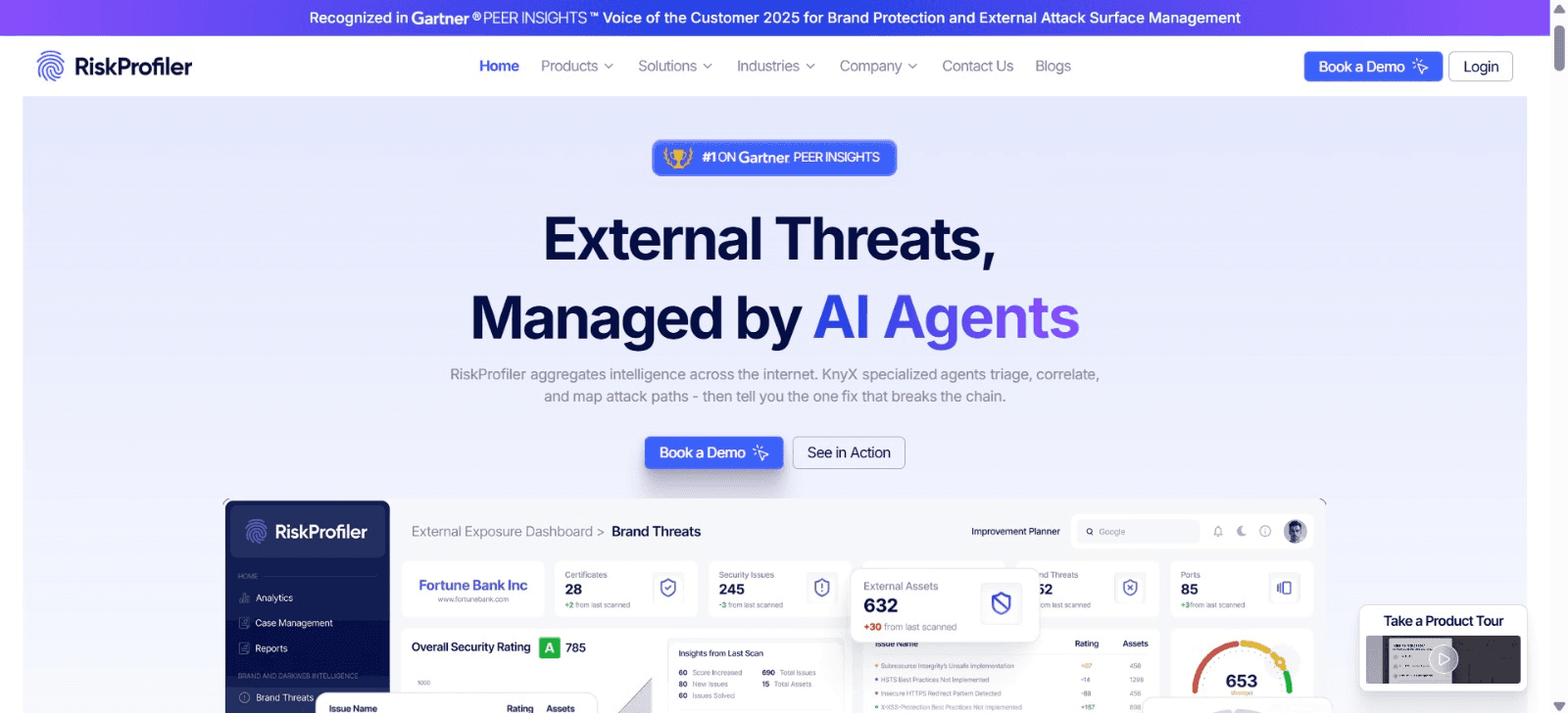
RiskProfiler is an agentic AI-driven external threat exposure management platform that combines EASM, brand protection, dark web monitoring, and third-party risk visibility in a unified system. It uses its KnyX AI engine to support automated external asset discovery, correlate exposure signals, and prioritize external risks across digital environments for security teams.
Company Overview
Founded: 2019
Headquarters: Rock Hill, South Carolina, USA
Employees: 51–200
Certifications: SOC 2, ISO 27001, GDPR
Recognition: #2 External Attack Surface Management (5/5) on Gartner Peer Insights
Key Features:
RiskProfiler External Threat Management Discovery: Identifies domains, IPs, cloud assets, and shadow IT resources to maintain an updated external attack surface inventory.
Dark Web Monitoring: Tracks leaked credentials, exposed data, and threat actor activity across underground forums and breach sources.
Brand Protection and Takedown Workflows: Detects phishing domains, impersonation sites, and supports structured takedown and remediation workflows.
Attack Path Correlation Engine: Correlates relationships between external assets, third-party risks, and brand exposure to prioritize interconnected external risks.
Pros
Unifies multiple external exposure domains into a single operational view.
Provides early visibility into external risks shortly after onboarding.
Helps reduce alert noise through contextual correlation of exposure signals.
Cons
Requires tuning to optimize alert accuracy and workflow relevance.
Full platform capability may require onboarding time across modules.
Recommended For: Mid-market and enterprise security teams seeking a unified external threat and exposure management platform with automation and cost efficiency.
Book a demo to see how RiskProfiler unifies EASM, dark web monitoring, brand protection, and third-party risk to detect exposures and prioritize external threats in real time.
2. Recorded Future
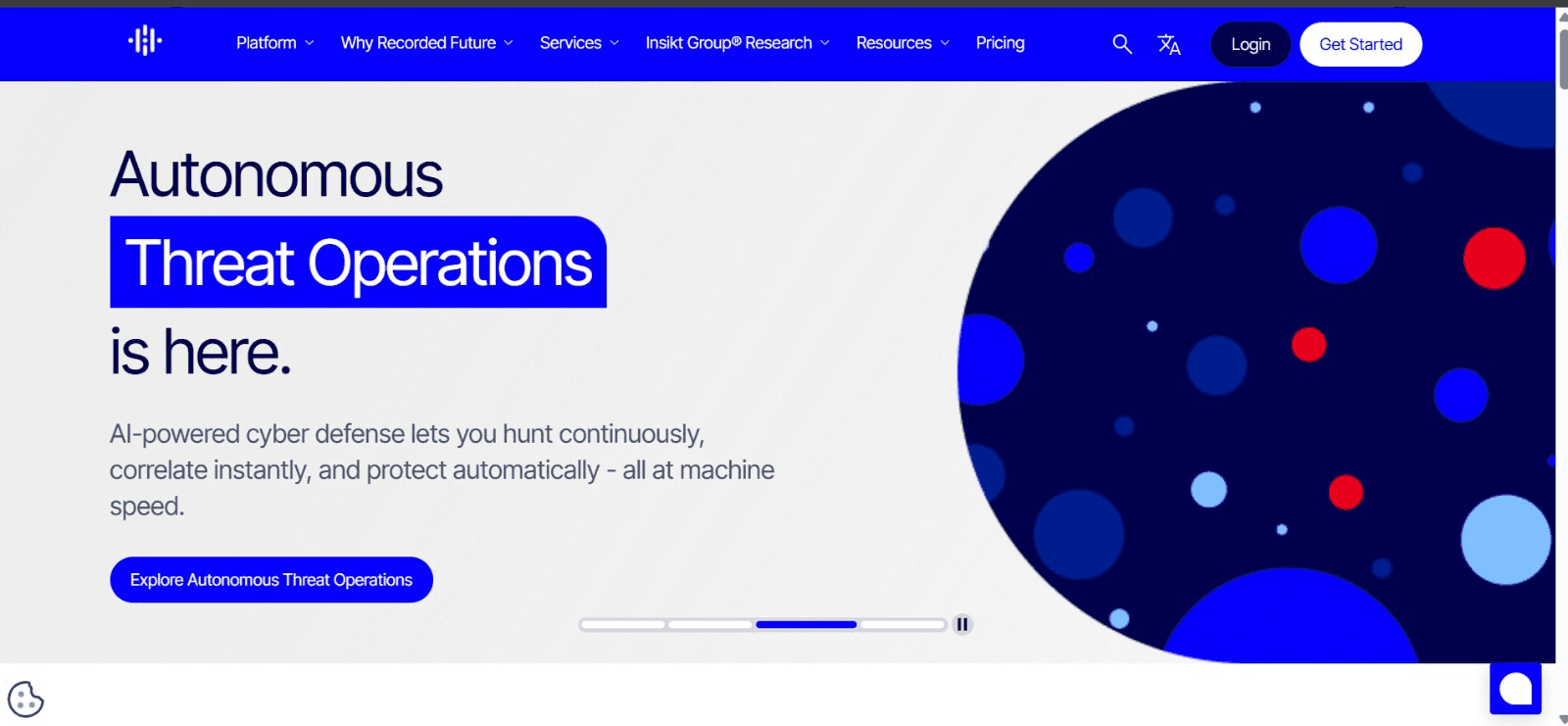
Recorded Future delivers threat intelligence by collecting and analyzing data from open web, dark web, technical sources, and subscription-based feeds. It uses machine learning and NLP to structure and correlate threat data across actors, infrastructure, vulnerabilities, and cyber activity. It enables contextual intelligence for security decision-making and risk analysis.
Company Overview
Founded: 2009
Headquarters: Somerville, Massachusetts, USA
Employees: 1,001–5,000
Certifications: Not publicly disclosed
Recognition: Forrester Wave Leader for External Threat Intelligence Service Providers (2024)
Key Features:
Intelligence Cloud: Aggregates and correlates threat data on actors, infrastructure, vulnerabilities, and targets to provide contextual intelligence for analysis and investigations.
Dark Web Monitoring: Tracks underground forums, leak sites, and marketplaces for exposed data, credentials, and relevant threat activity.
Vulnerability Intelligence: Links vulnerabilities with observed exploitation signals and threat activity to support risk-based remediation prioritization.
External Attack Surface Discovery: Identifies exposed internet-facing assets and unmanaged systems to improve visibility of external exposure.
Pros
Strong coverage of structured threat intelligence across multiple global data sources.
Provides contextual mapping between threats, actors, infrastructure, and vulnerabilities.
Used across enterprise and public sector security environments for intelligence support.
Cons
Capabilities depend on selected modules and licensing scope.
Requires trained analysts for effective interpretation and operational use.
Recommended For: Large enterprises, financial institutions, and government security teams requiring structured threat intelligence and visibility into external exposure and emerging cyber threats
3. CrowdStrike Falcon
CrowdStrike Falcon is a cloud-native cybersecurity platform that combines endpoint protection, threat intelligence, and external exposure capabilities into a unified architecture. It processes large-scale telemetry data to detect threats, track adversaries, and support security operations across endpoint, cloud, and identity environments.
Company Overview
Founded: 2011 (CrowdStrike)
Headquarters: Austin, Texas, USA
Employees: 10,698 worldwide
Certifications: ISO/IEC 27001:2022, 27017, 22301, 42001; SOC 2 Type II; FedRAMP High; DoD Impact Level 5 (IL5); HIPAA; PCI DSS; GDPR; CSA STAR; TX-RAMP
Recognition: Leader, The Forrester Wave™: Attack Surface Management Solutions, Q3 2024
Key Features:
Adversary Intelligence: Tracks named threat actor groups using behavioral analysis and intelligence collected from global threat activity.
External Attack Surface Management: Identifies and monitors externally exposed assets through dedicated attack surface visibility capabilities.
Dark Web and Credential Monitoring: Detects exposed credentials and compromised data linked to external threat activity.
Threat Graph Analytics: Processes large-scale event data to identify patterns, relationships, and potential malicious activity in near real time.
Pros
Consolidates endpoint, cloud, and identity security into a single platform.
Strong adversary tracking supported by human-led threat intelligence analysis.
High detection effectiveness validated through independent security evaluations.
Cons
External threat capabilities require additional licensed modules.
Higher cost compared to many competing security platforms.
Recommended For: Large enterprises needing unified endpoint protection, threat intelligence, and external exposure visibility within a single security platform.
4. Cyble
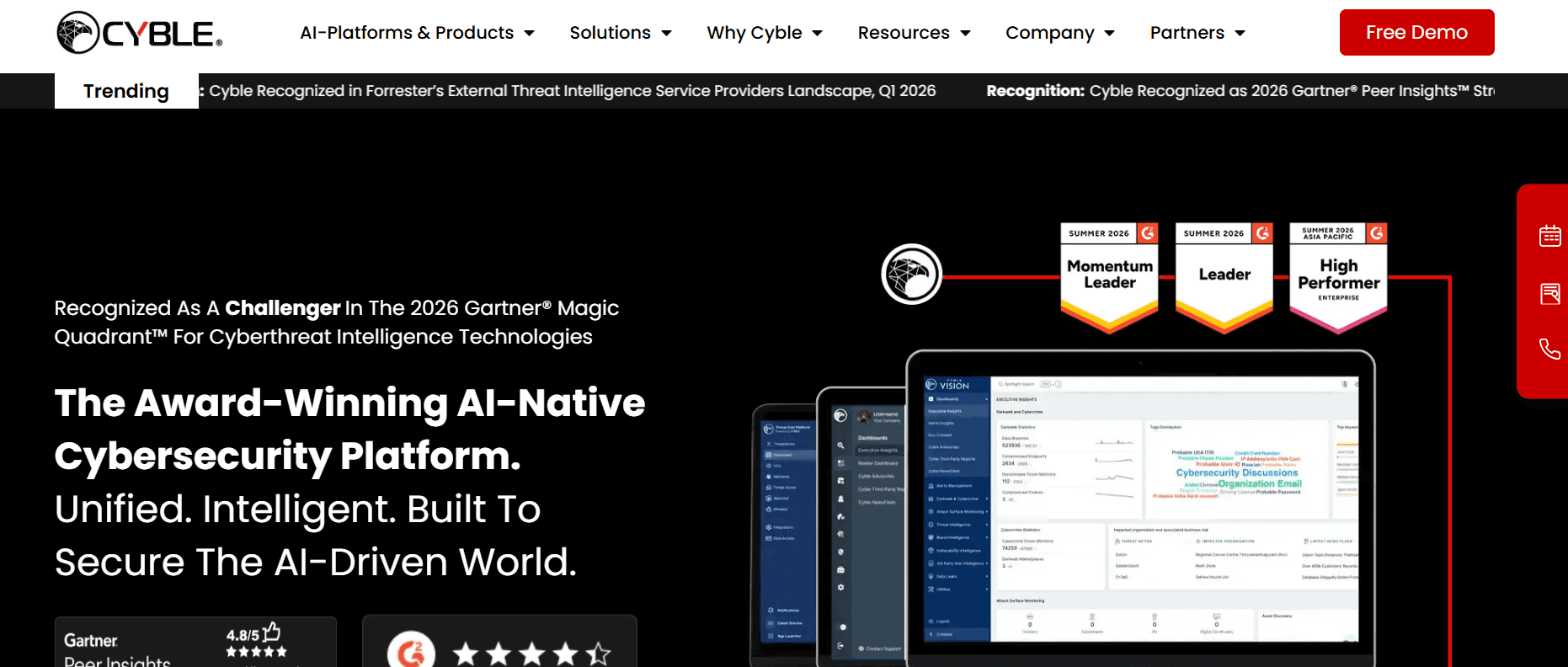
Cyble is an external threat management and cyber threat intelligence platform that combines external attack surface management, dark web monitoring, digital risk protection, and threat intelligence. The platform helps organizations identify exposed assets, monitor threat actor activity, detect leaked credentials, and assess external cyber risks across internet-facing environments.
Company Overview
Founded: 2019
Headquarters: Cupertino, California, USA (India operations: Bengaluru and Mumbai)
Employees: 201–500
Certifications: SOC 2 Type II; ISO/IEC 27001
Recognition: Challenger, Gartner Magic Quadrant™ for Cyberthreat Intelligence Technologies 2026
Key Features:
External Attack Surface Management: Discovers and monitors internet-facing assets, cloud resources, exposed services, and unmanaged infrastructure.
Dark Web Monitoring: Tracks leaked credentials, breach data, ransomware leak sites, stealer logs, and underground forums.
Digital Risk Protection: Detects phishing domains, impersonation campaigns, fraudulent websites, and brand-related threats.
Threat Intelligence: Provides threat actor intelligence, IOC monitoring, vulnerability intelligence, and contextual threat analysis.
Pros
Combines EASM, digital risk protection, dark web monitoring, and threat intelligence in a single platform.
Strong visibility into credential exposure and external threat activity.
Supports integration with security operations workflows.
Cons
Marketplace and counterfeit monitoring capabilities are not as extensive as dedicated brand protection platforms.
Some advanced workflows may require additional configuration and tuning.
Recommended For: Organizations seeking a unified external threat management platform that combines attack surface visibility, dark web monitoring, digital risk protection, and cyber threat intelligence.
5. ZeroFox

ZeroFox is an external threat intelligence and protection platform focused on identifying and disrupting digital risks across social media, dark web sources, marketplaces, and other online environments. It combines automated detection with analyst validation to support monitoring of brand threats, impersonation activity, and targeted digital risks across large-scale external ecosystems.
Company Overview
Founded: 2013
Headquarters: Baltimore
Employees: 501–1,000
Certifications: SOC 1, SOC 2 Type II
Recognition: $14M FBI social media intelligence contract (2020)
Key Features:
Social Media Threat Detection: Monitors multiple social platforms to identify impersonation, scams, and malicious content targeting organizations and individuals.
Brand Impersonation and Takedown Operations: Detects fake domains, accounts, and content, and supports structured takedown execution across external platforms.
Executive and VIP Protection: Monitors threats targeting executives, public figures, and high-risk individuals across digital and physical threat channels.
Dark Web and Forum Monitoring: Tracks underground forums and criminal marketplaces for leaked data, credentials, and threat actor activity.
Pros
Strong large-scale takedown capability with high-volume disruption operations.
Human analyst validation reduces false positives in threat detection workflows.
Covers both digital and physical threat signals in one platform.
Cons
High alert volume may require tuning for smaller security teams.
Less granular access control customization compared to some enterprise platforms.
Recommended For: Brand-focused enterprises and public sector organizations needing active threat disruption, social media monitoring, and managed takedown capabilities beyond passive detection.
Also Read: Top 5 External Threat Management Companies in India in 2026
How To Pick The Right External Threat Management Providers For Your Organization?
Choosing the right External Threat Management platform depends on how well it reduces external risks across internet-facing and external environments. It should deliver continuous visibility into external digital assets, accurate vulnerability detection, and strong risk prioritization across cloud and internet-facing systems.
The selection process becomes clearer when broken into key evaluation lenses:
Start With Your Biggest External Risk: Focus on whether brand, vendor, or cloud exposure drives your attack surface. The platform must support automated external asset discovery and continuously assess vulnerabilities across your digital footprint to reduce concentrated cyber risk.
5 Questions That Cut Through Vendor Marketing: Does it deliver integrated cyber threat intelligence and external threat intelligence beyond basic scanning? Can it maintain continuous discovery and real-time monitoring of assets? Does it support threat analysis and continuous threat monitoring across active cyber threats? Can it integrate with security tools for incident response and remediation workflows? Does it generate actionable insights that improve prioritization of remediation?
Warning Signs Of EASM-Only Tools Dressed As ETM: Limited asset inventory depth, weak attack surface visibility, and lack of threat detection across evolving attack vectors are key gaps. If it cannot connect external exposure with remediation workflows or lacks integrated intelligence for vulnerability management, it is not a full external attack surface management platform.
Conclusion: Why Choose RiskProfiler for External Threat Management?
External Threat Management is essential as organizations face increasing exposure across internet-facing assets, cloud infrastructure, third-party vendors, and hidden sources. Modern cyber risks now originate outside traditional network boundaries, making continuous visibility, threat intelligence correlation, and exposure prioritization critical to reduce attack impact. When evaluating External Threat Management platforms, organizations should prioritize unified visibility across external assets, threat intelligence integration, automated discovery, and remediation workflows.
RiskProfiler delivers External Threat Management through a unified platform combining EASM, dark web monitoring, cyber threat intelligence, brand protection, and third-party risk visibility. Its KnyX AI engine identifies exposed assets, correlates leaked credentials and external threat signals, and maps attack paths across organizational and vendor environments. This enables security teams to understand which exposures are actively targeted and prioritize remediation based on real operational risk rather than isolated alerts.
Explore how RiskProfiler helps security teams strengthen external visibility, monitor evolving cyber threats, and manage external exposure through a unified AI-driven External Threat Management platform.
External Threat Management helps organizations identify and reduce exposure across external attack surfaces through visibility, intelligence, and risk prioritization. This article discusses the top 5 ETM platforms, evaluation criteria, and vendor selection guidance.
At a Glance
RiskProfiler: Unified external threat exposure management
Recorded Future: AI-powered threat intelligence at scale
CrowdStrike Falcon: Unified platform spanning ETM and endpoint
Cyble: External threat exposure monitoring and threat intelligence
ZeroFox: Digital risk protection with active takedowns
What Is External Threat Management?
External Threat Management is a cyber exposure management discipline focused on monitoring the external attack surface and unmanaged digital assets using EASM and real-time threat intelligence. It helps security teams detect vulnerabilities and assess external exposure across cyber environments.
External Threat Management modules enable security teams to prioritize risks using actionable visibility while continuously monitoring internet-facing assets and expanding attack surface exposure.
What Makes Great External Threat Management Solutions?
A strong External Threat Management platform is defined by how effectively it discovers, analyzes, and reduces external exposure across digital environments. It must provide continuous visibility into assets, vulnerabilities, and threat signals while enabling security teams to assess cyber risk and respond to emerging threats in real time.
A high-quality platform is evaluated across three core areas:
Coverage Depth: It should map the full external attack surface, including dark web exposure, brand impersonation, surface web leaks, and supply chain risks. It must continuously discover unmanaged assets and maintain an accurate inventory of internet-facing systems, cloud services, and changes to the digital footprint.
AI and Automation: The tool must convert large volumes of alerts into actionable insights using automated correlation and prioritization. The system should detect vulnerabilities, analyze attack paths, and strengthen threat detection by filtering noise and highlighting real cyber threats that require attention.
Integration and Remediation Workflows: It should support seamless connection with security operations processes to enable faster incident response. It must help security teams prioritize remediation, enforce policy actions, and support takedown workflows to reduce exposure from data leaks, compromised assets, and active threat vectors.
5 Best External Threat Management Vendors in the USA
External Threat Management adoption in the USA continues to grow as organizations seek better visibility into internet-facing assets, unmanaged exposures, and evolving cyber risks across cloud and digital environments. The tools below help security teams find exposed assets, monitor threats, and manage vulnerabilities across cloud and digital environments.
Platform | Best At | Standout Capability |
RiskProfiler | Unified external threat exposure management | Single platform combining EASM, TPRM, brand protection, dark web monitoring, and cyber threat intelligence. It is powered by proprietary KnyX AI for agentic threat correlation and attack path prioritization |
Recorded Future | AI-powered threat intelligence at scale | Intelligence Graph indexes data from 1M+ sources, open web, dark web, and technical feeds, tracking 4,000+ threat actors, including 430 nation-state groups, with real-time risk scoring on every indicator |
CrowdStrike Falcon | Unified platform spanning ETM and endpoint | Threat Graph processes trillions of security events per day, correlating adversary intelligence from 245+ tracked threat groups with live attack surface data through a single cloud-native platform |
Cyble | External threat intelligence and dark web monitoring | Combines EASM, dark web monitoring, digital risk protection, and threat intelligence to help security teams identify exposed assets, leaked credentials, and external cyber threats. |
ZeroFox | Digital risk protection with active takedowns | Executed over 1 million takedowns in a single year via Global Disruption Network across 180+ platforms, with 24/7 human analyst validation covering brand, executive, physical, and dark web threats |
1. RiskProflier
RiskProfiler is an agentic AI-driven external threat exposure management platform that combines EASM, brand protection, dark web monitoring, and third-party risk visibility in a unified system. It uses its KnyX AI engine to support automated external asset discovery, correlate exposure signals, and prioritize external risks across digital environments for security teams.
Company Overview
Founded: 2019
Headquarters: Rock Hill, South Carolina, USA
Employees: 51–200
Certifications: SOC 2, ISO 27001, GDPR
Recognition: #2 External Attack Surface Management (5/5) on Gartner Peer Insights
Key Features:
RiskProfiler External Threat Management Discovery: Identifies domains, IPs, cloud assets, and shadow IT resources to maintain an updated external attack surface inventory.
Dark Web Monitoring: Tracks leaked credentials, exposed data, and threat actor activity across underground forums and breach sources.
Brand Protection and Takedown Workflows: Detects phishing domains, impersonation sites, and supports structured takedown and remediation workflows.
Attack Path Correlation Engine: Correlates relationships between external assets, third-party risks, and brand exposure to prioritize interconnected external risks.
Pros
Unifies multiple external exposure domains into a single operational view.
Provides early visibility into external risks shortly after onboarding.
Helps reduce alert noise through contextual correlation of exposure signals.
Cons
Requires tuning to optimize alert accuracy and workflow relevance.
Full platform capability may require onboarding time across modules.
Recommended For: Mid-market and enterprise security teams seeking a unified external threat and exposure management platform with automation and cost efficiency.
Book a demo to see how RiskProfiler unifies EASM, dark web monitoring, brand protection, and third-party risk to detect exposures and prioritize external threats in real time.
2. Recorded Future
Recorded Future delivers threat intelligence by collecting and analyzing data from open web, dark web, technical sources, and subscription-based feeds. It uses machine learning and NLP to structure and correlate threat data across actors, infrastructure, vulnerabilities, and cyber activity. It enables contextual intelligence for security decision-making and risk analysis.
Company Overview
Founded: 2009
Headquarters: Somerville, Massachusetts, USA
Employees: 1,001–5,000
Certifications: Not publicly disclosed
Recognition: Forrester Wave Leader for External Threat Intelligence Service Providers (2024)
Key Features:
Intelligence Cloud: Aggregates and correlates threat data on actors, infrastructure, vulnerabilities, and targets to provide contextual intelligence for analysis and investigations.
Dark Web Monitoring: Tracks underground forums, leak sites, and marketplaces for exposed data, credentials, and relevant threat activity.
Vulnerability Intelligence: Links vulnerabilities with observed exploitation signals and threat activity to support risk-based remediation prioritization.
External Attack Surface Discovery: Identifies exposed internet-facing assets and unmanaged systems to improve visibility of external exposure.
Pros
Strong coverage of structured threat intelligence across multiple global data sources.
Provides contextual mapping between threats, actors, infrastructure, and vulnerabilities.
Used across enterprise and public sector security environments for intelligence support.
Cons
Capabilities depend on selected modules and licensing scope.
Requires trained analysts for effective interpretation and operational use.
Recommended For: Large enterprises, financial institutions, and government security teams requiring structured threat intelligence and visibility into external exposure and emerging cyber threats
3. CrowdStrike Falcon
CrowdStrike Falcon is a cloud-native cybersecurity platform that combines endpoint protection, threat intelligence, and external exposure capabilities into a unified architecture. It processes large-scale telemetry data to detect threats, track adversaries, and support security operations across endpoint, cloud, and identity environments.
Company Overview
Founded: 2011 (CrowdStrike)
Headquarters: Austin, Texas, USA
Employees: 10,698 worldwide
Certifications: ISO/IEC 27001:2022, 27017, 22301, 42001; SOC 2 Type II; FedRAMP High; DoD Impact Level 5 (IL5); HIPAA; PCI DSS; GDPR; CSA STAR; TX-RAMP
Recognition: Leader, The Forrester Wave™: Attack Surface Management Solutions, Q3 2024
Key Features:
Adversary Intelligence: Tracks named threat actor groups using behavioral analysis and intelligence collected from global threat activity.
External Attack Surface Management: Identifies and monitors externally exposed assets through dedicated attack surface visibility capabilities.
Dark Web and Credential Monitoring: Detects exposed credentials and compromised data linked to external threat activity.
Threat Graph Analytics: Processes large-scale event data to identify patterns, relationships, and potential malicious activity in near real time.
Pros
Consolidates endpoint, cloud, and identity security into a single platform.
Strong adversary tracking supported by human-led threat intelligence analysis.
High detection effectiveness validated through independent security evaluations.
Cons
External threat capabilities require additional licensed modules.
Higher cost compared to many competing security platforms.
Recommended For: Large enterprises needing unified endpoint protection, threat intelligence, and external exposure visibility within a single security platform.
4. Cyble
Cyble is an external threat management and cyber threat intelligence platform that combines external attack surface management, dark web monitoring, digital risk protection, and threat intelligence. The platform helps organizations identify exposed assets, monitor threat actor activity, detect leaked credentials, and assess external cyber risks across internet-facing environments.
Company Overview
Founded: 2019
Headquarters: Cupertino, California, USA (India operations: Bengaluru and Mumbai)
Employees: 201–500
Certifications: SOC 2 Type II; ISO/IEC 27001
Recognition: Challenger, Gartner Magic Quadrant™ for Cyberthreat Intelligence Technologies 2026
Key Features:
External Attack Surface Management: Discovers and monitors internet-facing assets, cloud resources, exposed services, and unmanaged infrastructure.
Dark Web Monitoring: Tracks leaked credentials, breach data, ransomware leak sites, stealer logs, and underground forums.
Digital Risk Protection: Detects phishing domains, impersonation campaigns, fraudulent websites, and brand-related threats.
Threat Intelligence: Provides threat actor intelligence, IOC monitoring, vulnerability intelligence, and contextual threat analysis.
Pros
Combines EASM, digital risk protection, dark web monitoring, and threat intelligence in a single platform.
Strong visibility into credential exposure and external threat activity.
Supports integration with security operations workflows.
Cons
Marketplace and counterfeit monitoring capabilities are not as extensive as dedicated brand protection platforms.
Some advanced workflows may require additional configuration and tuning.
Recommended For: Organizations seeking a unified external threat management platform that combines attack surface visibility, dark web monitoring, digital risk protection, and cyber threat intelligence.
5. ZeroFox
ZeroFox is an external threat intelligence and protection platform focused on identifying and disrupting digital risks across social media, dark web sources, marketplaces, and other online environments. It combines automated detection with analyst validation to support monitoring of brand threats, impersonation activity, and targeted digital risks across large-scale external ecosystems.
Company Overview
Founded: 2013
Headquarters: Baltimore
Employees: 501–1,000
Certifications: SOC 1, SOC 2 Type II
Recognition: $14M FBI social media intelligence contract (2020)
Key Features:
Social Media Threat Detection: Monitors multiple social platforms to identify impersonation, scams, and malicious content targeting organizations and individuals.
Brand Impersonation and Takedown Operations: Detects fake domains, accounts, and content, and supports structured takedown execution across external platforms.
Executive and VIP Protection: Monitors threats targeting executives, public figures, and high-risk individuals across digital and physical threat channels.
Dark Web and Forum Monitoring: Tracks underground forums and criminal marketplaces for leaked data, credentials, and threat actor activity.
Pros
Strong large-scale takedown capability with high-volume disruption operations.
Human analyst validation reduces false positives in threat detection workflows.
Covers both digital and physical threat signals in one platform.
Cons
High alert volume may require tuning for smaller security teams.
Less granular access control customization compared to some enterprise platforms.
Recommended For: Brand-focused enterprises and public sector organizations needing active threat disruption, social media monitoring, and managed takedown capabilities beyond passive detection.
Also Read: Top 5 External Threat Management Companies in India in 2026
How To Pick The Right External Threat Management Providers For Your Organization?
Choosing the right External Threat Management platform depends on how well it reduces external risks across internet-facing and external environments. It should deliver continuous visibility into external digital assets, accurate vulnerability detection, and strong risk prioritization across cloud and internet-facing systems.
The selection process becomes clearer when broken into key evaluation lenses:
Start With Your Biggest External Risk: Focus on whether brand, vendor, or cloud exposure drives your attack surface. The platform must support automated external asset discovery and continuously assess vulnerabilities across your digital footprint to reduce concentrated cyber risk.
5 Questions That Cut Through Vendor Marketing: Does it deliver integrated cyber threat intelligence and external threat intelligence beyond basic scanning? Can it maintain continuous discovery and real-time monitoring of assets? Does it support threat analysis and continuous threat monitoring across active cyber threats? Can it integrate with security tools for incident response and remediation workflows? Does it generate actionable insights that improve prioritization of remediation?
Warning Signs Of EASM-Only Tools Dressed As ETM: Limited asset inventory depth, weak attack surface visibility, and lack of threat detection across evolving attack vectors are key gaps. If it cannot connect external exposure with remediation workflows or lacks integrated intelligence for vulnerability management, it is not a full external attack surface management platform.
Conclusion: Why Choose RiskProfiler for External Threat Management?
External Threat Management is essential as organizations face increasing exposure across internet-facing assets, cloud infrastructure, third-party vendors, and hidden sources. Modern cyber risks now originate outside traditional network boundaries, making continuous visibility, threat intelligence correlation, and exposure prioritization critical to reduce attack impact. When evaluating External Threat Management platforms, organizations should prioritize unified visibility across external assets, threat intelligence integration, automated discovery, and remediation workflows.
RiskProfiler delivers External Threat Management through a unified platform combining EASM, dark web monitoring, cyber threat intelligence, brand protection, and third-party risk visibility. Its KnyX AI engine identifies exposed assets, correlates leaked credentials and external threat signals, and maps attack paths across organizational and vendor environments. This enables security teams to understand which exposures are actively targeted and prioritize remediation based on real operational risk rather than isolated alerts.
Explore how RiskProfiler helps security teams strengthen external visibility, monitor evolving cyber threats, and manage external exposure through a unified AI-driven External Threat Management platform.
Jump to
Share Article
We Have Answers!
Explore our FAQ to learn more about how RiskProfiler can help safeguard your digital assets and manage risks efficiently.
What is the difference between ETM and EASM?
ETM focuses on reducing overall external risk using integrated threat intelligence, while EASM mainly maps exposed assets and basic attack surface visibility. A mature ETM approach includes comprehensive visibility, asset exposure analysis, and security management across internet-facing and external environments to reduce data breaches.
Do mid-sized US companies need External Threat Management Services, or is it only for enterprises?
Mid-sized companies benefit significantly because modern attack surface management software reveals unmanaged assets and application security gaps early. These platforms extend visibility beyond traditional tools and help identify exposure across cloud and hybrid systems.
How much does external threat management cost?
Cost depends on scale, asset inventory size, and management capabilities required. Platforms positioned as a management solution often vary based on integrated threat intelligence depth, cybersecurity tools coverage, and real-time monitoring features. Enterprise-grade tools are usually benchmarked on Gartner Peer Insights under the top external attack surface management categories.
Can ETM replace a SOC?
ETM does not replace a SOC but strengthens it. It feeds security teams with integrated threat intelligence, vulnerability detection, and asset exposure insights. When combined with Microsoft Sentinel or similar security tools, it improves incident response, prioritization, and security research workflows.
What should I look for in an ETM vendor in 2026?
Look for an ETM vendor that provides comprehensive visibility across external assets, automated asset discovery, dark web monitoring, threat intelligence, and risk prioritization within a single platform. The solution should help security teams identify unmanaged assets, correlate exposure signals, and support remediation workflows that reduce external risk. Platforms such as RiskProfiler combine EASM, cyber threat intelligence, brand protection, and third-party risk visibility to help organizations manage external exposures more effectively.
Latest Insights
Stay informed with expert perspectives on cybersecurity, attack surface management,
and building digital resilience.


Enterprise-Grade Security & Trust
Specialized intelligence agents working together toprotect your organization
Ready to Transform
Your Threat Management?
Join hundreds of security teams who trust KnyX to cut through the noise and focus on what matters most.
Book a Demo Today