
Top 5 External Threat Management Companies in India in 2026
Top 5 External Threat Management Companies in India in 2026
Exposed assets and leaked credentials increase cyber risk daily. Explore the top 5 effective External Threat Management platforms for reducing the risk in 2026.
Read Time
7 min read
Posted On
Social Media
Internet-facing assets, exposed APIs, and leaked credentials have significantly expanded external cyber risk for Indian enterprises. Security teams now require continuous external threat visibility and faster exposure detection. This article will discuss the top 5 External Threat Management solutions, ETM capabilities, vendor evaluation criteria, and India-specific cybersecurity considerations.
At a Glance
RiskProfiler: Agentic AI-powered external threat exposure management
Recorded Future: Threat intelligence and external risk monitoring
CloudSEK (XVigil): Predictive threat intelligence and digital risk monitoring
CrowdStrike Falcon: Adversary intelligence and threat hunting
CYFIRMA (DeCYFIR): Predictive external threat intelligence
What Is External Threat Management and Why Does India Need It Now?
External Threat Management identifies and reduces risks across internet-facing assets. It monitors cloud environments, exposed credentials, third-party systems, and attacker-controlled infrastructure. The approach combines real-time threat intelligence, exposure management, and continuous monitoring. Organizations use external attack surface management platforms to improve cybersecurity visibility and reduce external cyber exposure.
Here’s why India Needs External Threat Management Now:
Expanding External Attack Surface: India’s accelerated cloud adoption has increased unmanaged internet-facing assets. This exposure attracts ransomware operators, phishing infrastructure, automated reconnaissance activity, and state-sponsored cyber threat groups.
Reduced Security Visibility: SaaS platforms, APIs, and hybrid workforce environments have reduced visibility across exposed assets. Organizations struggle to identify shadow IT infrastructure and vulnerable external attack paths.
Targeted Sector-Specific Threats: Indian banking, telecom, healthcare, and manufacturing sectors increasingly face external cyber threats. Attackers target exposed applications, leaked credentials, vulnerable domains, and weak security configurations.
Regulatory and Compliance Pressure: DPDP Act requirements and RBI cybersecurity directives require stronger external risk management controls. CERT-In mandates also require continuous monitoring and actionable threat intelligence capabilities.
AI-Driven Threat Acceleration: AI-powered reconnaissance tools now accelerate attacker identification and vulnerability exploitation processes. Deep and dark web intelligence platforms also increase operational speed for cyber threat actors.
Need for Unified Cyber Risk Management: Modern attack surface management software centralizes external asset discovery and vulnerability management. These platforms also unify digital risk protection and actionable threat intelligence workflows.
What to Look for in External Threat Management Services?
An External Threat Management platform should identify exposed assets, leaked credentials, phishing infrastructure, vulnerable applications, and third-party risks. It should combine external threat intelligence, digital risk protection, automated asset discovery, and real-time monitoring. Organizations should prioritize platforms that improve threat visibility and reduce external exposure.
The most effective platforms combine continuous monitoring, actionable threat intelligence, and external cybersecurity visibility within centralized risk management workflows:
Dark Web and Deep Web Monitoring: The platform should monitor breach forums, credential dumps, Telegram channels, and dark web marketplaces for leaked organizational data and exposed credentials.
Brand Protection and Digital Risk Intelligence: Effective platforms should detect phishing domains, typosquatting activity, fake applications, impersonation campaigns, and fraudulent social media accounts targeting digital assets.
Third-Party and Supply Chain Risk Visibility: Organizations should monitor vendors, SaaS providers, hosting environments, and supply chain infrastructure for exposed services, vulnerable dependencies, and weak security configurations.
Threat Intelligence Integration and Contextualization: Strong platforms should correlate external threat intelligence with attack paths, exposed assets, and emerging threats to deliver contextualized cyber intelligence and actionable insights.
India Compliance and Data Localisation Readiness: The platform should support DPDP Act requirements, CERT-In reporting obligations, and regional data governance requirements across India-based digital infrastructure and cybersecurity operations.
Top 5 External Threat Management Vendors in India
External Threat Management tools differ in asset discovery accuracy, threat intelligence depth, dark web coverage, and third-party risk visibility. Some emphasize attack surface discovery, while others focus on cyber threat intelligence, digital risk protection, and preemptive external monitoring. The platforms below help identify exposed assets, leaked credentials, phishing infrastructure, vulnerable vendors, and exploitable external attack paths.
Platform | Best At | Standout Capability |
RiskProfiler | Unified external threat management | Single platform spanning EASM, brand protection, dark web monitoring, TPRM, and CTI through proprietary KnyX AI engine |
Recorded Future | Global threat intelligence depth | Intelligence Cloud indexing 8 billion+ entities across the open web, dark web, and technical sources with Mastercard financial intelligence layer |
CloudSEK (XVigil) | Predictive CTI for Indian enterprises | Identifies Initial Attack Vectors, leaked credentials, exposed APIs, before the breach occurs, with the deepest India-specific threat dataset |
CrowdStrike Falcon | Adversary intelligence + exposure management | Tracks 257+ named adversaries combined with Falcon platform telemetry, delivering outside-in and inside-out attack visibility |
CYFIRMA (DeCYFIR) | Preemptive external threat landscape management | 9-pillar ETLM framework combining predictive intelligence, deception-based attacker traps, and hacker-perspective outside-in threat modelling |
1. RiskProfiler
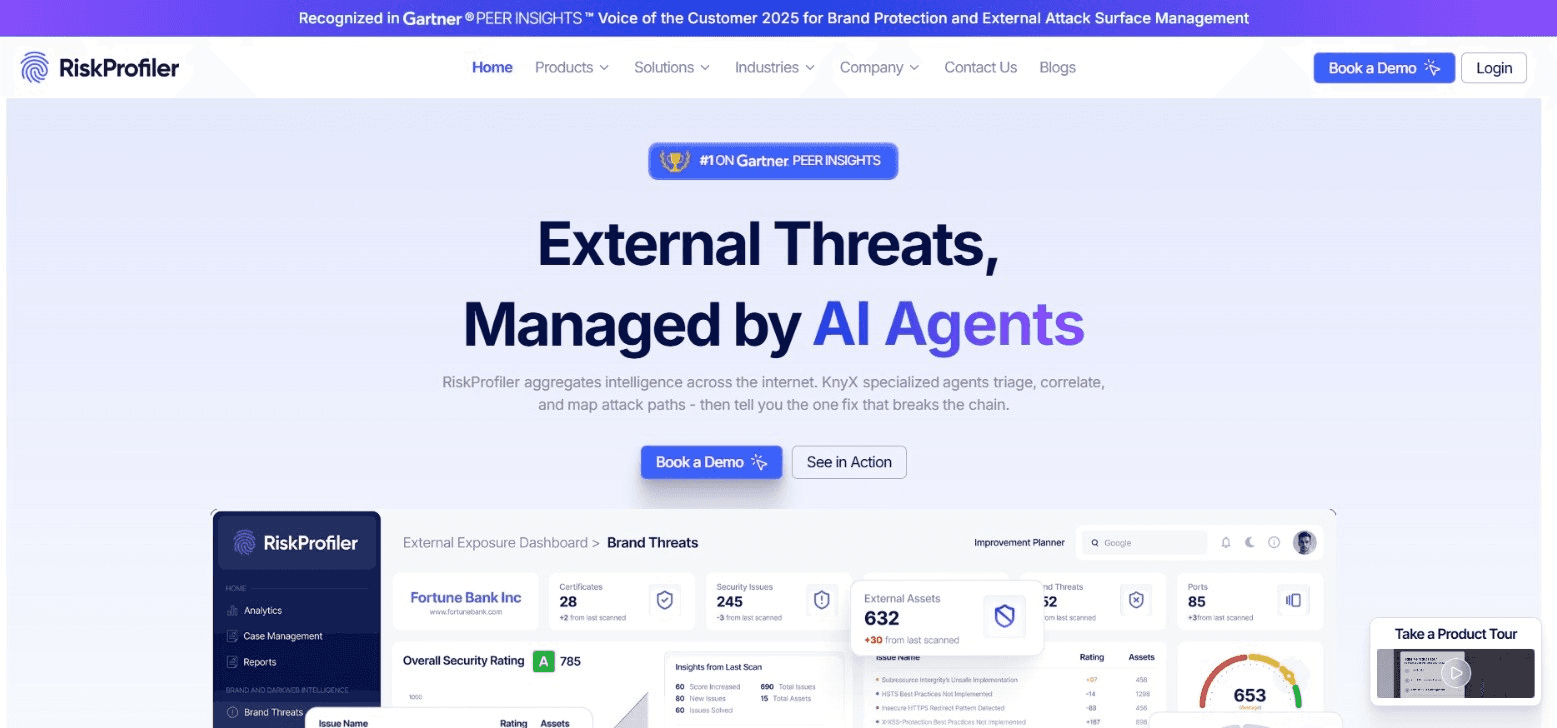
RiskProfiler delivers AI-driven External Threat Exposure Management through its proprietary KnyX agentic AI engine. The platform combines EASM, cloud attack surface management, brand protection, dark web monitoring, third-party risk management, and cyber threat intelligence within a unified risk graph. RiskProfiler distributes in India through RAH Infotech and maintains deployment presence across the BFSI, healthcare, automotive, and technology sectors.
Company Overview
Founded: 2019
Headquarters: Rock Hill, South Carolina, USA
Employees: 51–200
Certifications: SOC 2, ISO 27001, GDPR
Recognition: Gartner Peer Insights #2 External Attack Surface Management (5/5)
Key Features:
Unified RiskProfiler External Threat Management: Correlates external exposure intelligence, brand abuse signals, vendor risk data, and threat intelligence into a single external risk view.
AI Driven Correlation Engine: Uses AI to connect CVEs, IOCs, adversary infrastructure, and exposure signals to identify cross-domain external attack paths.
Continuous Exposure Discovery: Detects internet-facing exposures across cloud and digital environments. This includes misconfigurations, leaked services, identity exposures, and unmanaged external risks in real time.
External Threat Intelligence Coverage: Monitors threat actor infrastructure, phishing ecosystems, TOR networks, underground forums, and encrypted channels for relevant threat indicators.
Pros
Unified platform covering EASM, CTI, DRPS, and TPRM capabilities.
KnyX agentic AI reduces manual threat correlation workload.
India distribution support available through RAH Infotech partnership.
Cons
Smaller global market presence than established cybersecurity vendors.
Pricing requires direct vendor engagement and custom quotation.
Recommended For: Mid-to-large enterprises and MSSPs requiring unified external threat visibility, cyber threat intelligence, and third-party risk monitoring within a single platform.
Book a RiskProfiler demo to explore how AI-driven external threat exposure management helps security teams identify, prioritize, and respond to external risks faster.
2. Recorded Future
Recorded Future is a cyber threat intelligence company founded in 2009 and acquired by Mastercard in 2024 for $2.65 billion. The platform serves more than 1,900 organizations across 74 countries. It continuously indexes open web, dark web, malware, and technical intelligence sources. Recorded Future was also an early portfolio company backed by Google and In-Q-Tel.
Company Overview
Founded: 2009
Headquarters: Somerville, Massachusetts, USA
Employees: 1,001–5,000
Certifications: Not publicly disclosed
Recognition: Forrester Wave Leader for External Threat Intelligence Service Providers (2024)
Key Features:
Intelligence Cloud: AI-powered intelligence platform covering adversaries, infrastructure, malware, and external attack targets.
Threat Intelligence Modules: Ransomware intelligence, payment fraud monitoring, attack surface intelligence, and third-party risk visibility.
Recorded Future AI: AI model launched in 2024 specifically for cyber threat intelligence and security operations workflows.
Temporal Analytics Engine: Predictive analytics engine for threat forecasting, IOC enrichment, and threat actor profiling.
Pros
One of the largest cyber threat intelligence datasets globally.
Mastercard acquisition strengthens financial threat intelligence capabilities.
Extensive API, SIEM, and SOAR integration ecosystem.
Cons
Premium pricing targets large enterprises and government organizations.
Requires mature SOC and intelligence analysis capabilities.
Recommended For: Large enterprises, government agencies, and financial institutions requiring advanced cyber threat intelligence, adversary tracking, and large-scale intelligence operations support.
3. CloudSEK (XVigil)
CloudSEK is a Singapore-headquartered cybersecurity company with engineering and operations based in Bengaluru, India. Founded in 2015, the company serves more than 300 enterprises, including ICICI, NPCI, CRED, Sun Pharma, Reliance, and OLA. CloudSEK focuses heavily on digital risk protection, cyber threat intelligence, and predictive threat detection across India’s enterprise threat landscape.
Company Overview
Founded: 2015
Headquarters: Singapore
Employees: 51–200
Certifications: Not publicly disclosed
Recognition: First Indian-origin cybersecurity company to receive investment from a U.S. state-backed venture fund
Key Features:
XVigil: Digital risk protection platform covering dark web, deep web, and surface web monitoring
BeVigil: Security search engine for mobile application vulnerability assessment and exposed application analysis
SVigil: Third-party and supply chain threat intelligence monitoring platform
Nexus: AI-powered command center unifying threat intelligence and external attack surface insights
Pros
Strong India-focused cyber threat intelligence capabilities.
Large BFSI customer base strengthens regulatory and enterprise credibility.
Predictive threat models identify attack indicators before escalation.
Cons
EASM capabilities remain narrower than full-stack ETM platforms.
Global presence outside India and APAC remains comparatively smaller.
Recommended For: Indian enterprises requiring India-specific cyber threat intelligence, BFSI-focused digital risk protection, and predictive external threat monitoring capabilities.
4. CrowdStrike Falcon
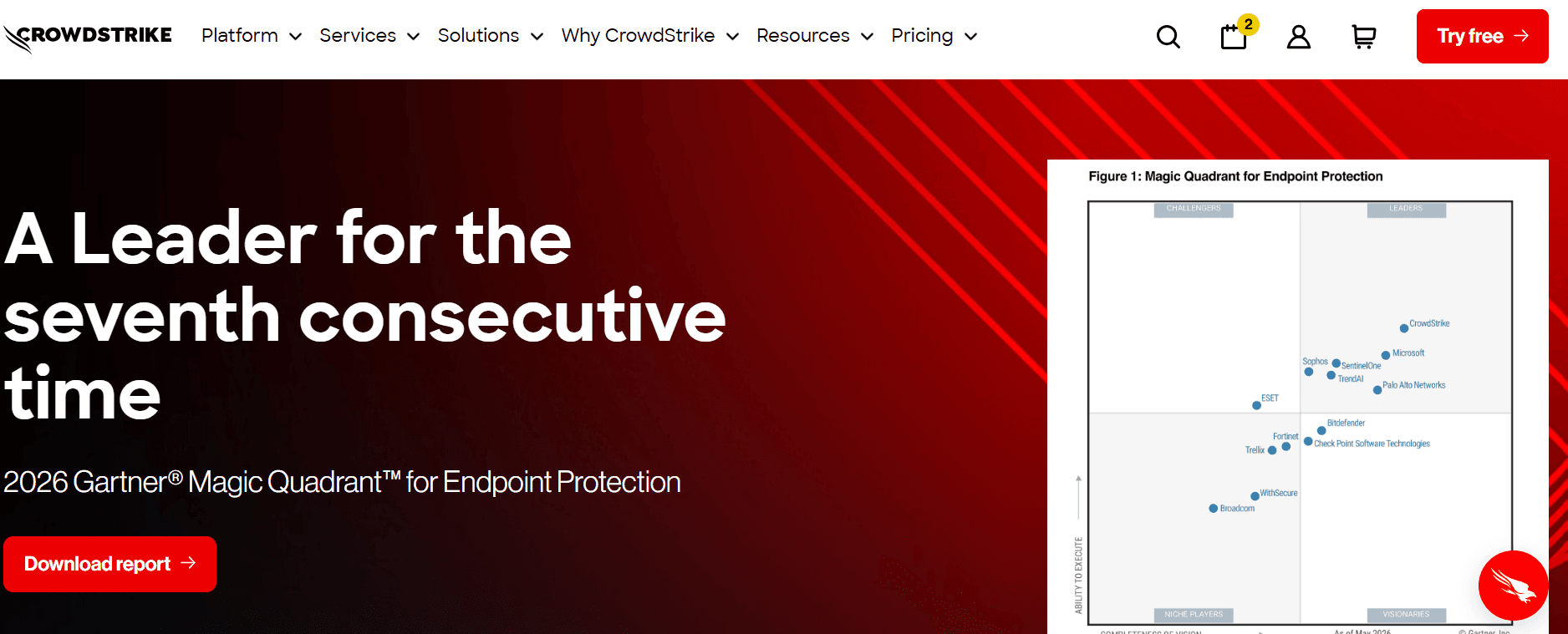
CrowdStrike Falcon is a cloud-native cybersecurity platform founded in 2011 and headquartered in Austin, Texas. The company operates across endpoint security, cloud security, identity protection, exposure management, and cyber threat intelligence. CrowdStrike also investigated major nation-state cyberattacks involving Sony Pictures, the DNC breach, and Fancy Bear operations.
Company Overview
Founded: 2011 (CrowdStrike)
Headquarters: Austin, Texas, USA
Employees: 5,001–10,000
Certifications: SOC 2 Type II, ISO 27001 (CrowdStrike Falcon platform)
Recognition: Gartner Magic Quadrant Leader for Endpoint Protection Platforms (multiple consecutive years)
Key Features:
Falcon Adversary Intelligence: Provides detailed intelligence profiles covering more than 245 global adversary groups, malware families, and active threat campaigns.
Falcon XDR: Correlates endpoint, cloud, identity, and third-party telemetry for unified cross-domain threat detection and investigation workflows.
Falcon OverWatch: Managed 24/7 threat hunting service operated by analyst teams monitoring suspicious attacker activity and behavioral anomalies.
Falcon Exposure Management: Continuously identifies exposed assets, misconfigurations, vulnerable systems, and external attack surface exposure across environments.
Pros
Industry-leading endpoint detection and cyber threat intelligence capabilities.
Extensive adversary intelligence and threat actor profiling coverage.
Cloud-native architecture enables rapid deployment with minimal infrastructure overhead.
Cons
Premium pricing may challenge mid-sized enterprise security budgets.
Platform breadth can overwhelm smaller or less mature SOC teams.
Recommended For: Large enterprises and multinational organizations requiring integrated endpoint security, cyber threat intelligence, threat hunting, and exposure management within a unified cybersecurity platform.
5. CYFIRMA (DeCYFIR)
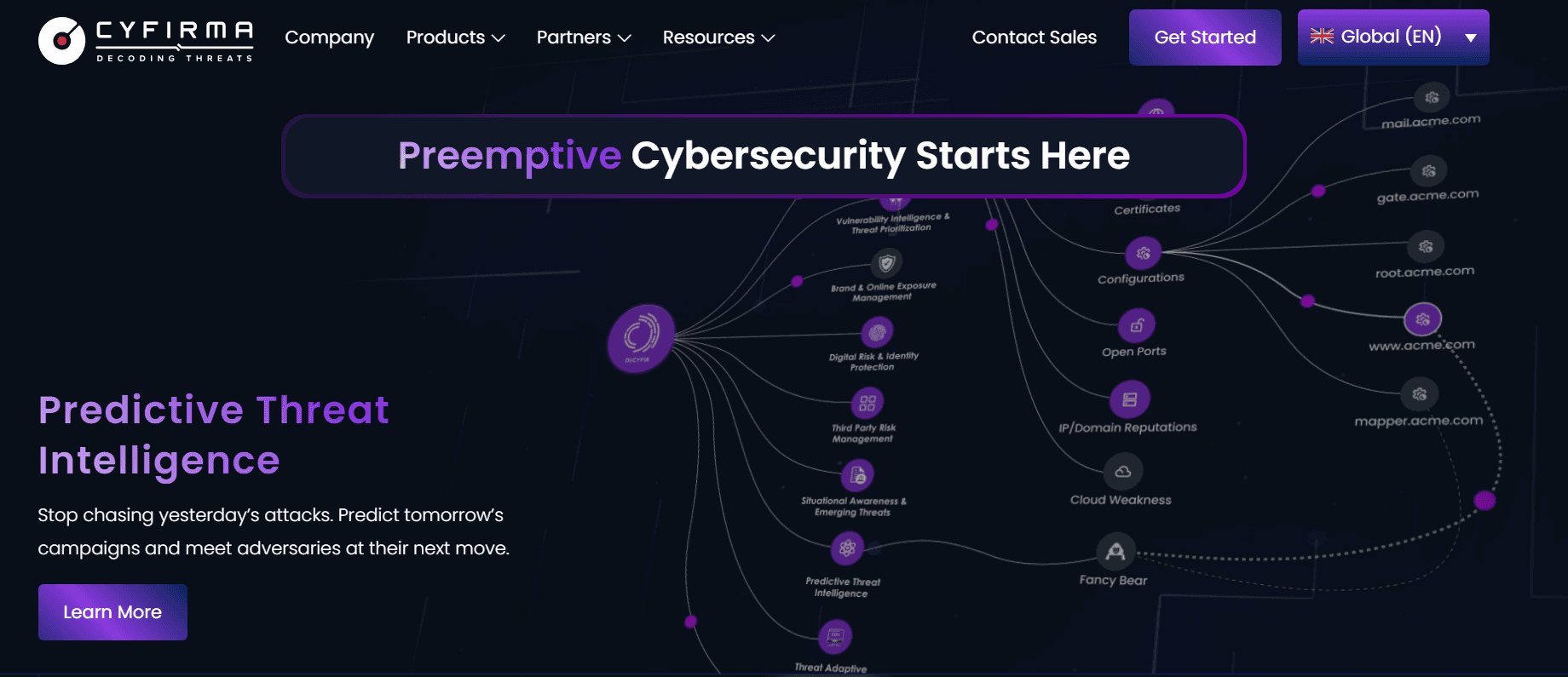
CYFIRMA positions itself around External Threat Landscape Management (ETLM), a category closely aligned with modern External Threat Management platforms. The company focuses heavily on predictive cyber threat intelligence, attacker-behavior modelling, digital risk protection, and external exposure monitoring. CYFIRMA maintains a strong India operational presence and supports enterprises, governments, and critical infrastructure organizations across multiple regions.
Company Overview
Founded: 2017
Headquarters: Singapore (India R&D hub: Bengaluru, Whitefield)
Employees: 51-200
Certifications: Not publicly disclosed
Recognition: Gartner Peer Insights listed vendor - Security Threat Intelligence Products and Services
Key Features:
DeCYFIR Platform: Nine-pillar ETLM platform covering attack surface discovery, digital risk protection, third-party risk, and vulnerability intelligence.
Predictive Threat Intelligence: Identifies attacker intent, emerging campaigns, and threat indicators before large-scale exploitation or public disclosure occurs.
Deception Intelligence: Sector-specific deception environments designed to detect attacker reconnaissance and early-stage intrusion activity across targeted industries.
Outside-In Threat Modelling: Hacker-perspective intelligence analysis focused on exposed assets, external attack paths, and organizational threat exposure.
Pros
Comprehensive ETLM framework covering multiple external threat intelligence and exposure management domains.
Strong India-focused threat research and operational intelligence capabilities.
Predictive intelligence approach improves early threat detection and external visibility.
Cons
Platform depth may require longer onboarding and operational tuning.
Primarily optimized for large enterprises and government environments.
Recommended For: Enterprises and government agencies requiring predictive cyber threat intelligence, deception capabilities, and comprehensive external threat landscape visibility across complex digital environments.
Also Read: 5 Online External Threat Management Companies in the USA (2026)
How Indian Enterprises Should Choose External Threat Management Providers?
Indian enterprises should evaluate ETM platforms using measurable external risk indicators. These include exposed assets, leaked credentials, phishing exposure, vulnerable applications, and third-party attack paths. The right ETM platform should align with organizational attack surface complexity, industry-specific threats, compliance obligations, and available cybersecurity resources.
Here’s how you should choose an ETM company:
Map Your Threat Exposure Before You Pick a Tool: Organizations should identify exposed domains, cloud workloads, public IPs, APIs, subsidiaries, vendors, and unmanaged internet-facing assets before evaluating ETM management software solutions.
Questions to Ask Every ETM Vendor: Enterprises should ask question relevant to threat intelligence quality, asset discovery accuracy, dark web monitoring coverage, third-party risk management capabilities, and real-time threat visibility performance metrics.
Build vs Buy vs MSSP - What Works for India: Large enterprises may build internal ETM operations, while mid-sized organizations often prefer MSSP-led management solutions for faster deployment and lower operational overhead.
Conclusion: Why Is RiskProfiler Important for External Threat Management?
External threats continue to evolve as organizations expand across cloud environments, internet-facing assets, third-party ecosystems, and digital channels. Exposed services, leaked credentials, phishing campaigns, and unmanaged assets can introduce risks that are often difficult to track through traditional security monitoring alone. Maintaining visibility into these external risks is an important part of strengthening the overall security posture.
RiskProfiler helps organizations address these challenges through a unified platform that combines EASM, Cloud ASM, cyber threat intelligence, dark web monitoring, brand protection, and third-party risk management. Powered by its KnyX agentic AI engine, the platform correlates exposure data, threat intelligence, and external risk signals to provide contextual visibility across the external threat landscape.
Book a personalized RiskProfiler demo to explore how the platform helps identify and manage external risks across modern digital environments.
Internet-facing assets, exposed APIs, and leaked credentials have significantly expanded external cyber risk for Indian enterprises. Security teams now require continuous external threat visibility and faster exposure detection. This article will discuss the top 5 External Threat Management solutions, ETM capabilities, vendor evaluation criteria, and India-specific cybersecurity considerations.
At a Glance
RiskProfiler: Agentic AI-powered external threat exposure management
Recorded Future: Threat intelligence and external risk monitoring
CloudSEK (XVigil): Predictive threat intelligence and digital risk monitoring
CrowdStrike Falcon: Adversary intelligence and threat hunting
CYFIRMA (DeCYFIR): Predictive external threat intelligence
What Is External Threat Management and Why Does India Need It Now?
External Threat Management identifies and reduces risks across internet-facing assets. It monitors cloud environments, exposed credentials, third-party systems, and attacker-controlled infrastructure. The approach combines real-time threat intelligence, exposure management, and continuous monitoring. Organizations use external attack surface management platforms to improve cybersecurity visibility and reduce external cyber exposure.
Here’s why India Needs External Threat Management Now:
Expanding External Attack Surface: India’s accelerated cloud adoption has increased unmanaged internet-facing assets. This exposure attracts ransomware operators, phishing infrastructure, automated reconnaissance activity, and state-sponsored cyber threat groups.
Reduced Security Visibility: SaaS platforms, APIs, and hybrid workforce environments have reduced visibility across exposed assets. Organizations struggle to identify shadow IT infrastructure and vulnerable external attack paths.
Targeted Sector-Specific Threats: Indian banking, telecom, healthcare, and manufacturing sectors increasingly face external cyber threats. Attackers target exposed applications, leaked credentials, vulnerable domains, and weak security configurations.
Regulatory and Compliance Pressure: DPDP Act requirements and RBI cybersecurity directives require stronger external risk management controls. CERT-In mandates also require continuous monitoring and actionable threat intelligence capabilities.
AI-Driven Threat Acceleration: AI-powered reconnaissance tools now accelerate attacker identification and vulnerability exploitation processes. Deep and dark web intelligence platforms also increase operational speed for cyber threat actors.
Need for Unified Cyber Risk Management: Modern attack surface management software centralizes external asset discovery and vulnerability management. These platforms also unify digital risk protection and actionable threat intelligence workflows.
What to Look for in External Threat Management Services?
An External Threat Management platform should identify exposed assets, leaked credentials, phishing infrastructure, vulnerable applications, and third-party risks. It should combine external threat intelligence, digital risk protection, automated asset discovery, and real-time monitoring. Organizations should prioritize platforms that improve threat visibility and reduce external exposure.
The most effective platforms combine continuous monitoring, actionable threat intelligence, and external cybersecurity visibility within centralized risk management workflows:
Dark Web and Deep Web Monitoring: The platform should monitor breach forums, credential dumps, Telegram channels, and dark web marketplaces for leaked organizational data and exposed credentials.
Brand Protection and Digital Risk Intelligence: Effective platforms should detect phishing domains, typosquatting activity, fake applications, impersonation campaigns, and fraudulent social media accounts targeting digital assets.
Third-Party and Supply Chain Risk Visibility: Organizations should monitor vendors, SaaS providers, hosting environments, and supply chain infrastructure for exposed services, vulnerable dependencies, and weak security configurations.
Threat Intelligence Integration and Contextualization: Strong platforms should correlate external threat intelligence with attack paths, exposed assets, and emerging threats to deliver contextualized cyber intelligence and actionable insights.
India Compliance and Data Localisation Readiness: The platform should support DPDP Act requirements, CERT-In reporting obligations, and regional data governance requirements across India-based digital infrastructure and cybersecurity operations.
Top 5 External Threat Management Vendors in India
External Threat Management tools differ in asset discovery accuracy, threat intelligence depth, dark web coverage, and third-party risk visibility. Some emphasize attack surface discovery, while others focus on cyber threat intelligence, digital risk protection, and preemptive external monitoring. The platforms below help identify exposed assets, leaked credentials, phishing infrastructure, vulnerable vendors, and exploitable external attack paths.
Platform | Best At | Standout Capability |
RiskProfiler | Unified external threat management | Single platform spanning EASM, brand protection, dark web monitoring, TPRM, and CTI through proprietary KnyX AI engine |
Recorded Future | Global threat intelligence depth | Intelligence Cloud indexing 8 billion+ entities across the open web, dark web, and technical sources with Mastercard financial intelligence layer |
CloudSEK (XVigil) | Predictive CTI for Indian enterprises | Identifies Initial Attack Vectors, leaked credentials, exposed APIs, before the breach occurs, with the deepest India-specific threat dataset |
CrowdStrike Falcon | Adversary intelligence + exposure management | Tracks 257+ named adversaries combined with Falcon platform telemetry, delivering outside-in and inside-out attack visibility |
CYFIRMA (DeCYFIR) | Preemptive external threat landscape management | 9-pillar ETLM framework combining predictive intelligence, deception-based attacker traps, and hacker-perspective outside-in threat modelling |
1. RiskProfiler
RiskProfiler delivers AI-driven External Threat Exposure Management through its proprietary KnyX agentic AI engine. The platform combines EASM, cloud attack surface management, brand protection, dark web monitoring, third-party risk management, and cyber threat intelligence within a unified risk graph. RiskProfiler distributes in India through RAH Infotech and maintains deployment presence across the BFSI, healthcare, automotive, and technology sectors.
Company Overview
Founded: 2019
Headquarters: Rock Hill, South Carolina, USA
Employees: 51–200
Certifications: SOC 2, ISO 27001, GDPR
Recognition: Gartner Peer Insights #2 External Attack Surface Management (5/5)
Key Features:
Unified RiskProfiler External Threat Management: Correlates external exposure intelligence, brand abuse signals, vendor risk data, and threat intelligence into a single external risk view.
AI Driven Correlation Engine: Uses AI to connect CVEs, IOCs, adversary infrastructure, and exposure signals to identify cross-domain external attack paths.
Continuous Exposure Discovery: Detects internet-facing exposures across cloud and digital environments. This includes misconfigurations, leaked services, identity exposures, and unmanaged external risks in real time.
External Threat Intelligence Coverage: Monitors threat actor infrastructure, phishing ecosystems, TOR networks, underground forums, and encrypted channels for relevant threat indicators.
Pros
Unified platform covering EASM, CTI, DRPS, and TPRM capabilities.
KnyX agentic AI reduces manual threat correlation workload.
India distribution support available through RAH Infotech partnership.
Cons
Smaller global market presence than established cybersecurity vendors.
Pricing requires direct vendor engagement and custom quotation.
Recommended For: Mid-to-large enterprises and MSSPs requiring unified external threat visibility, cyber threat intelligence, and third-party risk monitoring within a single platform.
Book a RiskProfiler demo to explore how AI-driven external threat exposure management helps security teams identify, prioritize, and respond to external risks faster.
2. Recorded Future
Recorded Future is a cyber threat intelligence company founded in 2009 and acquired by Mastercard in 2024 for $2.65 billion. The platform serves more than 1,900 organizations across 74 countries. It continuously indexes open web, dark web, malware, and technical intelligence sources. Recorded Future was also an early portfolio company backed by Google and In-Q-Tel.
Company Overview
Founded: 2009
Headquarters: Somerville, Massachusetts, USA
Employees: 1,001–5,000
Certifications: Not publicly disclosed
Recognition: Forrester Wave Leader for External Threat Intelligence Service Providers (2024)
Key Features:
Intelligence Cloud: AI-powered intelligence platform covering adversaries, infrastructure, malware, and external attack targets.
Threat Intelligence Modules: Ransomware intelligence, payment fraud monitoring, attack surface intelligence, and third-party risk visibility.
Recorded Future AI: AI model launched in 2024 specifically for cyber threat intelligence and security operations workflows.
Temporal Analytics Engine: Predictive analytics engine for threat forecasting, IOC enrichment, and threat actor profiling.
Pros
One of the largest cyber threat intelligence datasets globally.
Mastercard acquisition strengthens financial threat intelligence capabilities.
Extensive API, SIEM, and SOAR integration ecosystem.
Cons
Premium pricing targets large enterprises and government organizations.
Requires mature SOC and intelligence analysis capabilities.
Recommended For: Large enterprises, government agencies, and financial institutions requiring advanced cyber threat intelligence, adversary tracking, and large-scale intelligence operations support.
3. CloudSEK (XVigil)
CloudSEK is a Singapore-headquartered cybersecurity company with engineering and operations based in Bengaluru, India. Founded in 2015, the company serves more than 300 enterprises, including ICICI, NPCI, CRED, Sun Pharma, Reliance, and OLA. CloudSEK focuses heavily on digital risk protection, cyber threat intelligence, and predictive threat detection across India’s enterprise threat landscape.
Company Overview
Founded: 2015
Headquarters: Singapore
Employees: 51–200
Certifications: Not publicly disclosed
Recognition: First Indian-origin cybersecurity company to receive investment from a U.S. state-backed venture fund
Key Features:
XVigil: Digital risk protection platform covering dark web, deep web, and surface web monitoring
BeVigil: Security search engine for mobile application vulnerability assessment and exposed application analysis
SVigil: Third-party and supply chain threat intelligence monitoring platform
Nexus: AI-powered command center unifying threat intelligence and external attack surface insights
Pros
Strong India-focused cyber threat intelligence capabilities.
Large BFSI customer base strengthens regulatory and enterprise credibility.
Predictive threat models identify attack indicators before escalation.
Cons
EASM capabilities remain narrower than full-stack ETM platforms.
Global presence outside India and APAC remains comparatively smaller.
Recommended For: Indian enterprises requiring India-specific cyber threat intelligence, BFSI-focused digital risk protection, and predictive external threat monitoring capabilities.
4. CrowdStrike Falcon
CrowdStrike Falcon is a cloud-native cybersecurity platform founded in 2011 and headquartered in Austin, Texas. The company operates across endpoint security, cloud security, identity protection, exposure management, and cyber threat intelligence. CrowdStrike also investigated major nation-state cyberattacks involving Sony Pictures, the DNC breach, and Fancy Bear operations.
Company Overview
Founded: 2011 (CrowdStrike)
Headquarters: Austin, Texas, USA
Employees: 5,001–10,000
Certifications: SOC 2 Type II, ISO 27001 (CrowdStrike Falcon platform)
Recognition: Gartner Magic Quadrant Leader for Endpoint Protection Platforms (multiple consecutive years)
Key Features:
Falcon Adversary Intelligence: Provides detailed intelligence profiles covering more than 245 global adversary groups, malware families, and active threat campaigns.
Falcon XDR: Correlates endpoint, cloud, identity, and third-party telemetry for unified cross-domain threat detection and investigation workflows.
Falcon OverWatch: Managed 24/7 threat hunting service operated by analyst teams monitoring suspicious attacker activity and behavioral anomalies.
Falcon Exposure Management: Continuously identifies exposed assets, misconfigurations, vulnerable systems, and external attack surface exposure across environments.
Pros
Industry-leading endpoint detection and cyber threat intelligence capabilities.
Extensive adversary intelligence and threat actor profiling coverage.
Cloud-native architecture enables rapid deployment with minimal infrastructure overhead.
Cons
Premium pricing may challenge mid-sized enterprise security budgets.
Platform breadth can overwhelm smaller or less mature SOC teams.
Recommended For: Large enterprises and multinational organizations requiring integrated endpoint security, cyber threat intelligence, threat hunting, and exposure management within a unified cybersecurity platform.
5. CYFIRMA (DeCYFIR)
CYFIRMA positions itself around External Threat Landscape Management (ETLM), a category closely aligned with modern External Threat Management platforms. The company focuses heavily on predictive cyber threat intelligence, attacker-behavior modelling, digital risk protection, and external exposure monitoring. CYFIRMA maintains a strong India operational presence and supports enterprises, governments, and critical infrastructure organizations across multiple regions.
Company Overview
Founded: 2017
Headquarters: Singapore (India R&D hub: Bengaluru, Whitefield)
Employees: 51-200
Certifications: Not publicly disclosed
Recognition: Gartner Peer Insights listed vendor - Security Threat Intelligence Products and Services
Key Features:
DeCYFIR Platform: Nine-pillar ETLM platform covering attack surface discovery, digital risk protection, third-party risk, and vulnerability intelligence.
Predictive Threat Intelligence: Identifies attacker intent, emerging campaigns, and threat indicators before large-scale exploitation or public disclosure occurs.
Deception Intelligence: Sector-specific deception environments designed to detect attacker reconnaissance and early-stage intrusion activity across targeted industries.
Outside-In Threat Modelling: Hacker-perspective intelligence analysis focused on exposed assets, external attack paths, and organizational threat exposure.
Pros
Comprehensive ETLM framework covering multiple external threat intelligence and exposure management domains.
Strong India-focused threat research and operational intelligence capabilities.
Predictive intelligence approach improves early threat detection and external visibility.
Cons
Platform depth may require longer onboarding and operational tuning.
Primarily optimized for large enterprises and government environments.
Recommended For: Enterprises and government agencies requiring predictive cyber threat intelligence, deception capabilities, and comprehensive external threat landscape visibility across complex digital environments.
Also Read: 5 Online External Threat Management Companies in the USA (2026)
How Indian Enterprises Should Choose External Threat Management Providers?
Indian enterprises should evaluate ETM platforms using measurable external risk indicators. These include exposed assets, leaked credentials, phishing exposure, vulnerable applications, and third-party attack paths. The right ETM platform should align with organizational attack surface complexity, industry-specific threats, compliance obligations, and available cybersecurity resources.
Here’s how you should choose an ETM company:
Map Your Threat Exposure Before You Pick a Tool: Organizations should identify exposed domains, cloud workloads, public IPs, APIs, subsidiaries, vendors, and unmanaged internet-facing assets before evaluating ETM management software solutions.
Questions to Ask Every ETM Vendor: Enterprises should ask question relevant to threat intelligence quality, asset discovery accuracy, dark web monitoring coverage, third-party risk management capabilities, and real-time threat visibility performance metrics.
Build vs Buy vs MSSP - What Works for India: Large enterprises may build internal ETM operations, while mid-sized organizations often prefer MSSP-led management solutions for faster deployment and lower operational overhead.
Conclusion: Why Is RiskProfiler Important for External Threat Management?
External threats continue to evolve as organizations expand across cloud environments, internet-facing assets, third-party ecosystems, and digital channels. Exposed services, leaked credentials, phishing campaigns, and unmanaged assets can introduce risks that are often difficult to track through traditional security monitoring alone. Maintaining visibility into these external risks is an important part of strengthening the overall security posture.
RiskProfiler helps organizations address these challenges through a unified platform that combines EASM, Cloud ASM, cyber threat intelligence, dark web monitoring, brand protection, and third-party risk management. Powered by its KnyX agentic AI engine, the platform correlates exposure data, threat intelligence, and external risk signals to provide contextual visibility across the external threat landscape.
Book a personalized RiskProfiler demo to explore how the platform helps identify and manage external risks across modern digital environments.
Jump to
Share Article
We Have Answers!
Explore our FAQ to learn more about how RiskProfiler can help safeguard your digital assets and manage risks efficiently.
What is the difference between external threat management and traditional cyber security monitoring?
Traditional cyber security monitoring focuses on internal networks, endpoints, and logged security events. External Threat Management monitors internet-facing assets, exposed credentials, phishing infrastructure, threat vectors, and the organization’s external threat landscape across public-facing environments.
Why are threat intelligence platforms important for managing an expanding attack surface?
Threat intelligence platforms provide contextual visibility into attacker activity, phishing campaigns, dark web exposure, and emerging threat vectors. Organizations use actionable intelligence and digital risk protection capabilities to manage their external security posture more effectively. Platforms such as RiskProfiler help security teams correlate threat intelligence with external exposures to improve risk prioritization and investigation workflows.
How do digital risk protection platforms help protect an organization’s external digital footprint?
Digital risk protection platforms monitor phishing domains, impersonation campaigns, leaked credentials, fake applications, and fraudulent social media activity. These platforms help organizations protect their external digital footprint and improve visibility across the external threat landscape.
What should enterprises evaluate before choosing an external threat management platform?
Organizations should evaluate automated asset discovery accuracy, dark web monitoring, third-party risk visibility, threat hunting capabilities, and real-time threat visibility. Enterprises should also assess whether the platform supports comprehensive external cybersecurity and digital footprint monitoring. Platforms such as RiskProfiler bring these capabilities together within a unified external threat exposure management framework.
Latest Insights
Stay informed with expert perspectives on cybersecurity, attack surface management,
and building digital resilience.



Enterprise-Grade Security & Trust
Specialized intelligence agents working together toprotect your organization
Ready to Transform
Your Threat Management?
Join hundreds of security teams who trust KnyX to cut through the noise and focus on what matters most.
Book a Demo Today