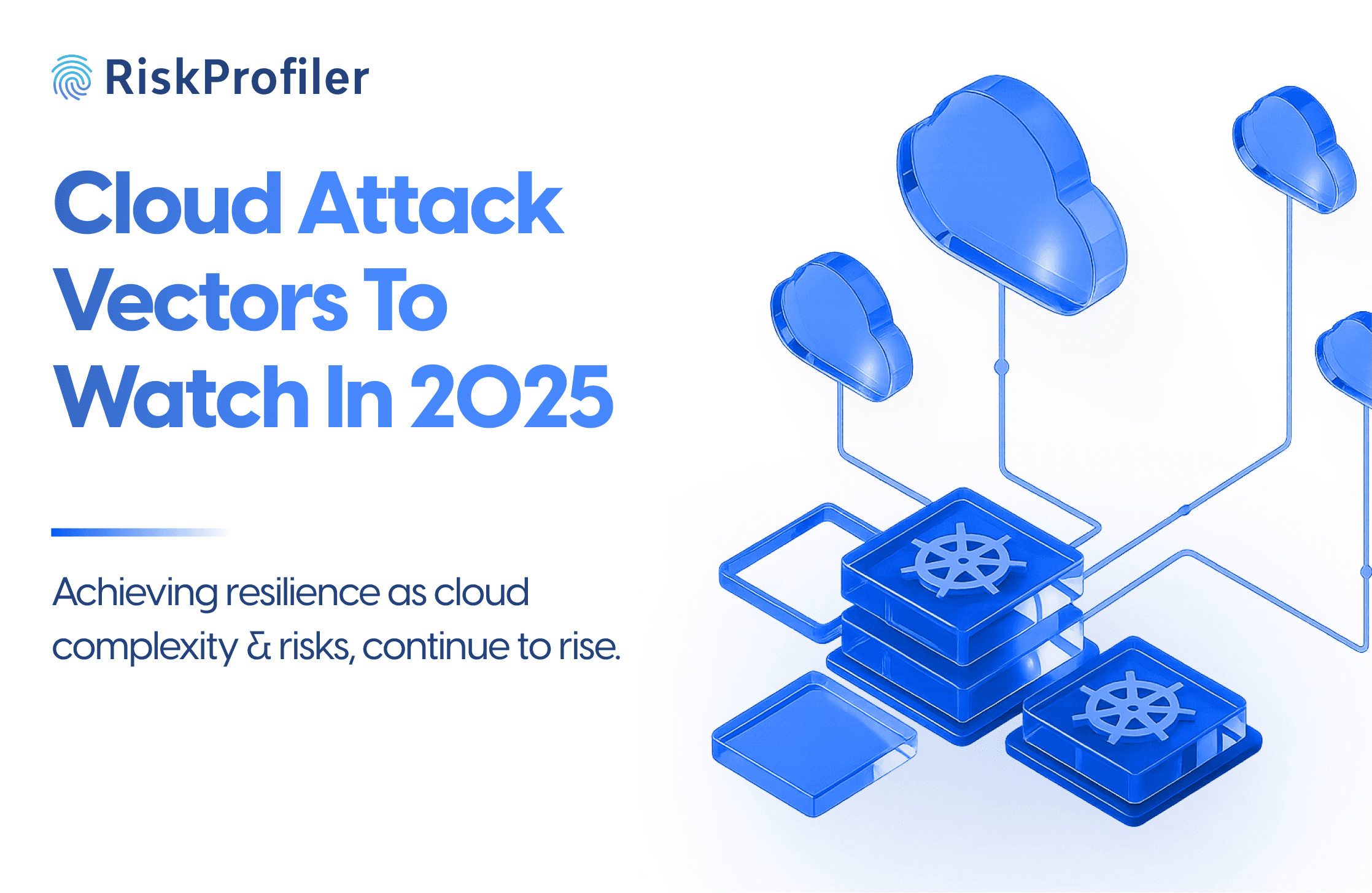
Top External Cloud Attack Vectors to Watch in 2025
Top External Cloud Attack Vectors to Watch in 2025
In the last decade, the implementation of cloud services has revolutionized the global business landscape. Since the initial stage, cloud computing has continued to transform how businesses operate, but it also brings new layers of complexity and risks.
Read Time
7 min read
Posted On
Social Media
In the last decade, the implementation of cloud services has revolutionized the global business landscape. Since the initial stage, cloud computing has continued to transform how businesses operate, but it also brings new layers of complexity and risks. The interconnected network style, coupled with its flexibility, easy accessibility, and simplified scalability, makes the vulnerabilities accumulate to create a dangerous external cloud attack posture. As organizations move faster in 2025, attackers are evolving just as quickly, exploiting the expanding cloud landscape. Misconfigurations, poor access control, and exposed APIs are just the tip of the iceberg of the evolving cloud attack vectors.
In this article, we’ll break down the top cloud attack vectors you need to watch in 2025, explore real-world breach examples, and show how RiskProfiler’s Cloud External Attack Surface Management (CEASM) solution can help you stay one step ahead.
The Evolving Cloud Attack Vectors in 2025
The global shift to multi-cloud, containerized, and serverless infrastructures has widened the attack surface. While businesses race to innovate, adversaries exploit oversights in asset visibility, identity mismanagement, and unsecured interfaces.
In late 2024, over 23% of reported breaches involving cloud infrastructure were due to misconfigurations and exposed services. Expect this trend to grow as more development pipelines push code without external exposure assessments.
1. Public Bucket Exposures
Cloud storage solutions such as Amazon S3, Azure Blob Storage, and Google Cloud Storage have revolutionized the way organizations manage and share data. Their scalability, ease of use, and integration with other cloud services make them indispensable tools for modern enterprises. However, in many cases, these storage buckets are left publicly accessible due to oversight, misunderstanding of access policies, or improper automation, creating one of the most pervasive cloud attack vectors.
When access control lists (ACLs) or policies are not carefully configured, it can result in sensitive files being exposed to the public internet with no authentication required. The types of data leaked through these exposures range from internal documents, source code, and client PII, to API keys and security credentials. A single misconfigured bucket can serve as an attack path for threat actors to pivot further into an organization’s infrastructure. Exposed logs or credentials, for instance, can provide the keys to internal systems, increasing the blast radius of a breach.
Example: In January 2025, a retail firm unintentionally exposed marketing documents containing customer segmentation models in an open S3 bucket. The data was indexed by public search engines before detection.
These exposures often occur when developers skip access control settings or when internal-use buckets are mistakenly configured as public.
2. Credential Leaks in CI/CD Pipelines
Continuous Integration and Continuous Deployment (CI/CD) pipelines have become the backbone of modern software delivery, enabling rapid code commits, automated testing, and seamless deployments. However, this efficiency often comes at the cost of security hygiene, especially when it comes to data security. A common and dangerous issue is the accidental exposure of credentials, such as API keys, SSH keys, access tokens, and cloud provider secrets within CI/CD workflows. These credentials can be hard-coded into source files, checked into version control systems like Git, or logged during build or test processes. Once committed to a public repository or a shared internal registry, these secrets can be easily harvested by attackers, often via automated tools that continuously scan GitHub, GitLab, and other platforms.
Another overlooked cloud attack vector is container images. Developers may embed secrets in Dockerfiles or within environment variables during image creation. These images, if pushed to a public or insufficiently protected registry, can be pulled and inspected by malicious actors to extract sensitive data.
Example: A fintech startup inadvertently pushed a GitHub repo containing a hardcoded Slack API token. Within hours, attackers gained access to internal alerts and deployed phishing campaigns mimicking system messages.
These leaks are often discovered after exploitation, but by implementing proactive vulnerability intelligence, they can be caught in time.
3. Exposed APIs
Application Programming Interfaces (APIs) serve to act as the connective vessel for most online services, tools, applications, and domains in this modern technical age. From handling user authentication to orchestrating complex backend processes, APIs power critical functionality across web, mobile, and cloud-based systems. However, as their usage expands, so does the attack surface they present. Publicly exposed APIs, especially those lacking proper authentication or rate limiting, are among the most attractive targets for threat actors. Attackers regularly scan the internet for these endpoints, probing them for misconfigurations, cloud vulnerabilities (like broken object-level authorization or injection flaws), and excessive data exposure. Attackers often exploit APIs for data harvesting, lateral movement, or even full account takeovers.
Example: A healthcare platform’s forgotten staging API allowed unauthenticated access to real patient appointment data. The API wasn’t documented, monitored, or even known to the security team.
4. Extended Privilege Access
Modern cloud platforms like AWS, Azure, and GCP offer highly granular Identity and Access Management (IAM) frameworks. While this granularity offers flexibility, it also creates complexity. Managing thousands of roles, users, service accounts, and policies across environments often leads to privilege creep, where users or services retain access they no longer need or should never have had in the first place.
Real-world incidents have shown how attackers leveraged cloud Identity and Access Management weaknesses to escalate from simple read permissions to escalate into full control over entire accounts, spinning up crypto-mining operations or planting persistent backdoors within CI/CD pipelines.
Common Identity and Access Management Pitfalls:
Use of overly broad permissions (e.g., *:* policies)
Lack of role separation between development, staging, and production
Service accounts with long-lived or hardcoded credentials
No enforcement of least privilege principles or access reviews
Inadequate visibility into permission changes and access logs
Example: An insider at a logistics firm used a legacy admin role that hadn’t been downgraded. Within minutes, they accessed and exfiltrated customer delivery data via a backup instance that wasn’t under monitoring.
How Do Misconfigurations Act As A Major Cloud Attack Vector?
Despite years of evolving cybersecurity tools and practices, misconfigurations remain one of the leading causes of data breaches, and in 2025, the trend shows no signs of slowing down. What makes misconfigurations so dangerous is that they often expose attack surfaces directly to the internet, allowing external actors to exploit them without needing to compromise an internal asset first. These cloud vulnerabilities frequently arise from a lack of visibility, human error, poor access controls, or reliance on default settings.
1. Publicly Accessible Cloud Storage Buckets
Misconfigured cloud storage services like AWS S3, Azure Blob, and GCP Cloud Storage can inadvertently expose sensitive files to the public internet. This can include anything from internal documents and source code to customer data and credentials. Despite industry awareness, dozens of such incidents still occur each month, often discovered by security researchers or attackers long before the organization is aware.
2. Forgotten or Unclaimed Subdomains
As organizations grow and their infrastructure evolves, old subdomains tied to deprecated apps or services, with getting decommissioned, still pointing to external services that are no longer active. These unclaimed subdomains can be hijacked by attackers to host phishing sites, deliver malware, or intercept traffic, exploiting a gap in DNS hygiene.
3. Open Ports on Cloud Assets
Default cloud configurations often expose critical services to the internet, such as SSH, RDP, and database ports without proper firewall rules or access controls. Attackers use automated scanners to find these open ports and launch brute-force attacks, exploit known cloud vulnerabilities, or simply connect and extract data if no authentication is in place.
4. Excessive Identity and Access Management Permissions
Improperly scoped roles, wildcard permissions (e.g., *:* in AWS IAM), or unused access rights create opportunities for privilege escalation and lateral movement within cloud environments. Over-permissioned identities are often the result of quick-fix solutions during development or testing and can turn a minor foothold into a full-blown breach if left unchecked.
5. Hardcoded Secrets in CI/CD Pipelines
Secrets embedded in source code, environment files, or Docker images are gold mines for attackers. When these pipelines are stored in public repositories or shared across multiple environments without encryption or access control, they expose tokens, credentials, and API keys that can be exploited to access cloud accounts, databases, or internal APIs.
6. Shadow APIs Not Tracked by Security Teams
Undocumented or legacy APIs, also known as shadow APIs, often evade discovery by security teams and go unmonitored and unpatched. These APIs may contain cloud vulnerabilities, lack proper authentication, or expose sensitive data. Since they fall outside the formal inventory, they create an invisible and uncontrolled attack surface.
Proactive Cloud Monitoring: Assets That Need Continuous Tracking
As cloud infrastructure continues to scale and evolve, real-time visibility and continuous monitoring have become essential pillars of a mature security strategy. To attackers, your incentive to secure your business’s inner perimeter is often inconsequential. Securing your external attack surface against cloud attack vectors is what makes the real difference against your chances of security breaches. Thus, to stay ahead, organizations must implement external-facing visibility and telemetry as an ongoing process, instead of scheduled one-time audits.
1. Cloud Storage Visibility
Cloud storage services (like AWS S3, Azure Blob Storage, and GCP Cloud Storage) are a prime target for attackers, especially when misconfigured. Public buckets, world-readable permissions, or unrestricted write access can lead to massive data leaks or tampering. Monitoring should focus on access policies, permission changes, and unusual data flows to quickly identify risky exposures.
2. Subdomain Takeover Risks
Unmonitored or orphaned subdomains, often from retired environments or third-party services, are frequently left pointing to decommissioned platforms. This creates a ripe opportunity for subdomain takeovers. In such scenarios, attackers hijack unused DNS records to serve malicious content under a legitimate domain. Regular DNS audits and dynamic monitoring of DNS changes can help close this gap.
3. External-Facing APIs and Endpoints
APIs act as gateways into your systems and are increasingly targeted for enumeration and abuse. Proactive monitoring should identify publicly accessible, undocumented, or unprotected APIs, as well as track changes in exposed services, authentication methods, and data returned. External APIs should be tested continuously for vulnerabilities like broken access control, excessive data exposure, and injection flaws, limiting potential creation of cloud attack vectors.
4. Privilege Drift Across Identities and Roles
Over time, user and service accounts often accumulate access rights they no longer need, creating a phenomenon known as privilege drift. In cloud environments, where IAM policies are complex and granular, this drift can open up paths for lateral movement and privilege escalation. Continuous role analysis and access tracking help enforce least privilege and prevent access creep.
5. CI/CD Pipeline Secrets and Exposure Indicators
Secrets—such as API keys, tokens, and credentials—are often mishandled in build pipelines. Whether stored in plaintext, embedded in scripts, or printed in logs, these secrets can be detected by attackers monitoring public repositories or internal artifacts. Tools that scan for exposed secrets, hardcoded values, or anomalous access to CI/CD environments are essential for protecting the software supply chain.
6. Third-Party Service Configurations Linked to Your Cloud
Cloud environments are rarely isolated; they’re woven together with dozens (if not hundreds) of third-party integrations—ranging from SaaS tools and monitoring agents to data processing platforms. Misconfigured third-party connectors or expired tokens can open indirect attack paths into your environment. Maintaining visibility into how external services interact with your cloud infrastructure is key to reducing interconnected risk.
How RiskProfiler’s Secure Businesses Against Cloud Attack Vectors?
RiskProfiler’s Cloud External Attack Surface Management is engineered to secure modern, cloud-native environments from the outside in. By offering visibility, contextual intelligence, and proactive remediation across sprawling cloud landscapes, it empowers security teams to stay ahead of threats. Here’s how cloud attack surface management helps businesses elevate their cloud security posture:
Real-time asset discovery
RiskProfiler continuously tracks, discovers, and maintains an updated inventory all known and unknown cloud assets including those spun up dynamically by DevOps teams across AWS, Azure, GCP, and other environments. It builds a comprehensive, real-time map of your external cloud attack surface, accounting for every IP address, domain, subdomain, container, load balancer, and service endpoint.
By eliminating blind spots and shadow infrastructure, security teams gain full visibility into assets that may otherwise be overlooked and unintentionally exposed to the internet.
Misconfiguration detection
Through continuous AI-assisted automated scanning, cloud attack surface management module flags misconfigured cloud services and security group settings that raise or amplify the concerns risk exposure. Such instances of flagged misconfigurations includes:
Publicly accessible S3 buckets, blobs, and storage accounts.
Open ports and unsecured databases such as MongoDB or Elasticsearch instances.
Overexposed APIs or cloud services lacking proper access controls.
The platform provides contextual remediation insights, helping teams swiftly prioritize and fix the most critical misconfigurations before they can be manipulated by malicious third-party entities.
Credential leak monitoring
RiskProfiler monitors public code repositories, developer forums, CI/CD platforms (like GitHub Actions, GitLab, Jenkins), and paste sites, along with dark web forums, marketplaces, and chatrooms for exposed API keys, tokens, usernames, and secrets that belong to your cloud environment. If a credential is leaked, even by accident, the platform alerts your security team with attribution and impact analysis, reducing the time to detect and revoke compromised secrets and preventing potential cloud account takeovers.
Shadow API detection
RiskProfiler identifies undocumented, unmanaged, or forgotten APIs, also known as Shadow APIs which can become backdoors for attackers. These APIs may bypass authentication, leak sensitive data, or allow lateral movement if not properly secured.
Cloud external attack surface management conducts external API enumeration, matches endpoints to known schema definitions, and highlights anomalies. By surfacing these invisible APIs, RiskProfiler helps businesses reduce their API sprawl and enforce consistent governance.
Privilege analysis
The platform simulates attacker movement across cloud IAM roles and policies, identifying:
Over-privileged service accounts
Unused roles with dangerous permissions
Paths for privilege escalation or lateral movement
By modeling attacker behavior, RiskProfiler empowers organizations to enforce least privilege and reduce the blast radius of potential breaches.
Attack Path Analysis
RiskProfiler’s Cloud threat exposure management maps the external attack path to detect external asset and cloud vulnerabilities that can be leveraged by attackers for lateral movement. This detailed visibility allows security teams to see and secure these access points and weak points to prevent future attacks. Hence, in short, the attack path analysis helps with:
Maps potential points that can be leveraged for lateral movement
Correlates external exposures and vulnerabilities with unsecured access points
Assesses the likelihood and impact of a chained compromise
Multi-Cloud Environment Management
RiskProfiler’s external threat exposure management is built for hybrid and multi-cloud environments, enabling seamless visibility across AWS, Azure, GCP, and private cloud infrastructure. The platform normalizes simultaneous visibility across providers in one place, offering a unified security dashboard and cross-platform policy enforcement. This helps security teams reduce monitoring and security management complexity, avoid configuration drift, and enforce consistent risk mitigation across all cloud platforms.
Conclusion
Cloud flexibility demands continuous vigilance to ensure reliable security. In 2025 and beyond, attackers are increasingly targeting overlooked cloud assets, misconfigurations, and exposed credentials, often before security teams even know they exist.
RiskProfiler’s Cloud External Attack Surface Management provides the external visibility, real-time intelligence, and automation needed to close these gaps proactively. As cloud ecosystems grow more complex, future-ready security practices will hinge on continuous discovery, context-driven risk prioritization, and cross-cloud governance.
The time to secure your cloud perimeter isn’t after a breach, it’s now.
In the last decade, the implementation of cloud services has revolutionized the global business landscape. Since the initial stage, cloud computing has continued to transform how businesses operate, but it also brings new layers of complexity and risks. The interconnected network style, coupled with its flexibility, easy accessibility, and simplified scalability, makes the vulnerabilities accumulate to create a dangerous external cloud attack posture. As organizations move faster in 2025, attackers are evolving just as quickly, exploiting the expanding cloud landscape. Misconfigurations, poor access control, and exposed APIs are just the tip of the iceberg of the evolving cloud attack vectors.
In this article, we’ll break down the top cloud attack vectors you need to watch in 2025, explore real-world breach examples, and show how RiskProfiler’s Cloud External Attack Surface Management (CEASM) solution can help you stay one step ahead.
The Evolving Cloud Attack Vectors in 2025
The global shift to multi-cloud, containerized, and serverless infrastructures has widened the attack surface. While businesses race to innovate, adversaries exploit oversights in asset visibility, identity mismanagement, and unsecured interfaces.
In late 2024, over 23% of reported breaches involving cloud infrastructure were due to misconfigurations and exposed services. Expect this trend to grow as more development pipelines push code without external exposure assessments.
1. Public Bucket Exposures
Cloud storage solutions such as Amazon S3, Azure Blob Storage, and Google Cloud Storage have revolutionized the way organizations manage and share data. Their scalability, ease of use, and integration with other cloud services make them indispensable tools for modern enterprises. However, in many cases, these storage buckets are left publicly accessible due to oversight, misunderstanding of access policies, or improper automation, creating one of the most pervasive cloud attack vectors.
When access control lists (ACLs) or policies are not carefully configured, it can result in sensitive files being exposed to the public internet with no authentication required. The types of data leaked through these exposures range from internal documents, source code, and client PII, to API keys and security credentials. A single misconfigured bucket can serve as an attack path for threat actors to pivot further into an organization’s infrastructure. Exposed logs or credentials, for instance, can provide the keys to internal systems, increasing the blast radius of a breach.
Example: In January 2025, a retail firm unintentionally exposed marketing documents containing customer segmentation models in an open S3 bucket. The data was indexed by public search engines before detection.
These exposures often occur when developers skip access control settings or when internal-use buckets are mistakenly configured as public.
2. Credential Leaks in CI/CD Pipelines
Continuous Integration and Continuous Deployment (CI/CD) pipelines have become the backbone of modern software delivery, enabling rapid code commits, automated testing, and seamless deployments. However, this efficiency often comes at the cost of security hygiene, especially when it comes to data security. A common and dangerous issue is the accidental exposure of credentials, such as API keys, SSH keys, access tokens, and cloud provider secrets within CI/CD workflows. These credentials can be hard-coded into source files, checked into version control systems like Git, or logged during build or test processes. Once committed to a public repository or a shared internal registry, these secrets can be easily harvested by attackers, often via automated tools that continuously scan GitHub, GitLab, and other platforms.
Another overlooked cloud attack vector is container images. Developers may embed secrets in Dockerfiles or within environment variables during image creation. These images, if pushed to a public or insufficiently protected registry, can be pulled and inspected by malicious actors to extract sensitive data.
Example: A fintech startup inadvertently pushed a GitHub repo containing a hardcoded Slack API token. Within hours, attackers gained access to internal alerts and deployed phishing campaigns mimicking system messages.
These leaks are often discovered after exploitation, but by implementing proactive vulnerability intelligence, they can be caught in time.
3. Exposed APIs
Application Programming Interfaces (APIs) serve to act as the connective vessel for most online services, tools, applications, and domains in this modern technical age. From handling user authentication to orchestrating complex backend processes, APIs power critical functionality across web, mobile, and cloud-based systems. However, as their usage expands, so does the attack surface they present. Publicly exposed APIs, especially those lacking proper authentication or rate limiting, are among the most attractive targets for threat actors. Attackers regularly scan the internet for these endpoints, probing them for misconfigurations, cloud vulnerabilities (like broken object-level authorization or injection flaws), and excessive data exposure. Attackers often exploit APIs for data harvesting, lateral movement, or even full account takeovers.
Example: A healthcare platform’s forgotten staging API allowed unauthenticated access to real patient appointment data. The API wasn’t documented, monitored, or even known to the security team.
4. Extended Privilege Access
Modern cloud platforms like AWS, Azure, and GCP offer highly granular Identity and Access Management (IAM) frameworks. While this granularity offers flexibility, it also creates complexity. Managing thousands of roles, users, service accounts, and policies across environments often leads to privilege creep, where users or services retain access they no longer need or should never have had in the first place.
Real-world incidents have shown how attackers leveraged cloud Identity and Access Management weaknesses to escalate from simple read permissions to escalate into full control over entire accounts, spinning up crypto-mining operations or planting persistent backdoors within CI/CD pipelines.
Common Identity and Access Management Pitfalls:
Use of overly broad permissions (e.g., *:* policies)
Lack of role separation between development, staging, and production
Service accounts with long-lived or hardcoded credentials
No enforcement of least privilege principles or access reviews
Inadequate visibility into permission changes and access logs
Example: An insider at a logistics firm used a legacy admin role that hadn’t been downgraded. Within minutes, they accessed and exfiltrated customer delivery data via a backup instance that wasn’t under monitoring.
How Do Misconfigurations Act As A Major Cloud Attack Vector?
Despite years of evolving cybersecurity tools and practices, misconfigurations remain one of the leading causes of data breaches, and in 2025, the trend shows no signs of slowing down. What makes misconfigurations so dangerous is that they often expose attack surfaces directly to the internet, allowing external actors to exploit them without needing to compromise an internal asset first. These cloud vulnerabilities frequently arise from a lack of visibility, human error, poor access controls, or reliance on default settings.
1. Publicly Accessible Cloud Storage Buckets
Misconfigured cloud storage services like AWS S3, Azure Blob, and GCP Cloud Storage can inadvertently expose sensitive files to the public internet. This can include anything from internal documents and source code to customer data and credentials. Despite industry awareness, dozens of such incidents still occur each month, often discovered by security researchers or attackers long before the organization is aware.
2. Forgotten or Unclaimed Subdomains
As organizations grow and their infrastructure evolves, old subdomains tied to deprecated apps or services, with getting decommissioned, still pointing to external services that are no longer active. These unclaimed subdomains can be hijacked by attackers to host phishing sites, deliver malware, or intercept traffic, exploiting a gap in DNS hygiene.
3. Open Ports on Cloud Assets
Default cloud configurations often expose critical services to the internet, such as SSH, RDP, and database ports without proper firewall rules or access controls. Attackers use automated scanners to find these open ports and launch brute-force attacks, exploit known cloud vulnerabilities, or simply connect and extract data if no authentication is in place.
4. Excessive Identity and Access Management Permissions
Improperly scoped roles, wildcard permissions (e.g., *:* in AWS IAM), or unused access rights create opportunities for privilege escalation and lateral movement within cloud environments. Over-permissioned identities are often the result of quick-fix solutions during development or testing and can turn a minor foothold into a full-blown breach if left unchecked.
5. Hardcoded Secrets in CI/CD Pipelines
Secrets embedded in source code, environment files, or Docker images are gold mines for attackers. When these pipelines are stored in public repositories or shared across multiple environments without encryption or access control, they expose tokens, credentials, and API keys that can be exploited to access cloud accounts, databases, or internal APIs.
6. Shadow APIs Not Tracked by Security Teams
Undocumented or legacy APIs, also known as shadow APIs, often evade discovery by security teams and go unmonitored and unpatched. These APIs may contain cloud vulnerabilities, lack proper authentication, or expose sensitive data. Since they fall outside the formal inventory, they create an invisible and uncontrolled attack surface.
Proactive Cloud Monitoring: Assets That Need Continuous Tracking
As cloud infrastructure continues to scale and evolve, real-time visibility and continuous monitoring have become essential pillars of a mature security strategy. To attackers, your incentive to secure your business’s inner perimeter is often inconsequential. Securing your external attack surface against cloud attack vectors is what makes the real difference against your chances of security breaches. Thus, to stay ahead, organizations must implement external-facing visibility and telemetry as an ongoing process, instead of scheduled one-time audits.
1. Cloud Storage Visibility
Cloud storage services (like AWS S3, Azure Blob Storage, and GCP Cloud Storage) are a prime target for attackers, especially when misconfigured. Public buckets, world-readable permissions, or unrestricted write access can lead to massive data leaks or tampering. Monitoring should focus on access policies, permission changes, and unusual data flows to quickly identify risky exposures.
2. Subdomain Takeover Risks
Unmonitored or orphaned subdomains, often from retired environments or third-party services, are frequently left pointing to decommissioned platforms. This creates a ripe opportunity for subdomain takeovers. In such scenarios, attackers hijack unused DNS records to serve malicious content under a legitimate domain. Regular DNS audits and dynamic monitoring of DNS changes can help close this gap.
3. External-Facing APIs and Endpoints
APIs act as gateways into your systems and are increasingly targeted for enumeration and abuse. Proactive monitoring should identify publicly accessible, undocumented, or unprotected APIs, as well as track changes in exposed services, authentication methods, and data returned. External APIs should be tested continuously for vulnerabilities like broken access control, excessive data exposure, and injection flaws, limiting potential creation of cloud attack vectors.
4. Privilege Drift Across Identities and Roles
Over time, user and service accounts often accumulate access rights they no longer need, creating a phenomenon known as privilege drift. In cloud environments, where IAM policies are complex and granular, this drift can open up paths for lateral movement and privilege escalation. Continuous role analysis and access tracking help enforce least privilege and prevent access creep.
5. CI/CD Pipeline Secrets and Exposure Indicators
Secrets—such as API keys, tokens, and credentials—are often mishandled in build pipelines. Whether stored in plaintext, embedded in scripts, or printed in logs, these secrets can be detected by attackers monitoring public repositories or internal artifacts. Tools that scan for exposed secrets, hardcoded values, or anomalous access to CI/CD environments are essential for protecting the software supply chain.
6. Third-Party Service Configurations Linked to Your Cloud
Cloud environments are rarely isolated; they’re woven together with dozens (if not hundreds) of third-party integrations—ranging from SaaS tools and monitoring agents to data processing platforms. Misconfigured third-party connectors or expired tokens can open indirect attack paths into your environment. Maintaining visibility into how external services interact with your cloud infrastructure is key to reducing interconnected risk.
How RiskProfiler’s Secure Businesses Against Cloud Attack Vectors?
RiskProfiler’s Cloud External Attack Surface Management is engineered to secure modern, cloud-native environments from the outside in. By offering visibility, contextual intelligence, and proactive remediation across sprawling cloud landscapes, it empowers security teams to stay ahead of threats. Here’s how cloud attack surface management helps businesses elevate their cloud security posture:
Real-time asset discovery
RiskProfiler continuously tracks, discovers, and maintains an updated inventory all known and unknown cloud assets including those spun up dynamically by DevOps teams across AWS, Azure, GCP, and other environments. It builds a comprehensive, real-time map of your external cloud attack surface, accounting for every IP address, domain, subdomain, container, load balancer, and service endpoint.
By eliminating blind spots and shadow infrastructure, security teams gain full visibility into assets that may otherwise be overlooked and unintentionally exposed to the internet.
Misconfiguration detection
Through continuous AI-assisted automated scanning, cloud attack surface management module flags misconfigured cloud services and security group settings that raise or amplify the concerns risk exposure. Such instances of flagged misconfigurations includes:
Publicly accessible S3 buckets, blobs, and storage accounts.
Open ports and unsecured databases such as MongoDB or Elasticsearch instances.
Overexposed APIs or cloud services lacking proper access controls.
The platform provides contextual remediation insights, helping teams swiftly prioritize and fix the most critical misconfigurations before they can be manipulated by malicious third-party entities.
Credential leak monitoring
RiskProfiler monitors public code repositories, developer forums, CI/CD platforms (like GitHub Actions, GitLab, Jenkins), and paste sites, along with dark web forums, marketplaces, and chatrooms for exposed API keys, tokens, usernames, and secrets that belong to your cloud environment. If a credential is leaked, even by accident, the platform alerts your security team with attribution and impact analysis, reducing the time to detect and revoke compromised secrets and preventing potential cloud account takeovers.
Shadow API detection
RiskProfiler identifies undocumented, unmanaged, or forgotten APIs, also known as Shadow APIs which can become backdoors for attackers. These APIs may bypass authentication, leak sensitive data, or allow lateral movement if not properly secured.
Cloud external attack surface management conducts external API enumeration, matches endpoints to known schema definitions, and highlights anomalies. By surfacing these invisible APIs, RiskProfiler helps businesses reduce their API sprawl and enforce consistent governance.
Privilege analysis
The platform simulates attacker movement across cloud IAM roles and policies, identifying:
Over-privileged service accounts
Unused roles with dangerous permissions
Paths for privilege escalation or lateral movement
By modeling attacker behavior, RiskProfiler empowers organizations to enforce least privilege and reduce the blast radius of potential breaches.
Attack Path Analysis
RiskProfiler’s Cloud threat exposure management maps the external attack path to detect external asset and cloud vulnerabilities that can be leveraged by attackers for lateral movement. This detailed visibility allows security teams to see and secure these access points and weak points to prevent future attacks. Hence, in short, the attack path analysis helps with:
Maps potential points that can be leveraged for lateral movement
Correlates external exposures and vulnerabilities with unsecured access points
Assesses the likelihood and impact of a chained compromise
Multi-Cloud Environment Management
RiskProfiler’s external threat exposure management is built for hybrid and multi-cloud environments, enabling seamless visibility across AWS, Azure, GCP, and private cloud infrastructure. The platform normalizes simultaneous visibility across providers in one place, offering a unified security dashboard and cross-platform policy enforcement. This helps security teams reduce monitoring and security management complexity, avoid configuration drift, and enforce consistent risk mitigation across all cloud platforms.
Conclusion
Cloud flexibility demands continuous vigilance to ensure reliable security. In 2025 and beyond, attackers are increasingly targeting overlooked cloud assets, misconfigurations, and exposed credentials, often before security teams even know they exist.
RiskProfiler’s Cloud External Attack Surface Management provides the external visibility, real-time intelligence, and automation needed to close these gaps proactively. As cloud ecosystems grow more complex, future-ready security practices will hinge on continuous discovery, context-driven risk prioritization, and cross-cloud governance.
The time to secure your cloud perimeter isn’t after a breach, it’s now.
Jump to
Share Article
We Have Answers!
Explore our FAQ to learn more about how RiskProfiler can help safeguard your digital assets and manage risks efficiently.
Latest Insights
Stay informed with expert perspectives on cybersecurity, attack surface management,
and building digital resilience.

Enterprise-Grade Security & Trust
Specialized intelligence agents working together toprotect your organization
Ready to Transform
Your Threat Management?
Join hundreds of security teams who trust KnyX to cut through the noise and focus on what matters most.
Book a Demo Today