
Top 5 Online External Attack Surface Management Companies in USA in 2026
Top 5 Online External Attack Surface Management Companies in USA in 2026
Hidden assets create silent attack paths. Explore top attack surface management tools to uncover risks, map exposure, and strengthen security control.
Read Time
7 min read
Posted On
Social Media
Modern organizations rely on cloud services, SaaS applications, APIs, and third-party platforms to operate efficiently. This growing dependence has blurred the traditional digital perimeter, creating a larger and more complex external attack surface. As organizations become increasingly interconnected, unknown assets, shadow IT, and exposed services can create security blind spots that attackers may exploit. This article explains attack surface management, reviews the top 5 external attack surface management companies in the USA, and outlines the key factors to consider when selecting the right provider.
At a Glance
RiskProfiler: Unified external attack surface management, vendor risk, dark web monitoring, and brand protection
Palo Alto Cortex Xpanse: Internet-scale external asset discovery and attack surface visibility
Microsoft Defender EASM: External attack surface management integrated with Microsoft Defender and Sentinel
CrowdStrike Falcon Surface: Adversary-driven external attack surface monitoring
Mandiant Attack Surface Management: Incident-informed external asset discovery and validation
What Is Attack Surface Management, and Why Your Organization Needs an Attack Surface Management Company?
Attack surface management is the continuous discovery, mapping, and protection of an organization’s external attack surface across cloud, SaaS, APIs, and internet-facing assets. It uses an attack surface management tool for detection, visibility, and risk prioritization. It helps security teams manage vulnerabilities and reduce exposure in real time for 2026 environments.
Here’s why ASM is critical and how it helps organizations:
Expanding External Attack Surfaces: Cloud adoption, SaaS usage, and third-party tools expand external attack surfaces. ASM improves attack surface visibility and discovers unknown internet-facing assets.
Limits of Traditional Tools: Traditional vulnerability management tools lack continuous external attack surface management. ASM platforms improve detection, mapping, and exposure management across internal and external assets.
Operational Security Improvement: ASM enables continuous monitoring, attack surface scanning, and threat intelligence correlation. It helps security teams prioritize vulnerabilities and reduce blind spots in security management.
Cost of Unmanaged Exposure: An unmanaged attack surface leads to missed attack vectors and delayed remediation. This increases breach risk and weakens risk management across the organization’s entire attack surface.
Key Features to Look for in an ASM Provider
An effective external attack surface management provider works as an attack surface management platform. It continuously discovers external digital assets and maps attack paths across environments in 2026.
Here are the key ASM provider capabilities:
Continuous Attack Surface Discovery and Coverage: An ASM tool must enable attack surface discovery across the internal and external attack surface. It should detect shadow IT and internet-facing assets using automated tools.
Risk Prioritization and Attack Path Analysis: The platform must perform attack surface analysis and risk assessment using external threat intelligence. It should map attack paths and identify potential attack vectors.
Integration with Security Tools and Platforms: The attack surface management solution should integrate with SIEM, SOAR, and vulnerability management tools like Tenable vulnerability management. This improves detection and remediation workflows.
External Exposure and Policy Management: The system must support security policy management and exposure management. It should help reduce attack surfaces and mitigate external exposure across digital attack environments.
Enterprise Scalability and Platform Readiness: Top external attack surface management tools must scale across expanding attack surfaces with continuous monitoring.
Top 5 External Attack Surface Management Vendors in the USA
Modern enterprises face expanding cloud estates, SaaS sprawl, APIs, and third-party integrations that increase unmanaged exposure. The companies below are selected based on enterprise deployment maturity, external attack surface coverage depth, continuous discovery accuracy, and integration strength with modern security operations.
Platform | Best At | Standout Capability |
RiskProfiler | Unified external threat exposure | One platform spanning ASM, brand, vendor risk, and dark web monitoring via KnyX AI |
Palo Alto Cortex Xpanse | Internet-scale external discovery | Continuous internet-wide scanning of attacker-discoverable assets across the IPv4 space |
Microsoft Defender EASM | Microsoft ecosystem ASM | Native integration with Defender XDR and Sentinel built on RiskIQ data |
CrowdStrike Falcon Surface | Adversary-driven EASM | Outside-in attacker view combined with inside-out Falcon platform data |
Mandiant Attack Surface Management | Incident-informed discovery | Asset validation using Mandiant frontline incident response intelligence |
1. RiskProfiler
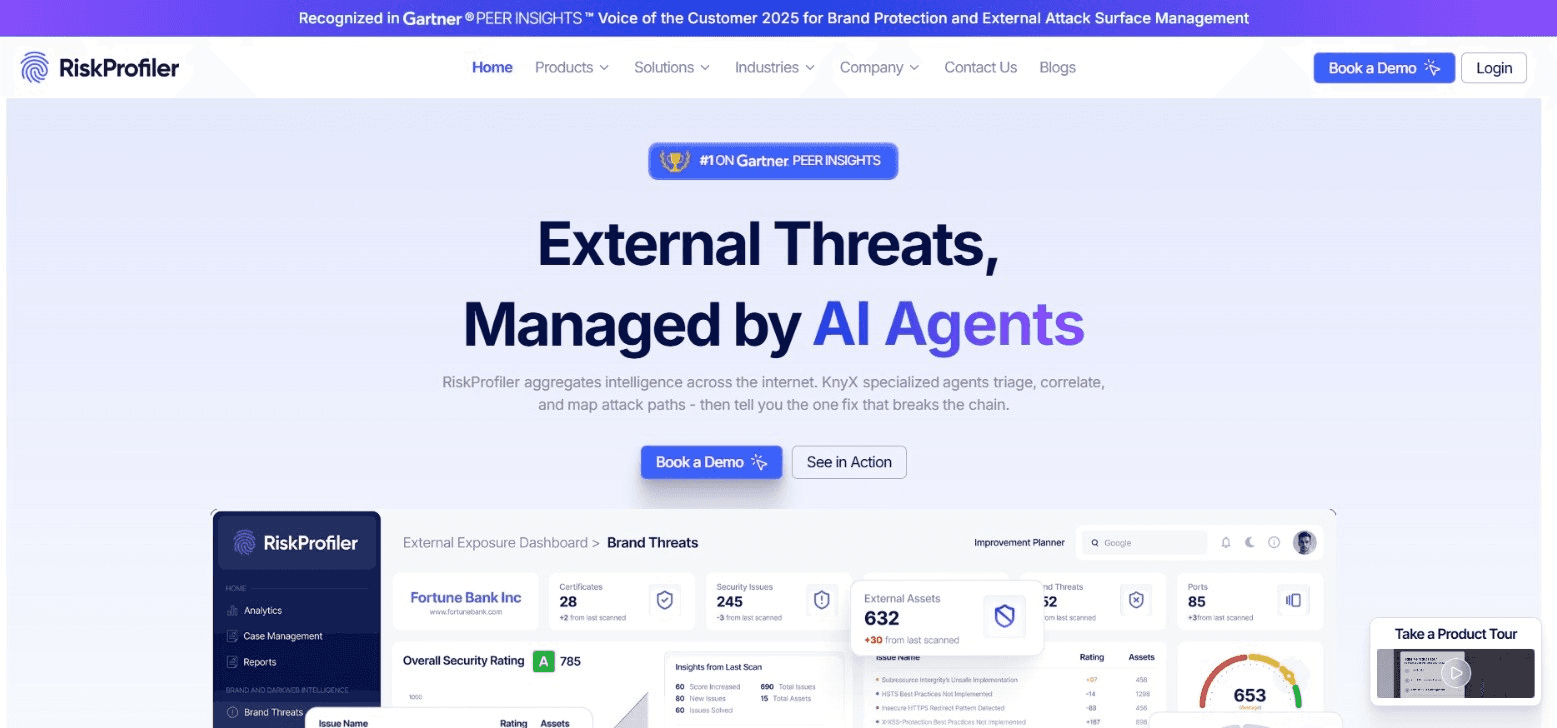
RiskProfiler is an AI-powered external threat exposure management platform designed to unify attack surface visibility, brand protection, vendor risk, and dark web monitoring in a single system. It correlates signals across multiple risk domains using KnyX AI to identify exposure patterns and prioritize threats across modern digital environments.
Company Overview
Founded: 2019
Headquarters: Rock Hill, South Carolina, USA
Employees: 51–200
Certifications: SOC 2, ISO 27001, GDPR
Recognition: Gartner Peer Insights #2 External Attack Surface Management (5/5)
Key Features:
Unified RiskProfiler External Attack Surface Management: Combines external attack surface management, brand protection, vendor risk, and dark web monitoring in one system.
AI-Driven Correlation Engine: Uses KnyX AI to connect signals across modules and identify cross-domain attack paths.
Continuous Exposure Discovery: Detects shadow IT, cloud misconfigurations, identity exposures, and external digital risks in real time.
Dark Web Intelligence Coverage: Monitors TOR networks, underground forums, and encrypted channels for threat indicators.
Pros
Consolidates multiple external risk functions into a single unified platform
AI-based correlation improves prioritization across different exposure types
Extends beyond ASM into brand and dark web threat monitoring
Cons
Relatively newer platform compared to long-established enterprise ASM vendors
Pricing is not publicly disclosed, limiting upfront evaluation transparency
Recommended For: Mid-market and growing enterprises needing a unified platform for external attack surface, brand risk, vendor exposure, and dark web monitoring without multiple standalone tools.
Book a demo with RiskProfiler to monitor your external attack surface, uncover hidden exposures, and prioritize risks across your digital footprint.
2. Palo Alto Networks Cortex Xpanse

Founded in 2005 and headquartered in Santa Clara, California, Palo Alto Networks Cortex Xpanse delivers external attack surface management through its Expanse acquisition, completed in 2020 for approximately $800M. The platform continuously scans internet-facing infrastructure to identify attacker-discoverable assets across global environments. It is adopted across large enterprises and government sectors, enriched by Unit 42 threat intelligence.
Company Overview
Founded: 2005 (Palo Alto Networks)
Headquarters: Santa Clara, California
Employees: 16,068 worldwide
Certifications: ISO/IEC 27001, 27017, 27018, 27701; SOC 2; FedRAMP Authorized; FIPS 140-2; Common Criteria; StateRAMP (per Palo Alto Networks Trust Center)
Recognition: Cortex Xpanse is used by branches of the U.S. military and large enterprises (per Palo Alto Networks product page)
Key Features:
Internet-Wide External Asset Discovery: Continuously scans global internet infrastructure to identify unknown external attack surface assets across IP ranges, cloud workloads, and exposed systems.
Cortex Ecosystem Integration: Integrates with Cortex XDR and XSOAR to enable coordinated detection, investigation, and automated response workflows.
Risk Prioritization Engine: Assesses exposed assets and evaluates exploitability to prioritize remediation across the organization’s attack surface.
Subsidiary Asset Discovery: Identifies unmanaged subsidiaries and acquired entities, mapping hidden infrastructure into the broader external attack surface.
Pros
Broad internet-scale discovery driven by Expanse asset intelligence and continuous scanning capabilities
Strong integration across the Cortex security platform supports unified detection and response operations
Unit 42 threat intelligence enhances the contextual accuracy of exposure identification
Cons
Premium pricing compared to many external attack surface management tools
Maximum value achieved primarily within the Palo Alto Networks ecosystem environments
Recommended For: Large enterprises and government organizations requiring continuous external attack surface visibility and automated response within an integrated Cortex security platform.
3. Microsoft Defender External Attack Surface Management
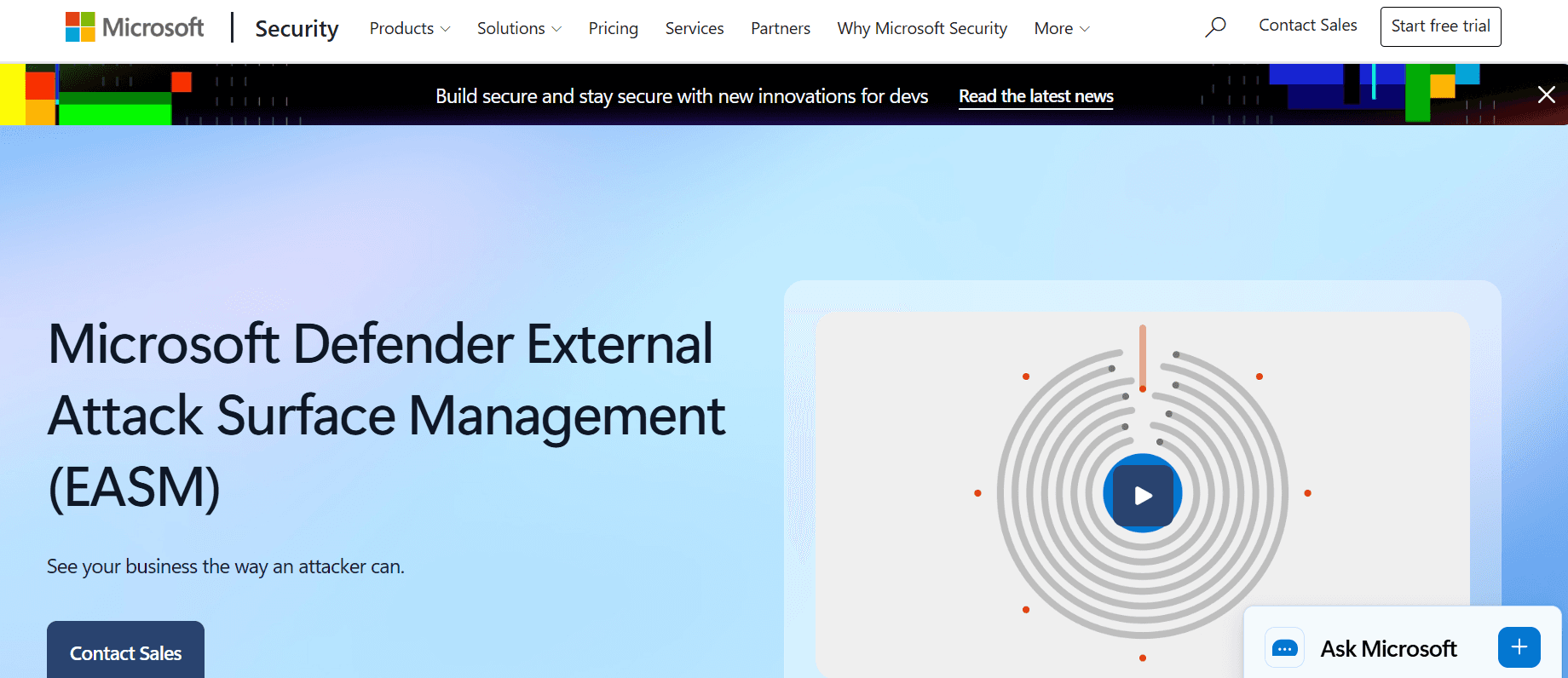
Microsoft Defender provides External Attack Surface Management through its RiskIQ acquisition, completed in 2021, with deal value reported by multiple public sources at over $500 million. The platform delivers continuous discovery of internet-facing assets, including unmanaged and previously unknown infrastructure, and integrates with Microsoft Defender XDR and Microsoft Sentinel for centralized security visibility.
Company Overview
Founded: 1975 (Microsoft Corporation)
Headquarters: Redmond, Washington
Employees: ~228,000 worldwide
Certifications: Microsoft maintains an extensive certification portfolio, including ISO/IEC 27001, 27017, 27018, 27701; SOC 1/2/3; FedRAMP High; HIPAA; GDPR; PCI DSS, plus regional certifications across 100+ jurisdictions (per Microsoft Trust Center)
Recognition: Microsoft Defender External Attack Surface Management is listed on Gartner Peer Insights for the External Attack Surface Management category.
Key Features:
Public-Facing Asset Discovery: Continuously identifies external attack surface assets across domains, IP ranges, cloud services, and internet-facing infrastructure.
Defender Ecosystem Integration: Connects with Microsoft Defender XDR and Microsoft Sentinel for correlated detection and response workflows.
Telemetry-Based Threat Intelligence: Uses Microsoft global telemetry signals to support exposure detection and contextual analysis.
Risk Prioritization Support: Helps security teams assess and prioritize exposed assets for remediation across external environments.
Pros
Strong integration with Microsoft 365, Azure, and Defender security ecosystem
Consolidated visibility across the internal and external attack surface within the Microsoft security stack
Built on RiskIQ asset inventory and external discovery capabilities
Cons
Primarily delivers full value in Microsoft-centric environments
Some deployments may require tuning to reduce false positive alerts
Recommended For: Organizations using Microsoft Azure, Microsoft 365, and Defender XDR seeking centralized visibility of internal and external attack surface within a unified security environment.
4. CrowdStrike Falcon Surface
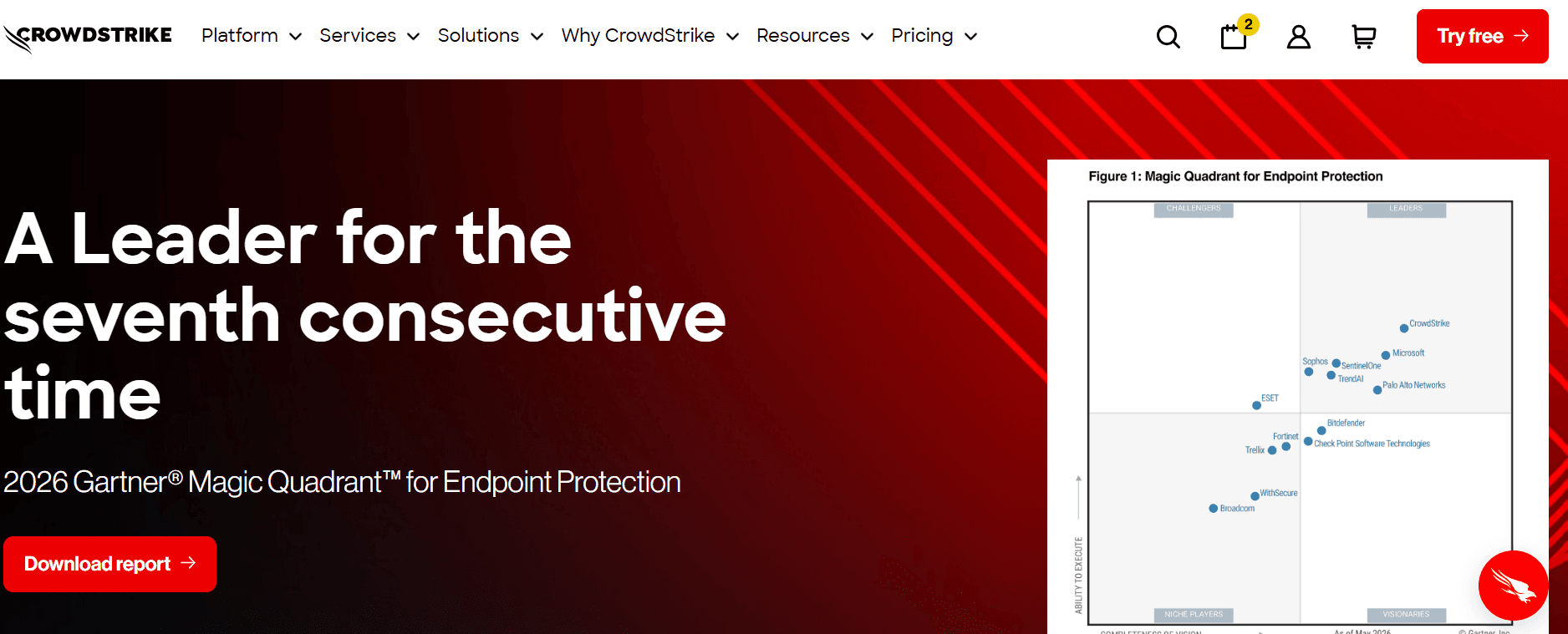
Founded in 2011 and headquartered in Austin, Texas, CrowdStrike provides Falcon Surface as its external attack surface management capability. It is built on the Reposify acquisition completed in 2022. The platform delivers an adversary-driven view of internet-facing assets and correlates external exposure with internal endpoint telemetry within the Falcon ecosystem.
Company Overview
Founded: 2011 (CrowdStrike)
Headquarters: Austin, Texas, USA
Employees: 5,001–10,000
Certifications: SOC 2 Type II, ISO 27001 (CrowdStrike Falcon platform)
Recognition: Gartner Magic Quadrant Leader for Endpoint Protection Platforms (multiple consecutive years)
Key Features:
Adversary Perspective Discovery: Identifies external attack surface assets using attacker-style reconnaissance across internet-facing systems and cloud environments.
Falcon Platform Integration: Combines EDR and EASM capabilities within a single Falcon console for unified security operations.
Threat Intelligence Enrichment: Uses CrowdStrike Intelligence to enhance detection accuracy and exposure context across environments.
Continuous Asset Monitoring: Tracks cloud and on-prem internet-facing assets for ongoing external attack surface visibility.
Pros
Strong correlation between external exposure and internal endpoint telemetry signals
Unified operations for organizations already using the CrowdStrike Falcon platform
Backed by CrowdStrike Intelligence research and threat analysis capabilities
Cons
Best value achieved when fully deployed within the Falcon ecosystem
EASM capability is newer compared to long-established pure-play ASM vendors
Recommended For: Organizations using CrowdStrike Falcon for endpoint security that want unified visibility across internal endpoints and external attack surface exposure.
5. Mandiant Attack Surface Management
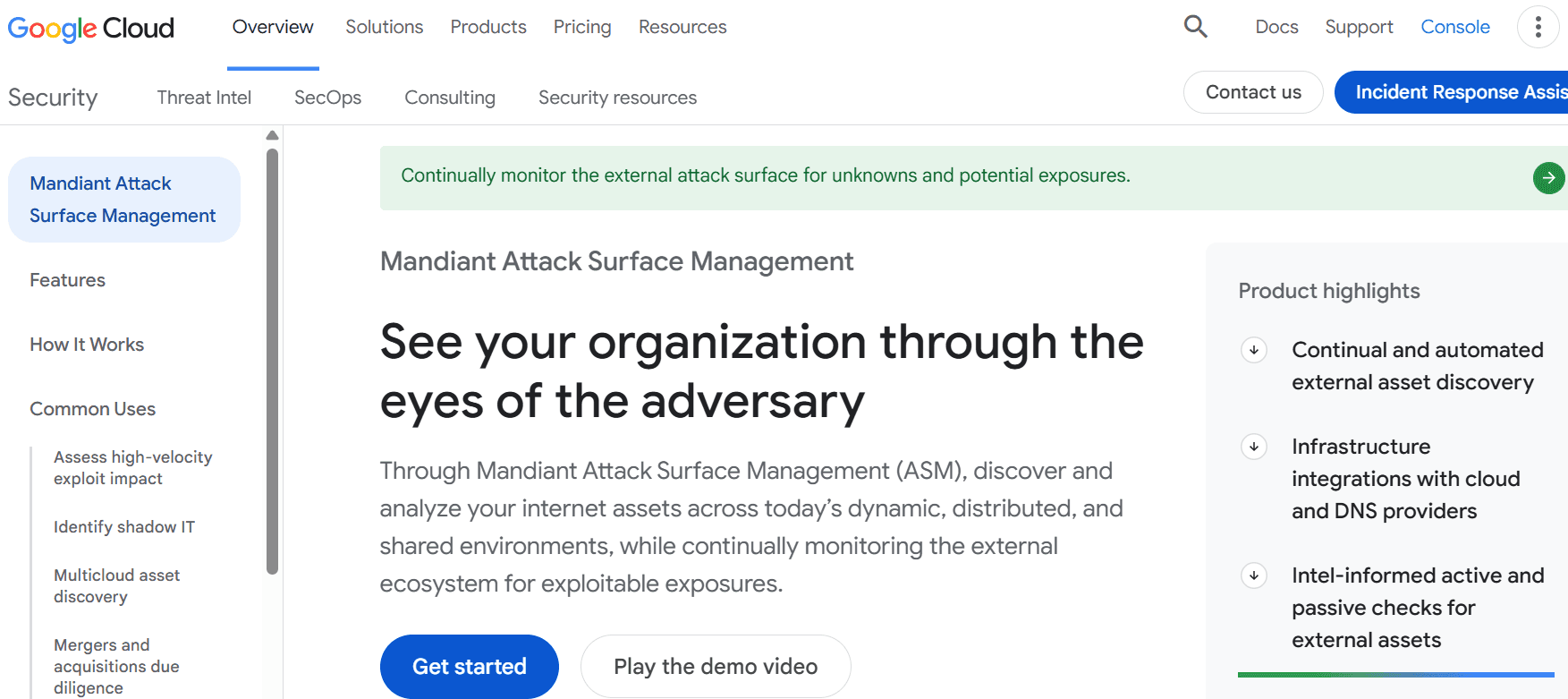
Mandiant Attack Surface Management is part of Google Cloud Security following Google’s 2022 acquisition of Mandiant for $5.4B. The platform focuses on continuous discovery and analysis of internet-facing assets using intelligence derived from real-world incident response operations. It is designed to improve visibility across distributed external attack surfaces and reduce unknown exposure.
Company Overview
Founded: 2004 (Mandiant)
Headquarters: Mandiant pre-acquisition: Reston, Virginia. Google Cloud: Mountain View, California
Employees: Part of Alphabet (~183,000 employees)
Certifications: ISO/IEC 27001, 27017, 27018, 27701; SOC 1/2/3; FedRAMP High; HIPAA; PCI DSS; CSA STAR (per Google Cloud Compliance Center)
Recognition: Listed as a "large vendor" in The Forrester External Attack Surface Management Landscape Report, Q1 2023 (per Mandiant / Google Cloud blog)
Key Features:
Scheduled Asset Discovery Scanning: Runs daily, weekly, or on-demand scans to maintain updated visibility of external attack surface assets.
Threat Intelligence Validation: Uses Mandiant indicators of compromise and incident data to validate exposed or active risks.
Risk-Driven Discovery Output: Organizes discovered assets based on real incident relevance and exposure severity.
Multi-Entity Access Control: Supports role-based access control for subsidiaries and complex enterprise environments.
Pros
Strong foundation in Mandiant incident response and breach investigation intelligence
Effective for organizations managing subsidiaries or frequent acquisitions
Continuously informed by real-world security investigations and threat research
Cons
Most effective when used within the Google Cloud Security ecosystem
Pricing model based on employee count may not suit all procurement structures
Recommended For: Enterprises with complex organizational structures requiring incident-informed external attack surface visibility across subsidiaries and acquisition-heavy environments.
Also Read: 5 Online External Attack Surface Management Companies in India in 2026
How to Choose the Best Online Attack Surface Management Providers?
Choosing the right external attack surface management provider requires evaluating how well it understands your organization’s attack surface, including internal and external environments. The right vendor should provide strong attack surface mapping, continuous monitoring, and clear visibility across the entire external attack surface.
Here’s how to pick the right attack surface monitoring tools:
Assess Your Organization’s Specific Needs: Start with a full attack surface assessment across the internal attack surface and external attack surfaces. Identify external assets, unmanaged domains, and exposure gaps. This defines your organization’s attack surface clearly.
Match Requirements to Vendor Strengths: Compare vendors offering attack surface management software or an EASM tool. Look for external attack surface management capabilities like attack surface monitoring, asset management, and attack surface reduction.
Run a Proof of Concept Before Committing: Test how the cybersecurity platform performs attack surface mapping and discovery. Evaluate if it identifies real external and internal attack vectors. Validate visibility across your entire external attack surface.
Evaluate Total Cost of Ownership: Consider licensing, scaling, and integration with management systems. Compare top attack surface management tools based on long-term cost, not just initial pricing or best attack surface positioning.
Check Market Credibility and Insights: Review analyst feedback from Gartner Peer Insights and compare providers. This helps validate platform maturity and alignment with best practices in 2026.
Conclusion: Why Is RiskProfiler Important for External Attack Surface Management?
External attack surfaces continue to expand as organizations adopt cloud services, SaaS applications, APIs, and third-party platforms. Without continuous visibility, unknown assets, shadow IT, exposed services, and unmanaged infrastructure can create security gaps that increase organizational risk. RiskProfiler addresses these challenges through a unified external threat exposure management platform that combines external attack surface management, brand protection, vendor risk monitoring, and dark web intelligence in a single solution.
Its AI-powered correlation capabilities help security teams connect signals across multiple risk domains, discover external assets, identify hidden exposures, and prioritize threats more effectively. By bringing multiple external risk functions together in one platform, RiskProfiler helps organizations improve visibility, reduce blind spots, and strengthen their external security posture.
Book a personalized demo to see how RiskProfiler helps secure your external attack surface.
Modern organizations rely on cloud services, SaaS applications, APIs, and third-party platforms to operate efficiently. This growing dependence has blurred the traditional digital perimeter, creating a larger and more complex external attack surface. As organizations become increasingly interconnected, unknown assets, shadow IT, and exposed services can create security blind spots that attackers may exploit. This article explains attack surface management, reviews the top 5 external attack surface management companies in the USA, and outlines the key factors to consider when selecting the right provider.
At a Glance
RiskProfiler: Unified external attack surface management, vendor risk, dark web monitoring, and brand protection
Palo Alto Cortex Xpanse: Internet-scale external asset discovery and attack surface visibility
Microsoft Defender EASM: External attack surface management integrated with Microsoft Defender and Sentinel
CrowdStrike Falcon Surface: Adversary-driven external attack surface monitoring
Mandiant Attack Surface Management: Incident-informed external asset discovery and validation
What Is Attack Surface Management, and Why Your Organization Needs an Attack Surface Management Company?
Attack surface management is the continuous discovery, mapping, and protection of an organization’s external attack surface across cloud, SaaS, APIs, and internet-facing assets. It uses an attack surface management tool for detection, visibility, and risk prioritization. It helps security teams manage vulnerabilities and reduce exposure in real time for 2026 environments.
Here’s why ASM is critical and how it helps organizations:
Expanding External Attack Surfaces: Cloud adoption, SaaS usage, and third-party tools expand external attack surfaces. ASM improves attack surface visibility and discovers unknown internet-facing assets.
Limits of Traditional Tools: Traditional vulnerability management tools lack continuous external attack surface management. ASM platforms improve detection, mapping, and exposure management across internal and external assets.
Operational Security Improvement: ASM enables continuous monitoring, attack surface scanning, and threat intelligence correlation. It helps security teams prioritize vulnerabilities and reduce blind spots in security management.
Cost of Unmanaged Exposure: An unmanaged attack surface leads to missed attack vectors and delayed remediation. This increases breach risk and weakens risk management across the organization’s entire attack surface.
Key Features to Look for in an ASM Provider
An effective external attack surface management provider works as an attack surface management platform. It continuously discovers external digital assets and maps attack paths across environments in 2026.
Here are the key ASM provider capabilities:
Continuous Attack Surface Discovery and Coverage: An ASM tool must enable attack surface discovery across the internal and external attack surface. It should detect shadow IT and internet-facing assets using automated tools.
Risk Prioritization and Attack Path Analysis: The platform must perform attack surface analysis and risk assessment using external threat intelligence. It should map attack paths and identify potential attack vectors.
Integration with Security Tools and Platforms: The attack surface management solution should integrate with SIEM, SOAR, and vulnerability management tools like Tenable vulnerability management. This improves detection and remediation workflows.
External Exposure and Policy Management: The system must support security policy management and exposure management. It should help reduce attack surfaces and mitigate external exposure across digital attack environments.
Enterprise Scalability and Platform Readiness: Top external attack surface management tools must scale across expanding attack surfaces with continuous monitoring.
Top 5 External Attack Surface Management Vendors in the USA
Modern enterprises face expanding cloud estates, SaaS sprawl, APIs, and third-party integrations that increase unmanaged exposure. The companies below are selected based on enterprise deployment maturity, external attack surface coverage depth, continuous discovery accuracy, and integration strength with modern security operations.
Platform | Best At | Standout Capability |
RiskProfiler | Unified external threat exposure | One platform spanning ASM, brand, vendor risk, and dark web monitoring via KnyX AI |
Palo Alto Cortex Xpanse | Internet-scale external discovery | Continuous internet-wide scanning of attacker-discoverable assets across the IPv4 space |
Microsoft Defender EASM | Microsoft ecosystem ASM | Native integration with Defender XDR and Sentinel built on RiskIQ data |
CrowdStrike Falcon Surface | Adversary-driven EASM | Outside-in attacker view combined with inside-out Falcon platform data |
Mandiant Attack Surface Management | Incident-informed discovery | Asset validation using Mandiant frontline incident response intelligence |
1. RiskProfiler
RiskProfiler is an AI-powered external threat exposure management platform designed to unify attack surface visibility, brand protection, vendor risk, and dark web monitoring in a single system. It correlates signals across multiple risk domains using KnyX AI to identify exposure patterns and prioritize threats across modern digital environments.
Company Overview
Founded: 2019
Headquarters: Rock Hill, South Carolina, USA
Employees: 51–200
Certifications: SOC 2, ISO 27001, GDPR
Recognition: Gartner Peer Insights #2 External Attack Surface Management (5/5)
Key Features:
Unified RiskProfiler External Attack Surface Management: Combines external attack surface management, brand protection, vendor risk, and dark web monitoring in one system.
AI-Driven Correlation Engine: Uses KnyX AI to connect signals across modules and identify cross-domain attack paths.
Continuous Exposure Discovery: Detects shadow IT, cloud misconfigurations, identity exposures, and external digital risks in real time.
Dark Web Intelligence Coverage: Monitors TOR networks, underground forums, and encrypted channels for threat indicators.
Pros
Consolidates multiple external risk functions into a single unified platform
AI-based correlation improves prioritization across different exposure types
Extends beyond ASM into brand and dark web threat monitoring
Cons
Relatively newer platform compared to long-established enterprise ASM vendors
Pricing is not publicly disclosed, limiting upfront evaluation transparency
Recommended For: Mid-market and growing enterprises needing a unified platform for external attack surface, brand risk, vendor exposure, and dark web monitoring without multiple standalone tools.
Book a demo with RiskProfiler to monitor your external attack surface, uncover hidden exposures, and prioritize risks across your digital footprint.
2. Palo Alto Networks Cortex Xpanse
Founded in 2005 and headquartered in Santa Clara, California, Palo Alto Networks Cortex Xpanse delivers external attack surface management through its Expanse acquisition, completed in 2020 for approximately $800M. The platform continuously scans internet-facing infrastructure to identify attacker-discoverable assets across global environments. It is adopted across large enterprises and government sectors, enriched by Unit 42 threat intelligence.
Company Overview
Founded: 2005 (Palo Alto Networks)
Headquarters: Santa Clara, California
Employees: 16,068 worldwide
Certifications: ISO/IEC 27001, 27017, 27018, 27701; SOC 2; FedRAMP Authorized; FIPS 140-2; Common Criteria; StateRAMP (per Palo Alto Networks Trust Center)
Recognition: Cortex Xpanse is used by branches of the U.S. military and large enterprises (per Palo Alto Networks product page)
Key Features:
Internet-Wide External Asset Discovery: Continuously scans global internet infrastructure to identify unknown external attack surface assets across IP ranges, cloud workloads, and exposed systems.
Cortex Ecosystem Integration: Integrates with Cortex XDR and XSOAR to enable coordinated detection, investigation, and automated response workflows.
Risk Prioritization Engine: Assesses exposed assets and evaluates exploitability to prioritize remediation across the organization’s attack surface.
Subsidiary Asset Discovery: Identifies unmanaged subsidiaries and acquired entities, mapping hidden infrastructure into the broader external attack surface.
Pros
Broad internet-scale discovery driven by Expanse asset intelligence and continuous scanning capabilities
Strong integration across the Cortex security platform supports unified detection and response operations
Unit 42 threat intelligence enhances the contextual accuracy of exposure identification
Cons
Premium pricing compared to many external attack surface management tools
Maximum value achieved primarily within the Palo Alto Networks ecosystem environments
Recommended For: Large enterprises and government organizations requiring continuous external attack surface visibility and automated response within an integrated Cortex security platform.
3. Microsoft Defender External Attack Surface Management
Microsoft Defender provides External Attack Surface Management through its RiskIQ acquisition, completed in 2021, with deal value reported by multiple public sources at over $500 million. The platform delivers continuous discovery of internet-facing assets, including unmanaged and previously unknown infrastructure, and integrates with Microsoft Defender XDR and Microsoft Sentinel for centralized security visibility.
Company Overview
Founded: 1975 (Microsoft Corporation)
Headquarters: Redmond, Washington
Employees: ~228,000 worldwide
Certifications: Microsoft maintains an extensive certification portfolio, including ISO/IEC 27001, 27017, 27018, 27701; SOC 1/2/3; FedRAMP High; HIPAA; GDPR; PCI DSS, plus regional certifications across 100+ jurisdictions (per Microsoft Trust Center)
Recognition: Microsoft Defender External Attack Surface Management is listed on Gartner Peer Insights for the External Attack Surface Management category.
Key Features:
Public-Facing Asset Discovery: Continuously identifies external attack surface assets across domains, IP ranges, cloud services, and internet-facing infrastructure.
Defender Ecosystem Integration: Connects with Microsoft Defender XDR and Microsoft Sentinel for correlated detection and response workflows.
Telemetry-Based Threat Intelligence: Uses Microsoft global telemetry signals to support exposure detection and contextual analysis.
Risk Prioritization Support: Helps security teams assess and prioritize exposed assets for remediation across external environments.
Pros
Strong integration with Microsoft 365, Azure, and Defender security ecosystem
Consolidated visibility across the internal and external attack surface within the Microsoft security stack
Built on RiskIQ asset inventory and external discovery capabilities
Cons
Primarily delivers full value in Microsoft-centric environments
Some deployments may require tuning to reduce false positive alerts
Recommended For: Organizations using Microsoft Azure, Microsoft 365, and Defender XDR seeking centralized visibility of internal and external attack surface within a unified security environment.
4. CrowdStrike Falcon Surface
Founded in 2011 and headquartered in Austin, Texas, CrowdStrike provides Falcon Surface as its external attack surface management capability. It is built on the Reposify acquisition completed in 2022. The platform delivers an adversary-driven view of internet-facing assets and correlates external exposure with internal endpoint telemetry within the Falcon ecosystem.
Company Overview
Founded: 2011 (CrowdStrike)
Headquarters: Austin, Texas, USA
Employees: 5,001–10,000
Certifications: SOC 2 Type II, ISO 27001 (CrowdStrike Falcon platform)
Recognition: Gartner Magic Quadrant Leader for Endpoint Protection Platforms (multiple consecutive years)
Key Features:
Adversary Perspective Discovery: Identifies external attack surface assets using attacker-style reconnaissance across internet-facing systems and cloud environments.
Falcon Platform Integration: Combines EDR and EASM capabilities within a single Falcon console for unified security operations.
Threat Intelligence Enrichment: Uses CrowdStrike Intelligence to enhance detection accuracy and exposure context across environments.
Continuous Asset Monitoring: Tracks cloud and on-prem internet-facing assets for ongoing external attack surface visibility.
Pros
Strong correlation between external exposure and internal endpoint telemetry signals
Unified operations for organizations already using the CrowdStrike Falcon platform
Backed by CrowdStrike Intelligence research and threat analysis capabilities
Cons
Best value achieved when fully deployed within the Falcon ecosystem
EASM capability is newer compared to long-established pure-play ASM vendors
Recommended For: Organizations using CrowdStrike Falcon for endpoint security that want unified visibility across internal endpoints and external attack surface exposure.
5. Mandiant Attack Surface Management
Mandiant Attack Surface Management is part of Google Cloud Security following Google’s 2022 acquisition of Mandiant for $5.4B. The platform focuses on continuous discovery and analysis of internet-facing assets using intelligence derived from real-world incident response operations. It is designed to improve visibility across distributed external attack surfaces and reduce unknown exposure.
Company Overview
Founded: 2004 (Mandiant)
Headquarters: Mandiant pre-acquisition: Reston, Virginia. Google Cloud: Mountain View, California
Employees: Part of Alphabet (~183,000 employees)
Certifications: ISO/IEC 27001, 27017, 27018, 27701; SOC 1/2/3; FedRAMP High; HIPAA; PCI DSS; CSA STAR (per Google Cloud Compliance Center)
Recognition: Listed as a "large vendor" in The Forrester External Attack Surface Management Landscape Report, Q1 2023 (per Mandiant / Google Cloud blog)
Key Features:
Scheduled Asset Discovery Scanning: Runs daily, weekly, or on-demand scans to maintain updated visibility of external attack surface assets.
Threat Intelligence Validation: Uses Mandiant indicators of compromise and incident data to validate exposed or active risks.
Risk-Driven Discovery Output: Organizes discovered assets based on real incident relevance and exposure severity.
Multi-Entity Access Control: Supports role-based access control for subsidiaries and complex enterprise environments.
Pros
Strong foundation in Mandiant incident response and breach investigation intelligence
Effective for organizations managing subsidiaries or frequent acquisitions
Continuously informed by real-world security investigations and threat research
Cons
Most effective when used within the Google Cloud Security ecosystem
Pricing model based on employee count may not suit all procurement structures
Recommended For: Enterprises with complex organizational structures requiring incident-informed external attack surface visibility across subsidiaries and acquisition-heavy environments.
Also Read: 5 Online External Attack Surface Management Companies in India in 2026
How to Choose the Best Online Attack Surface Management Providers?
Choosing the right external attack surface management provider requires evaluating how well it understands your organization’s attack surface, including internal and external environments. The right vendor should provide strong attack surface mapping, continuous monitoring, and clear visibility across the entire external attack surface.
Here’s how to pick the right attack surface monitoring tools:
Assess Your Organization’s Specific Needs: Start with a full attack surface assessment across the internal attack surface and external attack surfaces. Identify external assets, unmanaged domains, and exposure gaps. This defines your organization’s attack surface clearly.
Match Requirements to Vendor Strengths: Compare vendors offering attack surface management software or an EASM tool. Look for external attack surface management capabilities like attack surface monitoring, asset management, and attack surface reduction.
Run a Proof of Concept Before Committing: Test how the cybersecurity platform performs attack surface mapping and discovery. Evaluate if it identifies real external and internal attack vectors. Validate visibility across your entire external attack surface.
Evaluate Total Cost of Ownership: Consider licensing, scaling, and integration with management systems. Compare top attack surface management tools based on long-term cost, not just initial pricing or best attack surface positioning.
Check Market Credibility and Insights: Review analyst feedback from Gartner Peer Insights and compare providers. This helps validate platform maturity and alignment with best practices in 2026.
Conclusion: Why Is RiskProfiler Important for External Attack Surface Management?
External attack surfaces continue to expand as organizations adopt cloud services, SaaS applications, APIs, and third-party platforms. Without continuous visibility, unknown assets, shadow IT, exposed services, and unmanaged infrastructure can create security gaps that increase organizational risk. RiskProfiler addresses these challenges through a unified external threat exposure management platform that combines external attack surface management, brand protection, vendor risk monitoring, and dark web intelligence in a single solution.
Its AI-powered correlation capabilities help security teams connect signals across multiple risk domains, discover external assets, identify hidden exposures, and prioritize threats more effectively. By bringing multiple external risk functions together in one platform, RiskProfiler helps organizations improve visibility, reduce blind spots, and strengthen their external security posture.
Book a personalized demo to see how RiskProfiler helps secure your external attack surface.
Jump to
Share Article
We Have Answers!
Explore our FAQ to learn more about how RiskProfiler can help safeguard your digital assets and manage risks efficiently.
What does an attack surface management company actually do?
An attack surface management company continuously discovers and maps an organization’s external attack surface using an external attack surface management platform. It identifies exposed assets, tracks changes, and helps manage your attack surface through continuous monitoring, risk prioritization, and remediation workflows. Platforms such as RiskProfiler also combine external attack surface visibility with broader external risk monitoring to help security teams identify and prioritize exposures.
How much do attack surface management tools cost?
Costs vary based on asset volume, scanning frequency, and platform depth. Advanced external attack surface management platforms and best attack surface management tools typically use subscription pricing, scaling with external assets, integrations, and monitoring intensity across 2026 environments.
What's the difference between ASM and EASM?
ASM covers internal and external attack surface visibility, while EASM focuses only on external attack surface management. An EASM tool maps internet-facing assets, while full ASM includes internal attack surface, asset correlation, and broader risk assessment.
Can ASM replace vulnerability management?
No, ASM does not replace vulnerability management. It enhances it by improving attack surface mapping and discovery. Vulnerability tools focus on patching, while attack surface management provides visibility into unknown assets and external exposure.
Is attack surface management suitable for small and mid-sized businesses?
Yes, modern attack surface management platforms are scalable for SMBs. Surface management tools for 2026 offer automated discovery and simplified dashboards, helping smaller teams manage external exposure without complex management systems or large security teams. Platforms like RiskProfiler are designed to help growing organizations gain visibility into external exposures from a centralized platform.
Which compliance frameworks does ASM support?
Attack surface management supports compliance frameworks like ISO 27001, SOC 2, and PCI DSS. It improves audit readiness through continuous attack surface monitoring, asset tracking, and evidence generation across external digital environments and security policies.
Latest Insights
Stay informed with expert perspectives on cybersecurity, attack surface management,
and building digital resilience.



Enterprise-Grade Security & Trust
Specialized intelligence agents working together toprotect your organization
Ready to Transform
Your Threat Management?
Join hundreds of security teams who trust KnyX to cut through the noise and focus on what matters most.
Book a Demo Today