Shadow IT Risks: Combat Exposure with Cyber Threat Intelligence Copy
Shadow IT Risks: Combat Exposure with Cyber Threat Intelligence Copy
In a fast-growing IT environment, the number of unsanctioned software tool uses is multiplying at a concerning rate. Developers often use an unauthorized test environment and abandon it soon after without following proper protocols.
Read Time
7 min read
Posted On
Social Media
In a fast-growing IT environment, the number of unsanctioned software tool uses is multiplying at a concerning rate. Developers often use an unauthorized test environment and abandon it soon after without following proper protocols. Similarly, marketing and other business departments sign up for different SaaS tools for operational efficiency and a productivity boost, without following the advised IT approval channels. Due to their unregistered characteristics, these tools lack proper asset management oversight, creating unsecured access points to the system and generating Shadow IT risks.
Shadow IT assets and related SaaS integrations not only harm your internal asset management strategy but can also lead to security misconfigurations and unintended public exposure of sensitive data. These misconfiguration and data exposures can result in attackers gaining unauthorized access to your system, installation of ransomware, DDOS attacks, data leaks, operational downtime, and legal penalties due to non-compliance.
What is Shadow IT in Cybersecurity?
Shadow IT exposures refer to the security risk associated with the use of unmanaged and unvetted technologies. These assets includes but is not limited to cloud applications, SaaS tools, and personal devices, used by the tech and other organizational teams outside the purview of your organization’s centralized IT governance. Operating undetected outside the standard security protocols, leaves data and systems vulnerable to exploitation.
Shadow IT exposure, however, doesn’t always have to involve the complex steps or using tools without permissions. Linking personal accounts of IT-approved tools with your work system can also create such security gaps. Any interaction or activity from your personal account can go unnoticed by your IT team, creating the security blind spot. Sharing files, business data, or any sensitive information to your personal email or Dropbox account also results in shadow IT asset creation and related exposures.
What are The Risks of Shadow IT Exposures? Top 9 Shadow IT Risks
Unmonitored assets integration creates system vulnerabilities and security gaps that can be left open for too long due to a lack of knowledge. With a long period of inactivity or lack of regular updates, these shadow IT assets can lead to security exposures, leading to operational instability, loss of data, information leak, and other cyber incidents.
1. Data Leakage
Data leakage is a major concern stemming from shadow IT risks. When employees use unapproved platforms or SaaS tools such as personal cloud drives, messaging apps, or operational tools to store, share, or modify corporate data, it increases the likelihood of sensitive information being exposed. These platforms often lack enterprise-grade encryption creating security holes. Additionally, the lack of IT team oversight exclude such IT assets from regular update and safety reviews. This can lead to serious security blind spot, allowing the path for external manipulation and security breaches.
Solution: Deploy data loss prevention (DLP) tools that monitor and restrict data flow to unauthorized destinations. Implement cloud access security brokers (CASBs) to enforce encryption and usage policies for third-party apps.
2. Compliance Violations
Many industries are governed by strict data handling regulations (e.g., GDPR, HIPAA, SOC 2), and violation of any such protocol can lead to hefty penalties and legal damages. Using unvetted applications with regular operation may lead to accidental data residency breaches or failure to log required security events. Shadow IT risks can also cause breaches in user information and sensitive business data that can lead to violations of regulatory protocols.
Solution: Establish a compliance governance framework that includes an app approval process. Regularly audit software usage and use tools like RiskProfiler to map unknown assets and their compliance posture in real time.
3. Cloud Misconfigurations
Improperly configured cloud services, like publicly accessible databases or misconfigured storage buckets, are among the most exploited vulnerabilities. As shadow IT assets lie outside the internal IT inventory, the misconfigurations remain undetected for a long time. In the absence of pre-determined asset detection and management workflows, these misconfigured shadow IT assets can be discovered by external threat actors, allowing them access to internal systems.
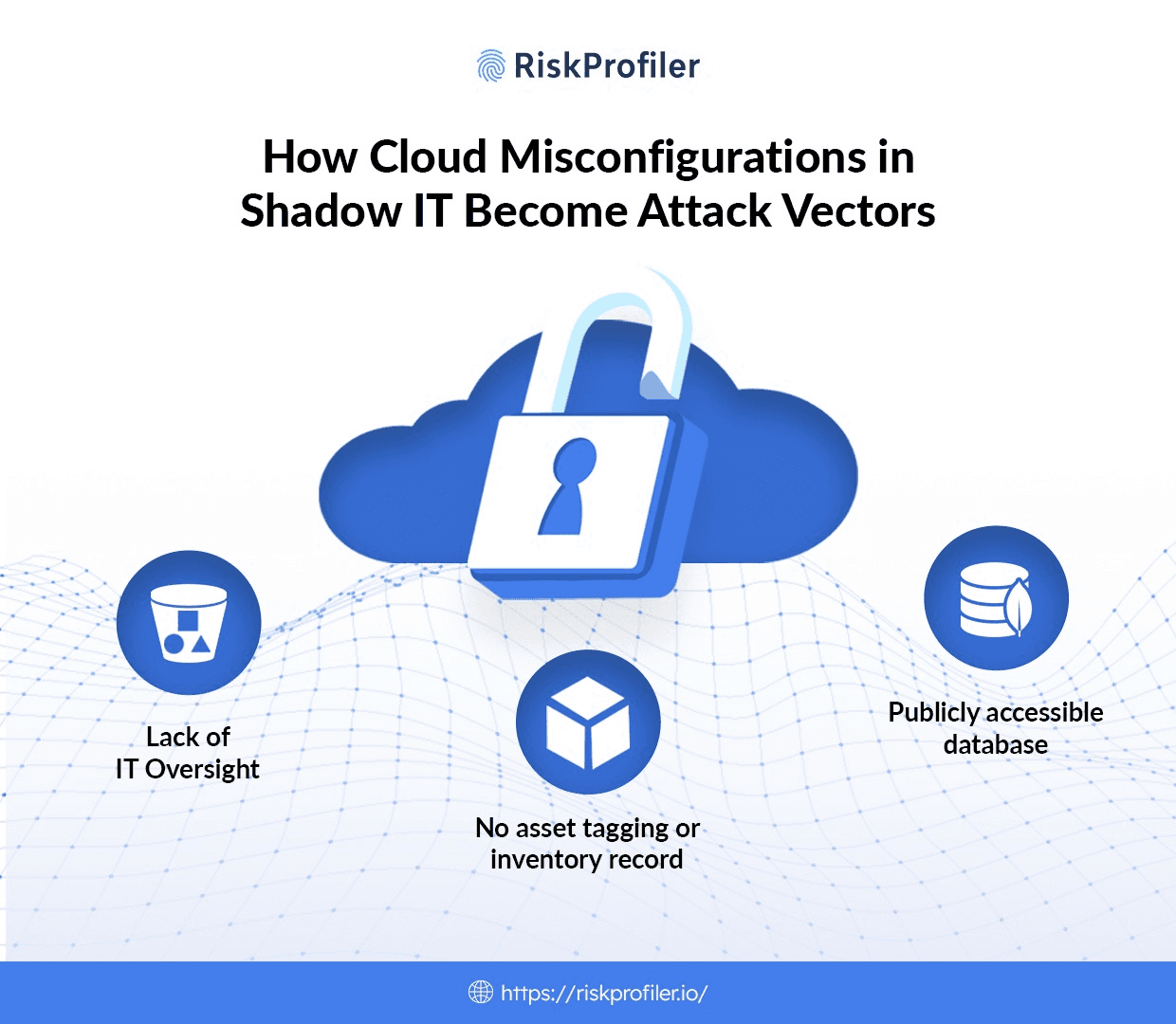
Solution: Employ automated configuration assessment tools that continuously scan for exposure points and misconfigurations. Enforce usage of pre-approved cloud templates with baked-in security settings. In extension, leveraging External attack Surface Management tools like RiskProfiler scans for misconfigurations on a regular basis, allowing IT teams to manage misconfigurations before they can pose any threat.
4. Unpatched Vulnerabilities
As mentioned earlier, shadow IT assets and APIs lie outside of the organization’s internal IT team’s visibility. Thus, the shadow API and IT assets are ignored during the organization’s patching cycle, leaving them outdated and vulnerable. When noticed by attackers, they scan such applications in order to exploit these vulnerabilities to enter the system.
Solution: Leverage external attack surface management (EASM) platforms to detect and inventory all active applications and correlate them with known CVEs (Common Vulnerabilities and Exposures) on a regular basis. Proactively communicate with users to phase out unsupported tools following IT-approved protocols.
5. Insider Threats
Insider threats can be malicious and also accidental. Irrespective of their intent, the creation of shadow assets by employees and executives without proper IT team supervision can lead to a major security blind spot. Employees using unauthorized platforms might unintentionally mishandle data, or worse, malicious insiders could exploit these tools to exfiltrate information without detection. Also, a lack of proper password hygiene can lead to the reuse of the same password in multiple accounts, leading to a wider threat profile.
Solution: Implement user behavior analytics (UBA) to detect anomalies in data access patterns. Combine this with employee training programs that educate users on the risks and policies related to Shadow IT.
6. Credential Theft
Shadow IT tools often lack strong authentication mechanisms. With the authentication oversight, employees may reuse passwords across platforms, making organizational operations vulnerable in times of an attack. Additionally, reusing passwords across multiple accounts and tools also increases the chances of successful credential stuffing attacks.
Solution: Enforce single sign-on (SSO) and multi-factor authentication (MFA) across all known apps, and monitor DNS activity to discover unknown SaaS logins. RiskProfiler can also detect exposed credentials on the dark web or breach forums.
7. Inconsistent Monitoring
Security teams cannot defend what they can’t see. Without integration into security information and event management (SIEM) tools, shadow apps generate no logs and go unmonitored. This makes the detection of vulnerability and risks hidden in these particular assets nearly impossible. This inconsistent monitoring or the absolute lack thereof, leads to vulnerabilities leaving dormant in the system for a long time. If discovered by the attackers, these security gaps can lead to threat exposure and considerable security risks
Solution: Use external attack surface monitoring tools that provide full visibility into cloud-based assets, including shadow domains, exposed services, and rogue applications. Integrate them with your SIEM or SOAR for centralized alerting.
8. Phishing Gateways
Unapproved collaboration or email platforms typically lack advanced anti-phishing filters. Without proper IT oversight, the organizational team fails to monitor these crucial gaps, leading to sizeable vulnerabilities. If left overlooked for a long time, attackers can exploit these weak links to spread phishing campaigns internally.
Solution: Adopt a zero-trust email security approach and restrict access to communication tools through network segmentation. Cyber threat intelligence tools like RiskProfiler can also identify and block phishing infrastructure tied to shadow domains.
9. Data Fragmentation
Large organizations rely on multiple teams to perform respective functions and improve operational efficiency. Often the members of these individual teams or departments, like Marketing or HR, integrates tools for improved productivity or operational ease without IT oversight. When employees spread data across multiple unauthorized apps, the organization loses control over where information is stored. This complicates data governance, backup, and disaster recovery efforts.
Solution: Conduct data mapping and discovery initiatives to identify all locations where business-critical information resides. Mandate the use of sanctioned platforms with version control and centralized backup.
Shadow IT Examples: Real-Life Events of Shadow IT Exposures
Shadow IT risks are not prophecy but data-backed predictions. Shadow assets often play a central role in several major data breaches, ransomware attacks, and compliance failures across industries. The following real-world shadow IT examples illustrate how unsanctioned tools can bypass security protocols, creating damaging consequences for organizations of all sizes.
Data Leaks Via Generative AI
The 2023 Samsung data leak is proof of how using generative AI without proper security oversight or IT approval can leak sensitive corporate information. In the leak, involving three independent incidents, employees of Samsung electronics uploaded organization sensitive information on the popular generative AI platform, ChatGPT, which included sensitive information on Samsung Electronics’ internal database.
The bugs in the generative AI platform caused the leak of sensitive corporate information in public spaces. Following the incidents, the popular appliance and electronics corporation banned the use of generative AI for employees working with them to avoid such incidents.
Unauthorized Login with Shadow IT Accounts and Tools
Storing sensitive corporate details and passwords in personal browsers and accounts can create security gaps, leading to data breaches, as seen in the 2023 Okta data breach. The source of the concerned breach is said to be an employee working for the cybersecurity organization who logged into their personal Google account from their workstation. In the breach, threat actors gained access to Okta’s support system, seized control over files containing information on session tokens. This incident resulted in attacks on several of Okta’s clients, including BeyondTrust and Cloudflare.
How Does RiskProfiler Detect Shadow IT Risks in Real Time?
Shadow IT risks presents a growing threat to organizations due to its invisible nature and the lack of governance surrounding its use. Traditional perimeter-based tools struggle to keep pace with the dynamic and distributed nature of modern cloud ecosystems. RiskProfiler bridges this gap by offering a unified platform that continuously monitors and neutralizes Shadow IT risks using real-time threat intelligence and external attack surface management.
Continuous Monitoring of Internet-Facing Assets
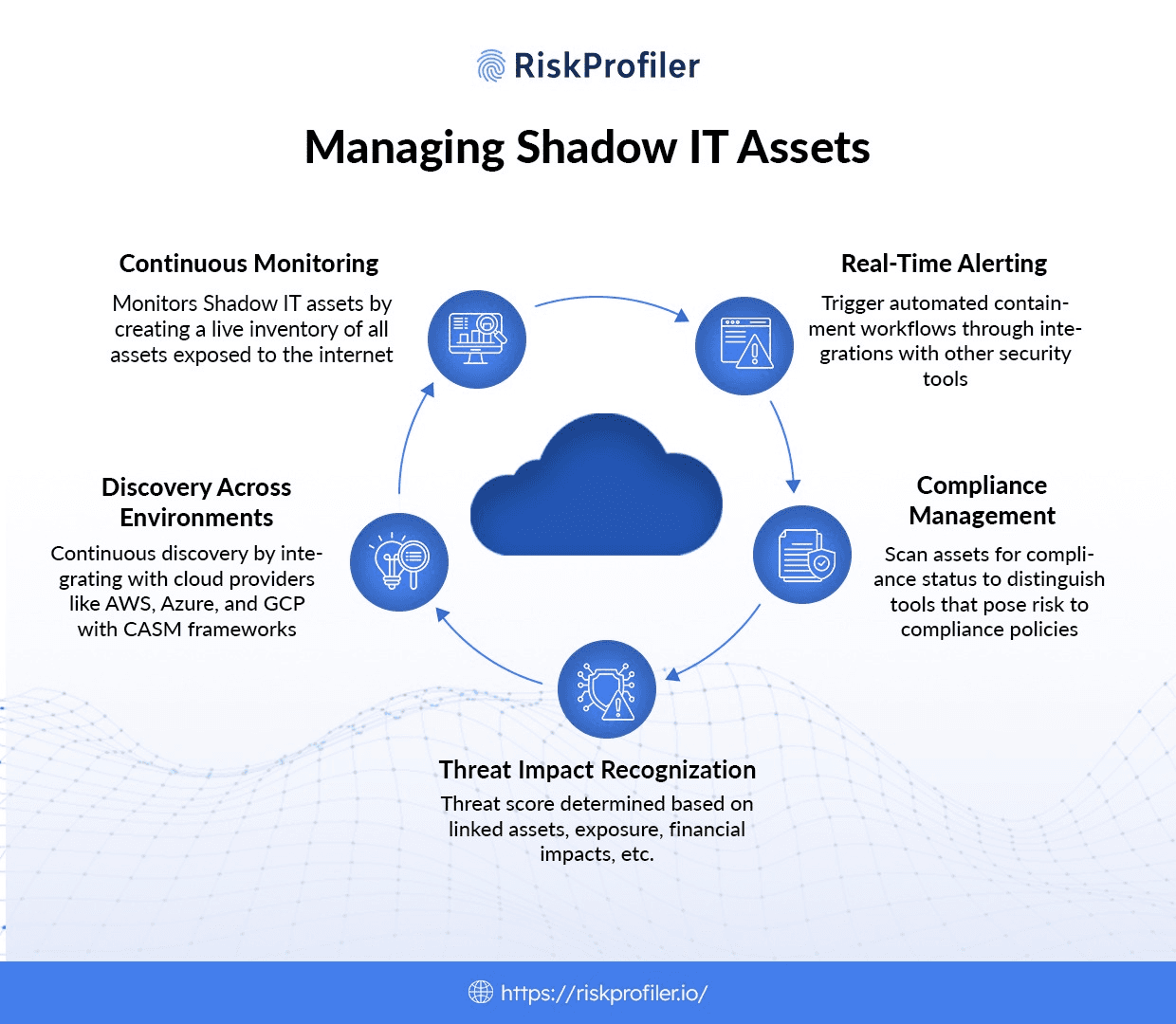
RiskProfiler, with its attack surface management, monitors Shadow IT assets by creating a live inventory of all digital assets exposed to the internet. This includes everything from subdomains and public IPs to cloud-hosted applications and misconfigured APIs. As teams within the organization deploy new tools or create temporary infrastructure, RiskProfiler automatically detects these changes. This ensures that even short-lived or unintended assets, such as forgotten development environments or test platforms, are identified before they can be exploited by malicious actors.
Third-Party Risk Intelligence
What sets RiskProfiler apart is its ability to evaluate not just the tools being used, but also the vendors behind them. Many Shadow IT tools integrate with corporate systems but originate from third-party providers with unknown or questionable security postures. RiskProfiler monitors the supply chain security posture in real time, drawing from breach history, vulnerability databases, and global threat feeds. It assigns risk ratings to each provider, helping security teams prioritize which shadow assets require immediate attention based on their business impact and threat exposure.
Cloud Asset Discovery Across Environments
In cloud environments, assets can be created and destroyed in seconds, often without centralized oversight. RiskProfiler performs continuous cloud asset discovery by integrating with cloud providers like AWS, Azure, and Google Cloud with its efficient cloud attack surface management frameworks. It maps out the organization’s infrastructure, identifies orphaned services, flags rogue applications, and detects misconfigurations that could expose sensitive data. This comprehensive visibility extends across environments, ensuring that every cloud-native component is accounted for and evaluated.
Real-Time Alerting and Automated Containment
Speed is critical in identifying and eliminating shadow it risks. RiskProfiler’s cyber threat intelligence platform is built for rapid response for managing shadow IT exposures. When a suspicious or unauthorized asset is discovered, the platform immediately alerts security teams. RiskProfiler can trigger automated containment workflows through integrations with other security tools. This means threats can be investigated and neutralized before they escalate, reducing dwell time and minimizing potential damage.
Integration with SIEMs and SOARs for Seamless Response
To maximize operational efficiency, RiskProfiler integrates directly into the security operations center’s existing stack. Whether through a SIEM for correlation and logging or a SOAR platform for automated remediation, RiskProfiler feeds its intelligence into existing workflows. This seamless integration allows security teams to treat Shadow IT threats with the same level of urgency and visibility as any internal alert, enabling end-to-end incident response and swift action to eliminate shadow IT risks.
Actionable Dashboards and Reporting
RiskProfiler provides a centralized dashboard that brings clarity to Shadow IT trends across departments, business units, and geographies. Security leaders can visualize risk exposure over time, track how many unauthorized apps have been discovered, and drill down into high-risk vendors. These insights not only support faster decision-making but also enhance board-level reporting and compliance audits with tangible metrics and real-time data.
The Strategic Advantage
By turning unknown Shadow IT assets into updated inventory and coupling discovery with intelligent response, RiskProfiler transforms Shadow IT risks from a blind spot into a manageable risk. Organizations gain the ability to proactively monitor and control their digital footprint, tighten governance around cloud use, and respond decisively to emerging threats. In doing so, RiskProfiler enables a more secure and resilient digital environment, where innovation and productivity no longer come at the cost of visibility and control.
Conclusion
Shadow IT risks are a major security concern in today’s age that bothers all businesses across the globe irrespective of their size and target marketplace. It is a mainstream security risk that demands continuous oversight, implementation of strict organization-wide protocols, and strategic mitigation. As cloud adoption surges, so do the threats lurking outside sanctioned channels.
Organizations must evolve from passive monitoring to proactive defense using AI powered cyber threat intelligence and cloud attack surface management mapping tools. By identifying unauthorized assets and enforcing cloud hygiene, businesses can implement better protocols for shadow IT monitoring and build resilience against modern attack vectors.
With solutions like RiskProfiler, enterprises can illuminate the hidden corners of their digital ecosystem, eliminate shadow IT structures on time, and curb the dangers at the seems before they can cause severe damage. In a fast-paced world, where cyber threats are evolving every day, reactive protection is not enough to secure your system.
Want to enable proactive security across your external cloud attack surface?
Book a call with a RiskProfiler expert, today!
In a fast-growing IT environment, the number of unsanctioned software tool uses is multiplying at a concerning rate. Developers often use an unauthorized test environment and abandon it soon after without following proper protocols. Similarly, marketing and other business departments sign up for different SaaS tools for operational efficiency and a productivity boost, without following the advised IT approval channels. Due to their unregistered characteristics, these tools lack proper asset management oversight, creating unsecured access points to the system and generating Shadow IT risks.
Shadow IT assets and related SaaS integrations not only harm your internal asset management strategy but can also lead to security misconfigurations and unintended public exposure of sensitive data. These misconfiguration and data exposures can result in attackers gaining unauthorized access to your system, installation of ransomware, DDOS attacks, data leaks, operational downtime, and legal penalties due to non-compliance.
What is Shadow IT in Cybersecurity?
Shadow IT exposures refer to the security risk associated with the use of unmanaged and unvetted technologies. These assets includes but is not limited to cloud applications, SaaS tools, and personal devices, used by the tech and other organizational teams outside the purview of your organization’s centralized IT governance. Operating undetected outside the standard security protocols, leaves data and systems vulnerable to exploitation.
Shadow IT exposure, however, doesn’t always have to involve the complex steps or using tools without permissions. Linking personal accounts of IT-approved tools with your work system can also create such security gaps. Any interaction or activity from your personal account can go unnoticed by your IT team, creating the security blind spot. Sharing files, business data, or any sensitive information to your personal email or Dropbox account also results in shadow IT asset creation and related exposures.
What are The Risks of Shadow IT Exposures? Top 9 Shadow IT Risks
Unmonitored assets integration creates system vulnerabilities and security gaps that can be left open for too long due to a lack of knowledge. With a long period of inactivity or lack of regular updates, these shadow IT assets can lead to security exposures, leading to operational instability, loss of data, information leak, and other cyber incidents.
1. Data Leakage
Data leakage is a major concern stemming from shadow IT risks. When employees use unapproved platforms or SaaS tools such as personal cloud drives, messaging apps, or operational tools to store, share, or modify corporate data, it increases the likelihood of sensitive information being exposed. These platforms often lack enterprise-grade encryption creating security holes. Additionally, the lack of IT team oversight exclude such IT assets from regular update and safety reviews. This can lead to serious security blind spot, allowing the path for external manipulation and security breaches.
Solution: Deploy data loss prevention (DLP) tools that monitor and restrict data flow to unauthorized destinations. Implement cloud access security brokers (CASBs) to enforce encryption and usage policies for third-party apps.
2. Compliance Violations
Many industries are governed by strict data handling regulations (e.g., GDPR, HIPAA, SOC 2), and violation of any such protocol can lead to hefty penalties and legal damages. Using unvetted applications with regular operation may lead to accidental data residency breaches or failure to log required security events. Shadow IT risks can also cause breaches in user information and sensitive business data that can lead to violations of regulatory protocols.
Solution: Establish a compliance governance framework that includes an app approval process. Regularly audit software usage and use tools like RiskProfiler to map unknown assets and their compliance posture in real time.
3. Cloud Misconfigurations
Improperly configured cloud services, like publicly accessible databases or misconfigured storage buckets, are among the most exploited vulnerabilities. As shadow IT assets lie outside the internal IT inventory, the misconfigurations remain undetected for a long time. In the absence of pre-determined asset detection and management workflows, these misconfigured shadow IT assets can be discovered by external threat actors, allowing them access to internal systems.
Solution: Employ automated configuration assessment tools that continuously scan for exposure points and misconfigurations. Enforce usage of pre-approved cloud templates with baked-in security settings. In extension, leveraging External attack Surface Management tools like RiskProfiler scans for misconfigurations on a regular basis, allowing IT teams to manage misconfigurations before they can pose any threat.
4. Unpatched Vulnerabilities
As mentioned earlier, shadow IT assets and APIs lie outside of the organization’s internal IT team’s visibility. Thus, the shadow API and IT assets are ignored during the organization’s patching cycle, leaving them outdated and vulnerable. When noticed by attackers, they scan such applications in order to exploit these vulnerabilities to enter the system.
Solution: Leverage external attack surface management (EASM) platforms to detect and inventory all active applications and correlate them with known CVEs (Common Vulnerabilities and Exposures) on a regular basis. Proactively communicate with users to phase out unsupported tools following IT-approved protocols.
5. Insider Threats
Insider threats can be malicious and also accidental. Irrespective of their intent, the creation of shadow assets by employees and executives without proper IT team supervision can lead to a major security blind spot. Employees using unauthorized platforms might unintentionally mishandle data, or worse, malicious insiders could exploit these tools to exfiltrate information without detection. Also, a lack of proper password hygiene can lead to the reuse of the same password in multiple accounts, leading to a wider threat profile.
Solution: Implement user behavior analytics (UBA) to detect anomalies in data access patterns. Combine this with employee training programs that educate users on the risks and policies related to Shadow IT.
6. Credential Theft
Shadow IT tools often lack strong authentication mechanisms. With the authentication oversight, employees may reuse passwords across platforms, making organizational operations vulnerable in times of an attack. Additionally, reusing passwords across multiple accounts and tools also increases the chances of successful credential stuffing attacks.
Solution: Enforce single sign-on (SSO) and multi-factor authentication (MFA) across all known apps, and monitor DNS activity to discover unknown SaaS logins. RiskProfiler can also detect exposed credentials on the dark web or breach forums.
7. Inconsistent Monitoring
Security teams cannot defend what they can’t see. Without integration into security information and event management (SIEM) tools, shadow apps generate no logs and go unmonitored. This makes the detection of vulnerability and risks hidden in these particular assets nearly impossible. This inconsistent monitoring or the absolute lack thereof, leads to vulnerabilities leaving dormant in the system for a long time. If discovered by the attackers, these security gaps can lead to threat exposure and considerable security risks
Solution: Use external attack surface monitoring tools that provide full visibility into cloud-based assets, including shadow domains, exposed services, and rogue applications. Integrate them with your SIEM or SOAR for centralized alerting.
8. Phishing Gateways
Unapproved collaboration or email platforms typically lack advanced anti-phishing filters. Without proper IT oversight, the organizational team fails to monitor these crucial gaps, leading to sizeable vulnerabilities. If left overlooked for a long time, attackers can exploit these weak links to spread phishing campaigns internally.
Solution: Adopt a zero-trust email security approach and restrict access to communication tools through network segmentation. Cyber threat intelligence tools like RiskProfiler can also identify and block phishing infrastructure tied to shadow domains.
9. Data Fragmentation
Large organizations rely on multiple teams to perform respective functions and improve operational efficiency. Often the members of these individual teams or departments, like Marketing or HR, integrates tools for improved productivity or operational ease without IT oversight. When employees spread data across multiple unauthorized apps, the organization loses control over where information is stored. This complicates data governance, backup, and disaster recovery efforts.
Solution: Conduct data mapping and discovery initiatives to identify all locations where business-critical information resides. Mandate the use of sanctioned platforms with version control and centralized backup.
Shadow IT Examples: Real-Life Events of Shadow IT Exposures
Shadow IT risks are not prophecy but data-backed predictions. Shadow assets often play a central role in several major data breaches, ransomware attacks, and compliance failures across industries. The following real-world shadow IT examples illustrate how unsanctioned tools can bypass security protocols, creating damaging consequences for organizations of all sizes.
Data Leaks Via Generative AI
The 2023 Samsung data leak is proof of how using generative AI without proper security oversight or IT approval can leak sensitive corporate information. In the leak, involving three independent incidents, employees of Samsung electronics uploaded organization sensitive information on the popular generative AI platform, ChatGPT, which included sensitive information on Samsung Electronics’ internal database.
The bugs in the generative AI platform caused the leak of sensitive corporate information in public spaces. Following the incidents, the popular appliance and electronics corporation banned the use of generative AI for employees working with them to avoid such incidents.
Unauthorized Login with Shadow IT Accounts and Tools
Storing sensitive corporate details and passwords in personal browsers and accounts can create security gaps, leading to data breaches, as seen in the 2023 Okta data breach. The source of the concerned breach is said to be an employee working for the cybersecurity organization who logged into their personal Google account from their workstation. In the breach, threat actors gained access to Okta’s support system, seized control over files containing information on session tokens. This incident resulted in attacks on several of Okta’s clients, including BeyondTrust and Cloudflare.
How Does RiskProfiler Detect Shadow IT Risks in Real Time?
Shadow IT risks presents a growing threat to organizations due to its invisible nature and the lack of governance surrounding its use. Traditional perimeter-based tools struggle to keep pace with the dynamic and distributed nature of modern cloud ecosystems. RiskProfiler bridges this gap by offering a unified platform that continuously monitors and neutralizes Shadow IT risks using real-time threat intelligence and external attack surface management.
Continuous Monitoring of Internet-Facing Assets
RiskProfiler, with its attack surface management, monitors Shadow IT assets by creating a live inventory of all digital assets exposed to the internet. This includes everything from subdomains and public IPs to cloud-hosted applications and misconfigured APIs. As teams within the organization deploy new tools or create temporary infrastructure, RiskProfiler automatically detects these changes. This ensures that even short-lived or unintended assets, such as forgotten development environments or test platforms, are identified before they can be exploited by malicious actors.
Third-Party Risk Intelligence
What sets RiskProfiler apart is its ability to evaluate not just the tools being used, but also the vendors behind them. Many Shadow IT tools integrate with corporate systems but originate from third-party providers with unknown or questionable security postures. RiskProfiler monitors the supply chain security posture in real time, drawing from breach history, vulnerability databases, and global threat feeds. It assigns risk ratings to each provider, helping security teams prioritize which shadow assets require immediate attention based on their business impact and threat exposure.
Cloud Asset Discovery Across Environments
In cloud environments, assets can be created and destroyed in seconds, often without centralized oversight. RiskProfiler performs continuous cloud asset discovery by integrating with cloud providers like AWS, Azure, and Google Cloud with its efficient cloud attack surface management frameworks. It maps out the organization’s infrastructure, identifies orphaned services, flags rogue applications, and detects misconfigurations that could expose sensitive data. This comprehensive visibility extends across environments, ensuring that every cloud-native component is accounted for and evaluated.
Real-Time Alerting and Automated Containment
Speed is critical in identifying and eliminating shadow it risks. RiskProfiler’s cyber threat intelligence platform is built for rapid response for managing shadow IT exposures. When a suspicious or unauthorized asset is discovered, the platform immediately alerts security teams. RiskProfiler can trigger automated containment workflows through integrations with other security tools. This means threats can be investigated and neutralized before they escalate, reducing dwell time and minimizing potential damage.
Integration with SIEMs and SOARs for Seamless Response
To maximize operational efficiency, RiskProfiler integrates directly into the security operations center’s existing stack. Whether through a SIEM for correlation and logging or a SOAR platform for automated remediation, RiskProfiler feeds its intelligence into existing workflows. This seamless integration allows security teams to treat Shadow IT threats with the same level of urgency and visibility as any internal alert, enabling end-to-end incident response and swift action to eliminate shadow IT risks.
Actionable Dashboards and Reporting
RiskProfiler provides a centralized dashboard that brings clarity to Shadow IT trends across departments, business units, and geographies. Security leaders can visualize risk exposure over time, track how many unauthorized apps have been discovered, and drill down into high-risk vendors. These insights not only support faster decision-making but also enhance board-level reporting and compliance audits with tangible metrics and real-time data.
The Strategic Advantage
By turning unknown Shadow IT assets into updated inventory and coupling discovery with intelligent response, RiskProfiler transforms Shadow IT risks from a blind spot into a manageable risk. Organizations gain the ability to proactively monitor and control their digital footprint, tighten governance around cloud use, and respond decisively to emerging threats. In doing so, RiskProfiler enables a more secure and resilient digital environment, where innovation and productivity no longer come at the cost of visibility and control.
Conclusion
Shadow IT risks are a major security concern in today’s age that bothers all businesses across the globe irrespective of their size and target marketplace. It is a mainstream security risk that demands continuous oversight, implementation of strict organization-wide protocols, and strategic mitigation. As cloud adoption surges, so do the threats lurking outside sanctioned channels.
Organizations must evolve from passive monitoring to proactive defense using AI powered cyber threat intelligence and cloud attack surface management mapping tools. By identifying unauthorized assets and enforcing cloud hygiene, businesses can implement better protocols for shadow IT monitoring and build resilience against modern attack vectors.
With solutions like RiskProfiler, enterprises can illuminate the hidden corners of their digital ecosystem, eliminate shadow IT structures on time, and curb the dangers at the seems before they can cause severe damage. In a fast-paced world, where cyber threats are evolving every day, reactive protection is not enough to secure your system.
Want to enable proactive security across your external cloud attack surface?
Book a call with a RiskProfiler expert, today!
Jump to
Share Article
We Have Answers!
Explore our FAQ to learn more about how RiskProfiler can help safeguard your digital assets and manage risks efficiently.
Latest Insights
Stay informed with expert perspectives on cybersecurity, attack surface management,
and building digital resilience.

Enterprise-Grade Security & Trust
Specialized intelligence agents working together toprotect your organization
Ready to Transform
Your Threat Management?
Join hundreds of security teams who trust KnyX to cut through the noise and focus on what matters most.
Book a Demo Today