10 Brand Protection Practices to Detect Fake Domains & Apps
10 Brand Protection Practices to Detect Fake Domains & Apps
In today’s hyperconnected landscape, your domain names, mobile apps, and digital assets are more than tools; they are the digital face of your brand.

Read Time
7 min read
Posted On
In today’s hyperconnected landscape, your domain names, mobile apps, and digital assets are more than tools; they are the digital face of your brand. While organizations invest in building a reputation, these assets are increasingly targeted by cybercriminals for impersonation and exploitation. A proactive digital brand protection strategy is critical to preserving your trust equity and defending against fake domains, rogue applications, and impersonation attacks.
Why is Digital Brand Protection Important?
Digital brand identity is a crucial element of trust in today’s hyperconnected world. Your website domains, mobile applications, and other digital tools are the key elements in establishing communication between your organization and the audience. While enterprises invest heavily in building brand value and expanding audience reach in their target market, the identity remains at high risk of exploitation.
However, Cyber threat actors can manipulate and exploit your brand identity to run malicious campaigns, gain access to corporate data, or steal consumer details by bypassing digital checkpoints. In a hyperconnected world, where everything rests on the click of your mouse, a phishing link or corrupted document can allow cybercriminals to take over your system, allow malware distribution, or expose corporate data. Using domain or app impersonation, attackers can easily collect PII details of your consumers, distribute harmful software, or access sensitive files.
Additionally, in the age of social media, apps like X (previously known as Twitter), LinkedIn, Facebook, Instagram, etc., establish business-consumer relationships. A fake campaign run by duplicated social accounts using a fake domain or mobile application can severely damage your public reputation. As virality continues to shape people’s perception about a brand, product, or topic, delayed detection of brand threats can erode trust in your leadership, damage credibility, and make you lose market standing.
Digital Brand Protection Practices Against Fake Domains & Apps in 2025
To take down sophisticated digital abuse and brand impersonation threats in real-time, brands should incorporate proactive and smart digital brand protection strategies. To track, identify, and take down brand threats in real-time, organizations need to utilize advanced brand and domain protection tools like RiskProfiler to recognize threats before they can cause severe damage. The top digital brand protection practices are as follows
1. Secure Your Brand Trademark
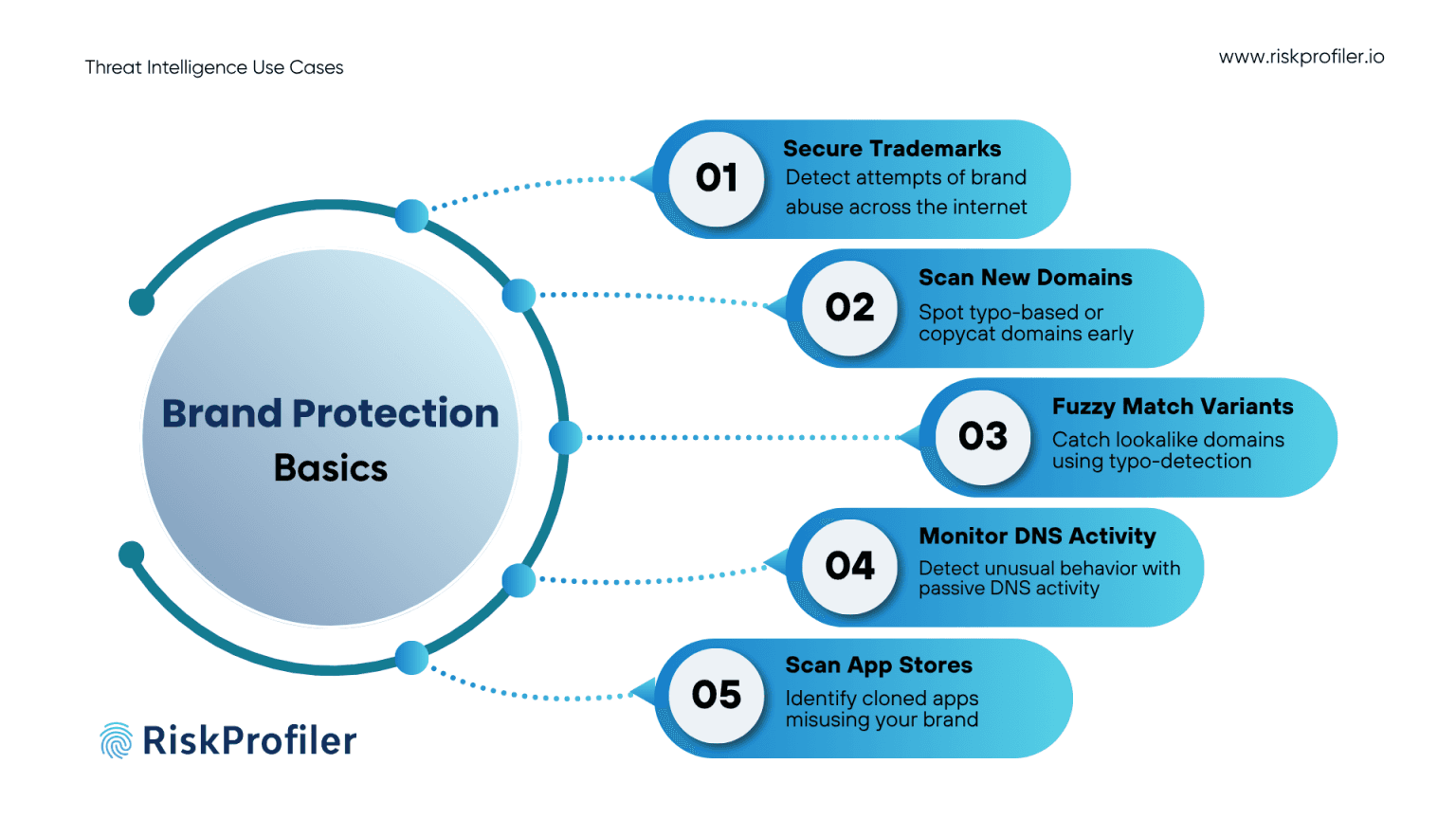
Your organization’s trademark is your most unique and identifiable asset in the digital world. Securing your trademark against infringement attempts is of utmost importance. To ensure security, your organization needs a brand protection tool to detect all possible duplication of your brand name, taglines, or identifiable signatures across the surface web, social media channels, or deep-dark web marketplaces. Using sophisticated digital brand protection tools like RiskProfiler allows you to ensure your trademark’s security against duplication attempts.
2. Monitor Newly Registered Domains
Duplicated domains are among the most common fraudulent practices, often used by criminals to copy brand identity. Such duplicated domains, also known as typosquats, might include common misspellings, added hyphens, or swapped letters (e.g., http://sansung.com or paypal-supp0rt.info) to deceive the target audience. Additionally, you should check for new registrations of domain listings across different gTLDs (.com, .io, .co, .shop, .net, etc.) with your brand name to identify potential infringement attempts.
Regularly monitoring newly registered domain databases helps security teams identify and flag potential threats early in their lifecycle, even before they can be weaponized by cybercriminals to deceive the brand’s target audience. Organizations can also register possible misspellings (amaazon.com to amazon.com) or alternative spellings of their domain name with substitute characters (like amaz0n.com to amazon.com) to avoid brand misuse.
3. Deploy Fuzzy Matching for Domain Variants
Fuzzy matching or approximate string matching is used to detect closely related variants of similar items. This technique helps detect variants of words or domain names with homophones or typos. Thus, fuzzy matching is used by algorithms to detect variations of your brand, product, service, or similar copyrighted assets across domain registries and DNS records. This includes homograph attacks (using Cyrillic or Greek letters), keyboard-adjacent typos, or deliberate substitutions. Sophisticated fuzzy logic combined with contextual threat scoring can drastically reduce false positives and help prioritize alerts.
4. Leverage DNS Monitoring and Passive DNS
DNS is the foundation of internet navigation and an often overlooked source of threat intelligence. Passive DNS allows you to track how domain name records change over time and spot suspicious infrastructure overlap with known malicious campaigns. Monitoring DNS resolution patterns tied to your brand can help catch impersonators before users fall victim. This method can detect typosquats, phishing, or other malicious domains.
5. Scan App Stores for Cloned or Spoofed Apps
Duplicating popular apps to market copied applications or deceive the users are common practices that run rampant across the app stores. Malicious apps may copy your brand’s design, name, and logo to trick users into downloading spyware, phishing tools, or subpar applications that might damage the brand’s image. Automating regular scans of iOS, Android, and third-party app stores for unauthorized or cloned apps is essential for mobile brand protection.
In order to identify the fraudulent apps, brand protection tools crawl the app stores and scan for similarities. Brand protection practices like code comparison, visual analysis, and metadata analysis are used by domain protection tools to identify suspicious applications.
6. Spoofed Image and Logo Detection
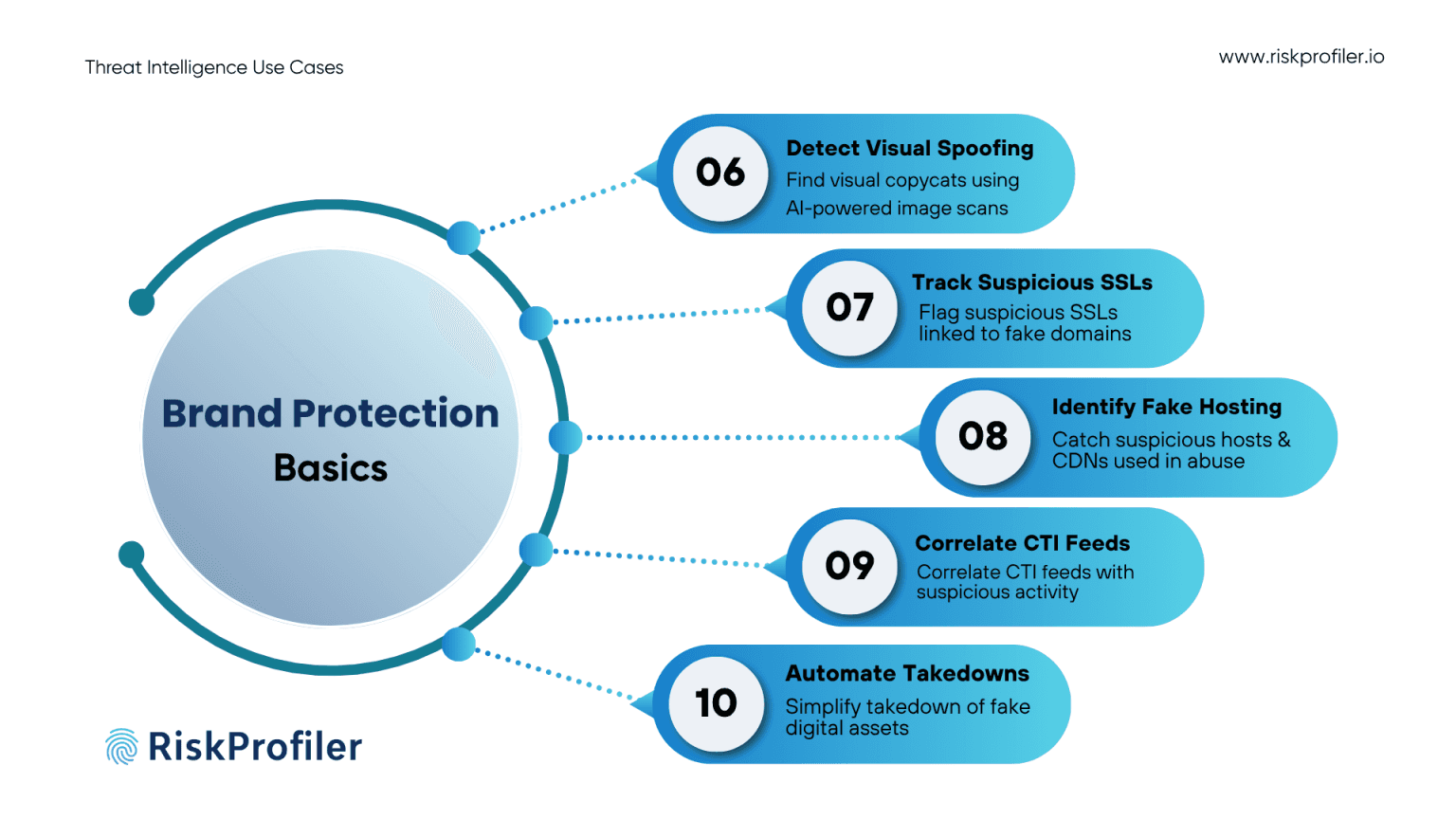
Fake websites and mobile apps often mimic official logos and UI designs to establish visual authenticity and confuse users. Image recognition tools can scan across the web, app stores, and social platforms for unauthorized use of your visual assets using sophisticated AI-ML technologies and computer vision. This is particularly effective for uncovering fake social profiles, app listings, or phishing pages built to mimic your brand’s look and feel.
In this process, the domain protection tools scan for replicas with slight modifications, object matches, or similar patterns used in image or logo creation. By continuously monitoring the surface and dark web spaces, the tools detect suspicious visuals and isolate them to initiate the takedown process.
7. Track SSL Certificates for Suspicious Domains
Most legitimate domains today use SSL/TLS encryption. However, fraudulent entities also use SSL/TLS certifications to appear authentic. Monitoring new SSL certificate issuances that reference your brand or mimic your domains can reveal fake sites before they go live. Certificate transparency logs are a valuable early warning system.
8. Identify Malicious Hosting Patterns
Brand impersonation often depends on quick, disposable hosting infrastructure. Identifying common traits in malicious IPs, hosting providers, or CDN services used by attackers can help predict and preempt future threats. Correlating this data with domain registration patterns enhances the detection capability across your digital footprint.
9. Integrate Brand Threat Detection with Threat Intelligence Platforms
The best brand protection strategies integrate domain protection tools with your broader cyber threat intelligence, SOAR, and incident response platforms. This ensures high-risk findings are automatically enriched, prioritized, and escalated to the right teams for takedown or mitigation.
10. Rapid Takedown Workflows to Mitigate Brand Threats
Proactive detection and takedown of harmful domains, links, and media are important to safeguard your brand integrity from digital impersonation and other brand threats. A proactive takedown process with automated workflow ensures fast mitigation of impersonation attempts in real-time, preventing the spread of malicious content or campaigns.
How Does RiskProfiler Enhance Digital Brand Protection Strategies?
RiskProfiler’s Brand Intelligence tool offers a tactical edge to organizations facing the growing threat of digital brand abuse. By combining continuous monitoring, AI-powered detection, and real-time response automation, RiskProfiler provides an end-to-end framework for identifying, prioritizing, and eliminating fake domains, malicious apps, and impersonation attempts across the open, deep, and dark web.
Real-Time Threat Detection with Continuous Digital Asset Monitoring
RiskProfiler constantly scans global DNS registries, app marketplaces, social platforms, and SSL certificate transparency logs for potential misuse of your brand. It identifies lookalike domains, spots cloned apps on app stores, and detects visual spoofing attempts through AI-powered brand threat intelligence modules. This continuous monitoring ensures instantaneous alerts on emerging brand threats in real-time to prevent escalation and reputational damage.
Automated Domain Takedown and Escalation Workflows
When a threat is confirmed, RiskProfiler’s domain protection tool initiates fast-track remediation through automated takedown workflows. The platform prepares registrar-specific abuse reports, submits evidence-backed requests to hosting providers, and tracks response outcomes in real-time.
Additionally, RiskProfiler also streamlines the UDRP and DMCA filings, automating the spam disruption process. This helps teams reduce dependency on legal teams or external vendors while accelerating takedown cycles from days to hours.
Deep and Dark Web Intelligence for Early Warning
RiskProfiler uncovers early signs of brand abuse, including cloned phishing kits, impersonation templates, and leaked executive data by scanning for suspicious brand and executive mentions across the deep and dark web marketplaces. Threat actor chatter referencing your organization is flagged immediately, allowing your team to intercept malicious campaigns before they become public-facing incidents.
Centralized Intelligence Hub with Prioritized Actioning
RiskProfiler aggregates all brand threat data into a single command center where alerts are enriched, scored, and contextualized. It uses machine learning to prioritize risks based on severity, exploitability, and brand impact. Teams can act directly from the dashboard, integrate alerts into SIEM and SOAR pipelines, and follow the progress status of detected brand risks and the takedown process for simplified threat management.
Conclusion
Fraudsters and cybercriminals are increasingly using fake domains and rogue apps to exploit brand trust and user vulnerability. To defend their brand integrity against these active threats, organizations must adopt a layered, data-driven, and continuous digital brand protection strategy.
Incorporating brand intelligence tools in your digital brand protection workflow is an essential step in the fast-paced digital world. With the rise of sophisticated threats, AI cyber risks, and social media influence, it is imperative to empower your business with proactive brand abuse detection capability before cybercriminals discover your vulnerabilities.
Want to secure your brand identity against impersonation attempts and malicious campaigns?
Book a call with RiskProfiler experts today!
In today’s hyperconnected landscape, your domain names, mobile apps, and digital assets are more than tools; they are the digital face of your brand. While organizations invest in building a reputation, these assets are increasingly targeted by cybercriminals for impersonation and exploitation. A proactive digital brand protection strategy is critical to preserving your trust equity and defending against fake domains, rogue applications, and impersonation attacks.
Why is Digital Brand Protection Important?
Digital brand identity is a crucial element of trust in today’s hyperconnected world. Your website domains, mobile applications, and other digital tools are the key elements in establishing communication between your organization and the audience. While enterprises invest heavily in building brand value and expanding audience reach in their target market, the identity remains at high risk of exploitation.
However, Cyber threat actors can manipulate and exploit your brand identity to run malicious campaigns, gain access to corporate data, or steal consumer details by bypassing digital checkpoints. In a hyperconnected world, where everything rests on the click of your mouse, a phishing link or corrupted document can allow cybercriminals to take over your system, allow malware distribution, or expose corporate data. Using domain or app impersonation, attackers can easily collect PII details of your consumers, distribute harmful software, or access sensitive files.
Additionally, in the age of social media, apps like X (previously known as Twitter), LinkedIn, Facebook, Instagram, etc., establish business-consumer relationships. A fake campaign run by duplicated social accounts using a fake domain or mobile application can severely damage your public reputation. As virality continues to shape people’s perception about a brand, product, or topic, delayed detection of brand threats can erode trust in your leadership, damage credibility, and make you lose market standing.
Digital Brand Protection Practices Against Fake Domains & Apps in 2025
To take down sophisticated digital abuse and brand impersonation threats in real-time, brands should incorporate proactive and smart digital brand protection strategies. To track, identify, and take down brand threats in real-time, organizations need to utilize advanced brand and domain protection tools like RiskProfiler to recognize threats before they can cause severe damage. The top digital brand protection practices are as follows
1. Secure Your Brand Trademark
Your organization’s trademark is your most unique and identifiable asset in the digital world. Securing your trademark against infringement attempts is of utmost importance. To ensure security, your organization needs a brand protection tool to detect all possible duplication of your brand name, taglines, or identifiable signatures across the surface web, social media channels, or deep-dark web marketplaces. Using sophisticated digital brand protection tools like RiskProfiler allows you to ensure your trademark’s security against duplication attempts.
2. Monitor Newly Registered Domains
Duplicated domains are among the most common fraudulent practices, often used by criminals to copy brand identity. Such duplicated domains, also known as typosquats, might include common misspellings, added hyphens, or swapped letters (e.g., http://sansung.com or paypal-supp0rt.info) to deceive the target audience. Additionally, you should check for new registrations of domain listings across different gTLDs (.com, .io, .co, .shop, .net, etc.) with your brand name to identify potential infringement attempts.
Regularly monitoring newly registered domain databases helps security teams identify and flag potential threats early in their lifecycle, even before they can be weaponized by cybercriminals to deceive the brand’s target audience. Organizations can also register possible misspellings (amaazon.com to amazon.com) or alternative spellings of their domain name with substitute characters (like amaz0n.com to amazon.com) to avoid brand misuse.
3. Deploy Fuzzy Matching for Domain Variants
Fuzzy matching or approximate string matching is used to detect closely related variants of similar items. This technique helps detect variants of words or domain names with homophones or typos. Thus, fuzzy matching is used by algorithms to detect variations of your brand, product, service, or similar copyrighted assets across domain registries and DNS records. This includes homograph attacks (using Cyrillic or Greek letters), keyboard-adjacent typos, or deliberate substitutions. Sophisticated fuzzy logic combined with contextual threat scoring can drastically reduce false positives and help prioritize alerts.
4. Leverage DNS Monitoring and Passive DNS
DNS is the foundation of internet navigation and an often overlooked source of threat intelligence. Passive DNS allows you to track how domain name records change over time and spot suspicious infrastructure overlap with known malicious campaigns. Monitoring DNS resolution patterns tied to your brand can help catch impersonators before users fall victim. This method can detect typosquats, phishing, or other malicious domains.
5. Scan App Stores for Cloned or Spoofed Apps
Duplicating popular apps to market copied applications or deceive the users are common practices that run rampant across the app stores. Malicious apps may copy your brand’s design, name, and logo to trick users into downloading spyware, phishing tools, or subpar applications that might damage the brand’s image. Automating regular scans of iOS, Android, and third-party app stores for unauthorized or cloned apps is essential for mobile brand protection.
In order to identify the fraudulent apps, brand protection tools crawl the app stores and scan for similarities. Brand protection practices like code comparison, visual analysis, and metadata analysis are used by domain protection tools to identify suspicious applications.
6. Spoofed Image and Logo Detection
Fake websites and mobile apps often mimic official logos and UI designs to establish visual authenticity and confuse users. Image recognition tools can scan across the web, app stores, and social platforms for unauthorized use of your visual assets using sophisticated AI-ML technologies and computer vision. This is particularly effective for uncovering fake social profiles, app listings, or phishing pages built to mimic your brand’s look and feel.
In this process, the domain protection tools scan for replicas with slight modifications, object matches, or similar patterns used in image or logo creation. By continuously monitoring the surface and dark web spaces, the tools detect suspicious visuals and isolate them to initiate the takedown process.
7. Track SSL Certificates for Suspicious Domains
Most legitimate domains today use SSL/TLS encryption. However, fraudulent entities also use SSL/TLS certifications to appear authentic. Monitoring new SSL certificate issuances that reference your brand or mimic your domains can reveal fake sites before they go live. Certificate transparency logs are a valuable early warning system.
8. Identify Malicious Hosting Patterns
Brand impersonation often depends on quick, disposable hosting infrastructure. Identifying common traits in malicious IPs, hosting providers, or CDN services used by attackers can help predict and preempt future threats. Correlating this data with domain registration patterns enhances the detection capability across your digital footprint.
9. Integrate Brand Threat Detection with Threat Intelligence Platforms
The best brand protection strategies integrate domain protection tools with your broader cyber threat intelligence, SOAR, and incident response platforms. This ensures high-risk findings are automatically enriched, prioritized, and escalated to the right teams for takedown or mitigation.
10. Rapid Takedown Workflows to Mitigate Brand Threats
Proactive detection and takedown of harmful domains, links, and media are important to safeguard your brand integrity from digital impersonation and other brand threats. A proactive takedown process with automated workflow ensures fast mitigation of impersonation attempts in real-time, preventing the spread of malicious content or campaigns.
How Does RiskProfiler Enhance Digital Brand Protection Strategies?
RiskProfiler’s Brand Intelligence tool offers a tactical edge to organizations facing the growing threat of digital brand abuse. By combining continuous monitoring, AI-powered detection, and real-time response automation, RiskProfiler provides an end-to-end framework for identifying, prioritizing, and eliminating fake domains, malicious apps, and impersonation attempts across the open, deep, and dark web.
Real-Time Threat Detection with Continuous Digital Asset Monitoring
RiskProfiler constantly scans global DNS registries, app marketplaces, social platforms, and SSL certificate transparency logs for potential misuse of your brand. It identifies lookalike domains, spots cloned apps on app stores, and detects visual spoofing attempts through AI-powered brand threat intelligence modules. This continuous monitoring ensures instantaneous alerts on emerging brand threats in real-time to prevent escalation and reputational damage.
Automated Domain Takedown and Escalation Workflows
When a threat is confirmed, RiskProfiler’s domain protection tool initiates fast-track remediation through automated takedown workflows. The platform prepares registrar-specific abuse reports, submits evidence-backed requests to hosting providers, and tracks response outcomes in real-time.
Additionally, RiskProfiler also streamlines the UDRP and DMCA filings, automating the spam disruption process. This helps teams reduce dependency on legal teams or external vendors while accelerating takedown cycles from days to hours.
Deep and Dark Web Intelligence for Early Warning
RiskProfiler uncovers early signs of brand abuse, including cloned phishing kits, impersonation templates, and leaked executive data by scanning for suspicious brand and executive mentions across the deep and dark web marketplaces. Threat actor chatter referencing your organization is flagged immediately, allowing your team to intercept malicious campaigns before they become public-facing incidents.
Centralized Intelligence Hub with Prioritized Actioning
RiskProfiler aggregates all brand threat data into a single command center where alerts are enriched, scored, and contextualized. It uses machine learning to prioritize risks based on severity, exploitability, and brand impact. Teams can act directly from the dashboard, integrate alerts into SIEM and SOAR pipelines, and follow the progress status of detected brand risks and the takedown process for simplified threat management.
Conclusion
Fraudsters and cybercriminals are increasingly using fake domains and rogue apps to exploit brand trust and user vulnerability. To defend their brand integrity against these active threats, organizations must adopt a layered, data-driven, and continuous digital brand protection strategy.
Incorporating brand intelligence tools in your digital brand protection workflow is an essential step in the fast-paced digital world. With the rise of sophisticated threats, AI cyber risks, and social media influence, it is imperative to empower your business with proactive brand abuse detection capability before cybercriminals discover your vulnerabilities.
Want to secure your brand identity against impersonation attempts and malicious campaigns?
Book a call with RiskProfiler experts today!
Jump to
Share Article
We Have Answers!
Explore our FAQ to learn more about how RiskProfiler can help safeguard your digital assets and manage risks efficiently.
Latest Insights
Stay informed with expert perspectives on cybersecurity, attack surface management,
and building digital resilience.


Enterprise-Grade Security & Trust
Specialized intelligence agents working together toprotect your organization
Ready to Transform
Your Threat Management?
Join hundreds of security teams who trust KnyX to cut through the noise and focus on what matters most.
Book a Demo Today